

Chand Kishor Sharma
Mata Sukrala Devi, popularly known as Mal mata holds a paramount place in the spiritual and cultural fabric of the Dogra community in Jammu region. Mata Sukrala is not only a deity but is considered the Kul Devi ( ancestral protector) for a vast number of Dogra families. Mata Sukrala Devi is a manifestation of Sharda Devi and is highly worshipped in the Duggar region of Jammu. In Dogra tradition, goddess Sukrala Devi is regarded as elder sister of Mata Vaishno Devi. The name Sukrala is said to be derived from Sharikalaya which though, of course is another revered name of Mata Sharda. Thousands of devotees throngs every year to pay obeisance and seek blessings from Mata Sukrala Devi. Huge hush of devotees is witnessed in this temple on every Sunday and Tuesday and also during Navratri .Not only from Jammu & Kashmir, devotees also come from adjoining states especially from Punjab and Himachal Pradesh to have holy darshan & seek blessings from Mata Sukrala. It is believed that every wish of the devotees, whether it is for birth of a child, relief from suffering, return of lost relative/friend, getting a job and relief from chronic diseases are fulfilled by Devi Mata. No one return empty handed from the court of Mal Mata.
The temple of Mata Sukrala Devi is located on a hillock at Sukrala village, north of Billawar town ( tehsil head quarter) in Kathua district. It is well connected by road from Kathua, Jammu and Udhampur. The temple is about 9.60 km from Billawar, 81 from Kathua, 125 from Jammu and about 98 km from Udhampur. The nearest Railway station is kathua and the nearest airport is Jammu.
The best time to visit the temple is during navratri festivals. October to May is the very pleasant season. The area generally experiences a temperate climate, characterized by cold winters and pleasant summers. Basic guest houses and dharamshalas are available near the temple and in Billawar town.
The existing bus stand near Sukrala is too small and unable to handle the increasing number of vehicles, resulting in frequent congestion and inconvenience to passengers as well as drivers. To reach the temple, pilgrims have to climb about 150 steps. There are shops on both sides of the steps where devotees buy offerings, Prasad and pictures of Mata Sukrala Devi.
The temple is situated at a height of about 3500 feet and is surrounded by lush green pine forests, rolling hills and serene environment.
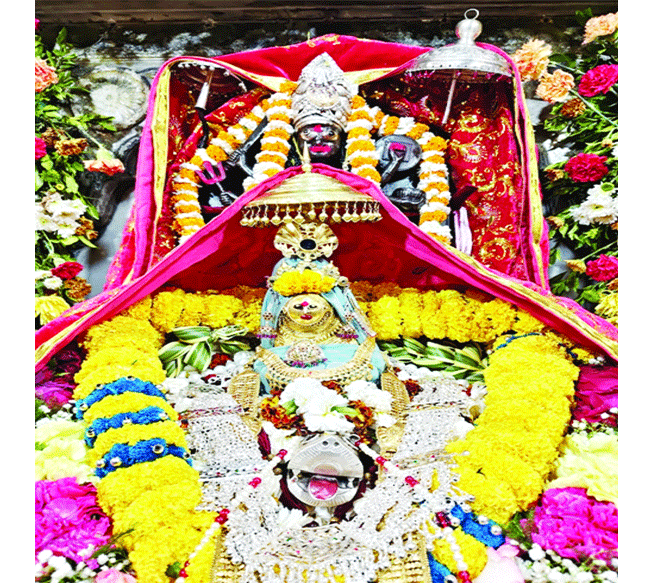
The sacred idol of mata sukrala devi is in the form of a Shila (a natural piece of sacred rock), symbolizing the divine presence of the goddess. The rock is often adorned with shining traditional clothing and jewellery, making it a vivid anthropomorphic form while maintaining its stone base. The shila is placed on a brass lion, whose head is mounted with silver, representing the lion as the traditional vehicle (vahana) of Durga and a symbol of strength and power. Behind the shila is a depiction of Mahishasuramardini, the fierce form of Durga, standing over the demon king Mahishasura, symbolizing the victory of good over evil. The goddess is portrayed as chaturbhuja (four armed) holding a sword in one of her hands, signifying divine protection and destruction of evil forces. The eyes of goddess are made of silver and inlaid with dark vermilion, giving the image a powerful and sacred expression.
The overall imaginary represents strength, protection and triumph of good over evil. Mata Sukrala is regarded as a very benign form of Shakti, believed to fulfill the wishes of her devotees. The idol was installed by Raja Brajrajdev of Jammu in 1755 A.D.
History of Mata Sukrala Devi temple
According to local legend, Pandit Trilochan Dutt (a saint from Basohli) was the devout local devotee who requested the manifestation of the goddess at Sukrala in Billawar (Kathua). In his childhood, he went to Kashmir and kashi for education, where he was taught only “Durga Saptashati” by his guru. He also visited many shrines including Shri Amaranth ji, Sharda Peeth, Hari Parvat etc. His unwavering devotion prompted the goddess to appear and asked him for a boon. She granted him four boons but he did not accept even one. Trilochan Dutt said “if you wish to give me a boon, then grant me this-that the child born to me should serve you and accept your given grace”. After this, the boon was accepted.
Shiv Nandan was born in the family of Trilochan Dutt. He was a pious and learned Brahmin and is identified as a grandson of Trilochan Dutt who had received a boon from the goddess that she would appear in that region during the time of his grandson.
Pandit Mahadev (Shiv Nandan) and his brother Amolak Ram adopted the Billawar and Basohli areas as their residence, leading to their prominent roles in the religious affairs of the region.
*According to legend when the navratri festival arrived, Shiv Nandan performed a havan (a sacred fire ritual) that continued for many days. After some times when the havan material exhausted, Shiv Nandan thought he had no money left and began wondering what to do. After some time, he began cutting his own flesh and started offering it into the havan. When he approached his neck, the goddess appeared and stopped him. She said “I am very pleased with your devotion, Ask for a boon”. Shiv Nandan bowed and said that he wished to always remember the goddess feet. The goddess granted him four boons-to become a learned priest/wise scholar/a poet and a tantric. He did not accept even one. Shiv Nandan humbly requested that whatever offerings are made by the devotees should be accepted by the goddess and that she should fulfill their wishes. The goddess granted this request as well.
After some time, Shiv Nandan returned to home at Basohli. Some months later the goddess appeared in his dream and said that a Jasmine (Malti) tree was growing in the forest above Billawar and beneath it lay her sacred idol buried. She asked him to bring it out and worship. When Shiv Nandan went to the forest, he initially could not find the place. The next day, the goddess again appeared in his dream and guided him. He finally reached the place, saw the divine signs and located the idol beneath the tree. While coming from Billawar, there was a very large rock. By the power of goddess, the rock split apart and path emerged through it. Shiv Nandan used to come every morning and evening from Billawar to perform puja and then return in the evening to Billawar. The rock that split due to goddess’s power still exists today by the roadside at Billawar – sukrala road.
It was during the era of Shiv Nandan, grandson of Trilochan Dutt, the Shila (stone slab) of Sukrala Devi miraculously began to emerge from a local spring embodying the goddess ( Mahishasurmardini).
Construction of Temple: The narrative begins with Madho Singh, a prince of the Chamba Royal family who was forced to exile by his elder brother. He travelled through the rugged mountains of the Himalayas until he reached the Sukrala region. At that time, this area was a vast, uninhabited wilderness teeming with wildlife and thick forests.
Prince Madho Singh once went on hunting and killed about 140 wild goats and deer. However, while returning from hunt, he suddenly fell seriously ill and was on the verge of death. Despite all possible treatments, his condition did not improve.
Finally, he approached Pandit Shiv Nandan, who was well known for his spiritual knowledge and reputation. Pandit Shiv Nandan then called upon a devotee of the goddess, Hira Thakur who was locally known as a chela (disciple) of the goddess and he was asked to perform a ritual dance. During the ritual, he entered into a trance state, often referred to as Shakti dance. In this divine state, he was requested to reveal the cause of Madho singh’s illness.
As a result, the disciple revealed that the goddess was very angry because Madho Singh had killed many wild animals and birds at her sacred place in the forest. He advised that a temple should be built for the goddess using materials brought from Chamba in order to seek her forgiveness.
Madho Singh replied that he had already lost his kingdom and had no wealth left to construct a temple. In response the dancing Hira Thakur instructed him to immediately proceed towards Chamba and assured him that the goddess would restore his kingdom.
After few days, Prince Madho Singh recovered. After having a vision of divine mother ( Mal Mata),he set out for Chamba. On his way, he received news of the death of his elder brother who had earlier exiled him. Upon reaching Chamba, people accepted him as their ruling prince.
However, while performing his royal duties, he forgot the promise he had made to the goddess to build a temple. As a result, misfortune struck again and he was imprisoned by the king of Nurpur. One night while sleeping, he fell from his bed. At that moment, he remembered his vow to the goddess, sincerely repented and prayed for forgiveness.
The goddess forgave him, restored his kingdom and freed him from captivity. King Madho singh then fulfilled his promise. He personally carried bricks, stones and lime to the Sukrala forests and constructed the temple.
Shrine board for Sukrala Mata and Bala Sundri
The shri Mata Sukrala Devi and shri Mata Bala Sundri board was constituted by the Jammu and Kashmir Government ( Act No.III of 2013) for the management and governance of shrines in Billawar, Kathua. The board is headed by the Divisional Commissioner, Jammu with Deputy Commissioner Kathua as Vice Chairman to manage and improve facilities for the devotees. The board has taken over control of donations/offerings and implemented security measures like CCTV. Currently, major infrastructure development has been stalled by legal challenges.
(The writer is Joint Director EDI J&K)
 Follow our WhatsApp channel
