

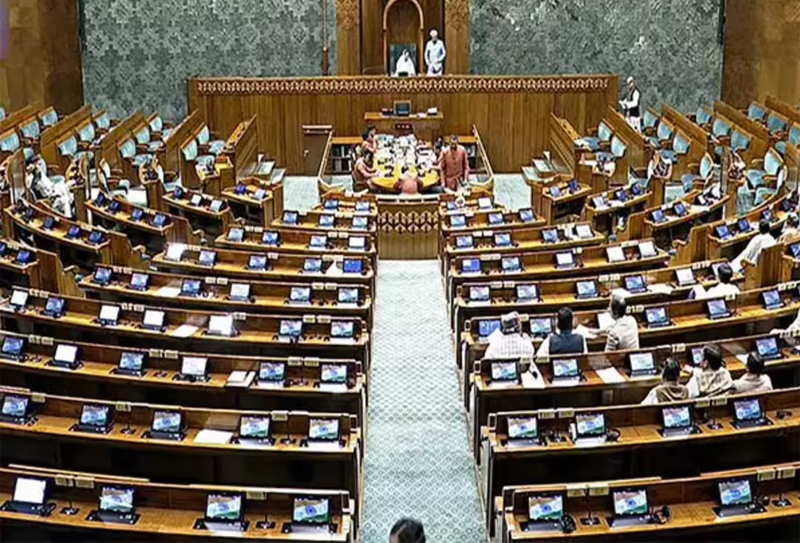
NEW DELHI, Apr 1: Parliament on Wednesday passed amendments to the insolvency law to provide faster resolution of stressed firms and reduce case backlog, with Finance Minister Nirmala Sitharaman emphasising that the intent is not to liquidate companies but to help them run with guardrails.
The Rajya Sabha on Wednesday passed the Insolvency and Bankruptcy Code (Amendment) Bill, 2026, with a voice vote. It had received the Lok Sabha approval on March 30.
As of December 2025, IBC has facilitated the resolution of 1,376 companies, enabling creditors to recover Rs 4.11 lakh crore. Financial creditors have seen recovery exceeding 34 per cent of their claims.
IBC is a framework for rescuing viable businesses and resolving financial stress while preserving enterprise value, Sitharaman said while replying to a brief discussion in the Rajya Sabha.
“It (IBC) was never intended to be a debt recovery tool. Recovery values are incidentally a by-product. The IBC process is market-driven.
“Recoveries are reflective of underlying asset quality and commercial viability of the distressed enterprise,” Sitharaman, who also holds the corporate affairs ministry portfolio, said while responding to concerns raised by some Rajya Sabha members on huge haircuts and low recovery rates in the insolvency process.
Recoveries also depend on the nature of the firm, sector and larger economic considerations, she said, and added that IBC realises 94.95 per cent of the fair value at the time of admission.
Realisation exceeding 171.54 per cent of liquidation value indicates recovery levels and reflects the enterprise’s distressed state upon entry, not a failure of the resolution framework, the minister said.
Sitharaman further said the IBC has contributed to the improvement of the health of the Indian banking sector.
“One concrete thing that I can say for India is that the Code actually has contributed to improving the health of our banking sector. One of the reasons why India’s banking sector has actually gotten better in itself is because of the way in which IBC has recovered assets and gone through the process and given back money to the banks,” the minister said.
Banks have recovered a total of Rs 1,04,099 crore through various channels, and out of the total amount, the IBC channel alone contributed a significant Rs 54,528 crore, accounting for 52.3 per cent of the total recoveries, she added.
She also said the World Bank, in its 2019 report, observed that reforms to India’s insolvency regime increased creditor recovery rates from 26.5 cents to 71.6 cents a US dollar.
“Even just after a few years of its introduction, it has been recognised world over,” Sitharaman said.
The Act was enacted in 2016, and since then, it has undergone seven amendments.
On the reasons for the new amendments, Sitharaman said that IBC is a law which pertains to economic activity, and the legislation has to respond to the growing needs of the economy. The government has been making periodic amendments required by industry and stakeholders.
Sitharaman emphasised that the intent of the IBC is not to liquidate companies but to give a resolution which will keep them going.
“IBC was not brought with the intention of liquidating companies. It was brought in to address the stress that the companies are facing and give a resolution which will make them come back to some form and then attain the status that they were earlier running with quite a few guardrails,” she said.
The minister pointed out that there are eventually some companies where no resolution is possible despite repeated trying, so they go for liquidation.
In the current set of amendments, the minister said the government aims to bring in expeditious admission of insolvency applications by limiting adjudication to the existence of default and greater reliance on information utilities and sets statutory timelines for adjudicatory authorities to reduce delays.
Another important aspect is to strengthen the liquidation process through enhanced creditor oversight, ensuring independence of the liquidator and removal of procedural overlaps.
It also introduces an enabling framework for group insolvency and cross-border insolvency, aimed at improving investor confidence and aligning domestic processes with international best practices.
The minister also informed the upper house that micro, small and medium enterprises (MSMEs) are exempted from disqualification under Sections 29A, 29AC, and 29AH of the IBC.
This provision enables existing promoters to participate in the resolution process and facilitates the rescue of businesses, ensuring that small players do not lose their enterprises when they enter insolvency, she said.
The bill replaces the underutilised fast-track process with a new creditor-initiated insolvency framework, featuring out-of-court initiation, debtor-in-possession and creditor-in-control model, where management continues to vest in the existing Board of Directors or partners with safeguards, and defined timelines.
Also, there is an enabling framework for group insolvency and cross-border insolvency to promote investor confidence and align domestic practices with best international practices.
Stricter timelines will be put in place to ensure the timely resolution of stressed companies, and there will be penalties to deter vexatious and frivolous complaints that delay the process.
Among other changes, an application for initiating the insolvency resolution process has to be admitted within 14 days if the default by a company has been established, and appeals related to IBC before the National Company Law Appellate Tribunal (NCLAT) have to be decided upon within three months. (PTI)
 Follow our WhatsApp channel
