

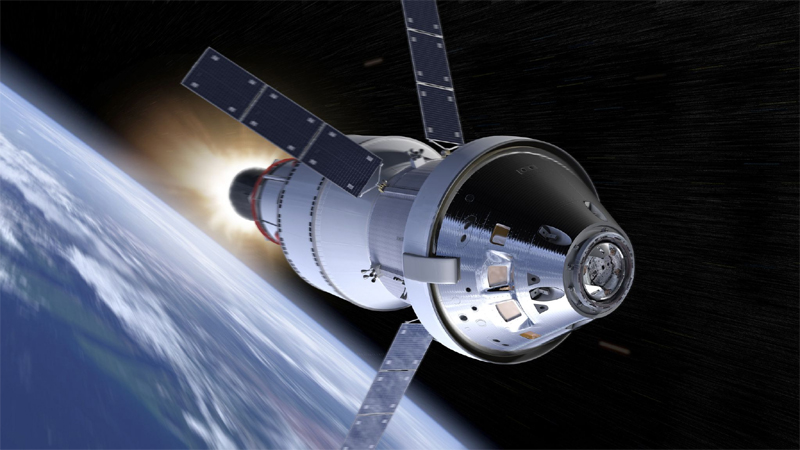
WASHINGTON, Apr 1 : NASA is preparing to launch its Artemis II mission, which will send four astronauts on a nine-day journey around the Moon, marking the agency’s first crewed lunar flight in more than 50 years.
Part of its broader Artemis programme, the Artemis II aims to return humans to the Moon and support future exploration beyond Earth orbit, and will be commanded by Reid Wiseman, with Victor Glover as pilot, and Christina Koch and Canadian astronaut Jeremy Hansen as mission specialists. Hansen will become the first Canadian to travel beyond Earth’s orbit.
Liftoff is scheduled for 6:24 p.m. EDT Wednesday from Kennedy Space Center, following weeks of delays linked to hydrogen leaks and propulsion system concerns. Weather conditions are currently favourable.
The crew will fly aboard the Orion capsule, named Integrity, launched on NASA’s Space Launch System rocket.
Within minutes of liftoff, the spacecraft is expected to reach speeds of nearly five miles per second, entering orbit before executing burns to travel deeper into space than any human mission has since the historic Apollo launch.
The first day of the mission will focus on testing Orion’s core systems – including life support, navigation, propulsion and communication – while still close enough to Earth to allow a rapid return if necessary. Basic onboard systems such as water supply and waste management will also be evaluated.
About 25 hours post launch, a trans-lunar injection burn will send the spacecraft on a four-day journey towards the Moon. Rather than entering orbit, Orion will follow a “free return” trajectory, looping around the Moon and using its gravity to return to Earth.
At its closest point, the spacecraft will pass around 4,100 miles above the lunar surface, offering views of the Moon’s far side. The mission is expected to reach a maximum distance of about 252,000 miles from Earth, setting a new record for human spaceflight.
Artemis II will be the first crewed flight of both the Space Launch System and Orion. Engineers have made modifications following the uncrewed Artemis I mission, including addressing concerns over the heat shield, which must withstand temperatures of around 5,000 degrees during re-entry.
Astronauts have acknowledged the risks involved in a test mission. Hansen said uncertainty is part of the process, noting that the crew is prepared for all scenarios.
After completing the lunar flyby, Orion will return to Earth, re-entering the atmosphere at around 25,000 miles per hour. The capsule will experience a communications blackout as it is surrounded by plasma before deploying parachutes and splashing down in the Pacific Ocean.
(UNI)
 Follow our WhatsApp channel
