

Rakshit Sharma
sharmarakshit16@gmail.com
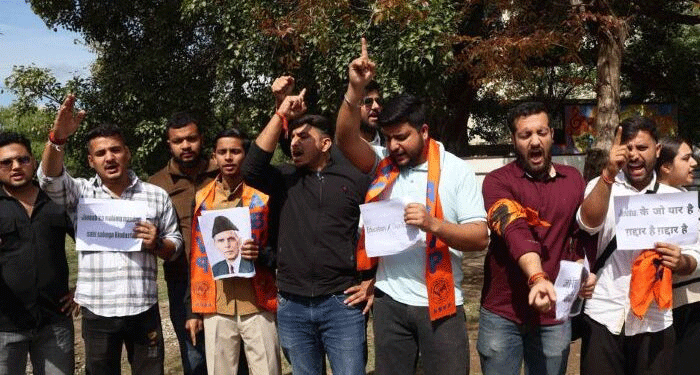
The recent debate over including Muhammad Ali Jinnah in the postgraduate political science syllabus has stirred strong feelings on campus. Many student organisations have raised concerns, while the administration has been deliberating with them. Instead of turning this into a rigid confrontation, it may help to pause and look at the issue with a calm and open mind.
Universities are meant to be spaces where ideas are explored, not avoided. At the postgraduate level, students are not just learning facts, they are learning how to think. Any political science varsity has the responsibility to present history in its full complexity. This often includes figures who are admired, but also those who are questioned or even disliked.
Muhammad Ali Jinnah falls into that second category for many in India. He is closely associated with Partition, an event that brought immense pain and loss. It is natural for students to feel uncomfortable studying such a figure. These emotions come from lived histories, family memories, and a sense of identity, deserving utmost respect.
At the same time, there are strong academic reasons for his inclusion. You cannot fully understand Partition or nation-building without engaging with Jinnah’s role. Studying him also sharpens critical thinking, as students learn to analyse rather than accept. It allows drawing comparison with leaders like Mahatma Gandhi and Jawaharlal Nehru, helping students see how different visions shaped the subcontinent. It is also worth noting that Jinnah is already part of national academic standards such as the UGC NET, which makes his inclusion in postgraduate study both relevant and consistent.
To study Jinnah is not to celebrate him. It is to understand how history unfolded. His political journey itself is worth examining. He was once called the “ambassador of Hindu Muslim unity” by Sarojini Naidu. Yet, over time, he became the main voice behind the demand for Pakistan. This change did not happen overnight. It was shaped by political disagreements, changing circumstances, and also, many believe, a growing desire for power and leadership.
Some of his key roles help us see this complexity more clearly. In the Lucknow Pact, he worked to bring the Congress and Muslim League together. Later, his Fourteen Points of Jinnah showed a clear push for separate political safeguards, indicating the rise of identity politics. During the Royal Indian Navy Mutiny, he chose a cautious and constitutional approach alongside Sardar Patel rather than supporting a mass uprising.
These examples do not tell a simple story. They show a leader who changed with time, sometimes uniting, sometimes dividing, sometimes negotiating. This is exactly why he is studied. Political thought is not about heroes and villains alone. It is about understanding choices, pressures, and consequences.
A helpful comparison can be made from constitutional law. Students across India study the Government of India Act 1935, even though it was made by the British to rule India. It was not meant to empower Indians. Yet, it is studied because it shaped many features of our present Constitution. Learning about it does not mean supporting colonial rule. It simply means understanding where our institutions came from.
The same logic applies here. Studying Jinnah does not mean agreeing with him. It means trying to understand a difficult chapter of our past.
Still, the concerns raised by students are not without reason. For many, Jinnah represents the trauma of Partition, and there is a fear that his inclusion may appear as a form of legitimisation. There is also a concern that such topics can turn campuses into spaces of political confrontation rather than learning. In a highly polarised environment, even academic decisions can be seen through ideological lenses.
This is why the way such topics are taught becomes crucial. The faculty must discuss Jinnah with balance and context, not in isolation. His role should be studied alongside the human cost of Partition and the different viewpoints that existed at the time, to add to the academic depth. Classrooms should remain spaces where students can question freely, disagree respectfully, and learn without fear. There is a room here for dialogue. Administration can hold open discussions to explain why such topics are included. Students, in turn, can raise their concerns through debate rather than rejection. When both sides listen, the issue becomes less about conflict and more about learning.
In the end, this is not just about one person in a syllabus. It is about how we deal with our history. Do we avoid the difficult parts, or do we try to understand them? A mature society does not erase its past. It studies it, questions it, and learns from it.
Political science, by its nature, asks us to look at uncomfortable truths. It teaches us that history is rarely black and white. By engaging with figures like Jinnah in a thoughtful and balanced way, and critically analysing his role in Partition, the university can help students grow into informed and responsible citizens.
Perhaps the answer lies somewhere in the middle. We can respect emotions, and still protect academic freedom. We can disagree, and still learn. And most importantly, we can remember that education is not about telling us what to think, but helping us understand why things happened the way they did.
(The author is a PhD Scholar at Department of Political Science, University of Jammu)
 Follow our WhatsApp channel
