

Biju Dharmapalan
bijudharmapalan@gmail.com
War has been a story of triumph and defeat, of boundaries re-established and authority reasserted. But lurking behind these histories is a more sorrowful and more tragic fact: war is not merely a tragedy for the nations involved, but for the whole planet. It is an ecological disaster and a moral failure, which is a threat to the survival of life on this planet. The consequences of war go well beyond the battlefields in the world we live in today, where Eastern Europe and Western Asia teeter on the brink of geopolitical conflict. It leaks into the earth, pollutes the air, desecrates an ecosystem, and destroys the soul of what it is to be a human. The continual disputes, the war between Russia and Ukraine or the growing tension between the United States, Israel and Iran are bright reminders that mankind has not overcome the most primitive instincts.
Even after centuries of philosophical, scientific, and moral advances, we still resort to violence to gain dominance. Countries are eloquent in the language of force, coercion, and calculated interest, but scarcely in the language of duty, mercy, and peace. The outcome is a world full of insecurity, as peace seems to be weak and short-lived. The human price of war is short-term and obvious. Cities are crushed to ruins, families are disintegrated, and so many lives are sacrificed in a second. What is more disturbing, however, may well be the increasing normalisation of such loss. In these days and times of a continuous stream of information, the death that happens to hundreds (sometimes thousands) is hardly a whimper beyond a few flashing headlines. It is very possible that the current generation, who are bombarded with images of violence every day, may become desensitised. Death is an abstraction, suffering a far-off abstraction. Such a loss of empathy is itself a vast casualty of war.
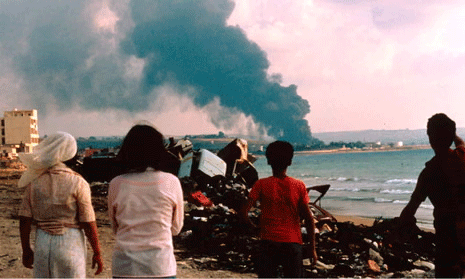
But human lives are not the only ones which suffer. War makes an equally fierce attack upon nature–our quiet suffering comrade. The explosions and bombings discharge toxic chemicals into the air and into the water. Forests are set on fire, farmlands are devastated, and biodiversity is permanently crippled. In Ukraine, they have reported the destruction of fertile farmland and the pollution of water bodies. Oil fires and chemical spills have resulted in permanent marks on sensitive ecosystems in the conflict countries of the Middle East. They do not come as temporary disturbances but as incurable wounds on the planet. Nature takes centuries to recover, whereas human societies can be restored even after several decades. The soil contaminated with heavy metals cannot be returned to its original state overnight, nor can the rivers now choke with debris and the species now being driven to extinction. The toxic residue of war, which includes unexploded ammunition, radioactivity, and chemical contamination, remains to ostensively degrade life even years after the guns are still.
Conflict is handed down to future generations not only as a memory but also as the war’s impact on the environment. Ironically, all creatures slay to survive, and humans, with their rationality and moral awareness, slaughter their fellow humans in the name of ideology, land, or authority. This perversion of the natural order is haunting. Lack of regret between the warring parties only adds to the tragedy. Worse is the silence, and even sometimes the ambiguity, of its institutions meant to maintain peace, like the UN and the religious ones, whose tradition it is to preach peace, compassion, and the sanctity of life.
The lack of moral authorities speaking and acting is the start of the decline of society’s ethical structure. Fundamentally, war is an inability to imagine coexistence rather than conflict, rather than dialogue, rather than destruction. It is also indicative of a perilous sense of ownership, as if the country owns Earth and its resources. Such an attitude is inherently wrong. The world belongs to neither any nation nor any generation. It is a common possession, left to us by the past and handed to the future. Water, forests, minerals and fossil fuels are not instruments of domination; it is a bloodline that has to be given and passed on.
The war also overlaps with other global issues, such as global warming. The post-war recovery process is usually a consumptive undertaking, which puts additional pressure on the globe. Conflict, therefore, not only destabilises the present but also destabilises the future, hastening ecological catastrophes with no boundaries.
Ancient Indian wisdom provides a ray of hope in this foreseeable dim scenery. The Indian philosophical ideal of Vasudhaiva Kutumbakam-the world as a family-echoes with a new urgency. It tells us that we are all one, that the misery of one part of the world will eventually catch up with the rest and that we must live in harmony with nature because that is the only way. Our forefathers saw that our human needs were in equilibrium with the stewardship of the environment. It requires a radical change in our vision of progress and power.
Even education is playing an important role in cultivating empathy, environmental awareness, and global citizenship among younger generations. The current time is a pivotal point. Unless mankind finds an alternative growth direction, the cumulative effects of wars over time, both on human beings and the environment, may lead to fatal degradation.
It is time to overcome narrow conceptions of nationalism and take a broader planetary approach. By ignoring this fact, we find ourselves on the verge of abandoning a planet that, at best, is uninhabitable to coming generations and, at worst, is uninhabitable to life.
(The author is the Dean -Academic Affairs, Garden City University, Bengaluru and an adjunct faculty at the National Institute of Advanced Studies, Bangalore)
 Follow our WhatsApp channel
