

Gourav Sabharwal
sabharwal308@gmail.com
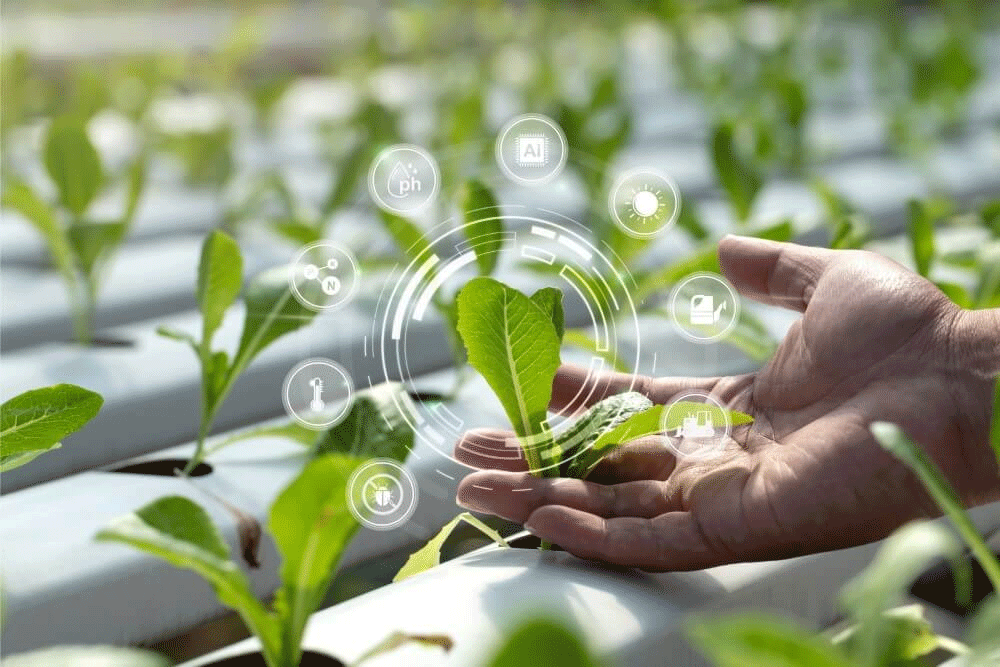
Aeroponics is considered one of the most resource-efficient agricultural technologies developed in modern controlled environment agriculture. Unlike traditional soil-based farming and even hydroponics, aeroponics suspends plant roots in air and delivers nutrients through a fine mist. This seemingly simple innovation produces profound ecological and physiological advantages.
1. Soil Conservation and Land Restoration
One of the most significant advantages of aeroponics is that it eliminates the need for soil entirely. Globally, nearly 33 percent of soils are moderately to highly degraded due to erosion, salinization, nutrient depletion, and chemical contamination. Conventional farming accelerates this degradation through over-tillage, monocropping, and excessive fertilizer application.
Aeroponics reduces pressure on arable land by:
• Eliminating soil dependency
• Preventing soil erosion
• Avoiding soil salinity buildup
• Allowing degraded land to recover naturally
• Enabling food production in non-arable regions such as deserts and urban environments
By shifting certain high-value crops to aeroponic systems, natural soils can be conserved for staple crops or ecological restoration.
2. Exceptional Water Use Efficiency
Water scarcity is one of the defining challenges of modern agriculture. Traditional irrigation methods lose significant water through evaporation, runoff, and deep percolation.
Aeroponic systems:
• Use up to 90–95 percent less water than conventional farming
• Recycle nutrient solution in closed-loop systems
• Deliver water directly to roots with minimal evaporation
• Reduce waterlogging and root rot risks
Because the nutrient mist is precisely controlled, plants absorb nearly all applied moisture. This makes aeroponics particularly valuable in drought-prone and water-stressed regions.
3. Enhanced Nutrient Use Efficiency (NUE)
Nutrient Use Efficiency refers to the percentage of applied nutrients that plants actually absorb and convert into biomass. In soil-based farming, nutrient losses occur through leaching, volatilization, and runoff, often leading to groundwater contamination and eutrophication.
Aeroponics improves NUE by:
• Delivering nutrients directly to root surfaces
• Maintaining optimal nutrient concentration
• Allowing stage-specific nutrient formulations
• Minimizing fertilizer wastage
• Preventing leaching losses
Studies indicate that nutrient absorption rates are significantly higher in aeroponic systems due to increased root oxygenation and surface exposure. This leads to faster growth cycles and improved biomass accumulation.
4. Superior Root Oxygenation and Plant Physiology
Roots require oxygen for respiration and energy production. In soil systems, compaction and overwatering often limit oxygen availability.
Aeroponics provides:
• Maximum root oxygen exposure
• Improved cellular respiration
• Enhanced metabolic activity
• Stronger root architecture
• Faster nutrient transport within the plant
This increased oxygenation promotes accelerated growth rates, often reducing crop cycles by 20 to 30 percent compared to conventional methods.
5. Improved Crop Quality and Nutritional Value
Controlled aeroponic environments allow precise manipulation of light, temperature, humidity, and nutrient composition.
This results in:
• Higher phytochemical content
• Improved flavor and texture
• Uniform crop size and appearance
• Reduced pesticide residues
• Lower heavy metal contamination
Research suggests that controlled nutrient stress in aeroponic systems can enhance antioxidant levels and secondary metabolites in leafy greens and herbs, improving nutritional density.
6. Reduced Environmental Pollution
Because aeroponic systems operate in closed environments:
• There is minimal agricultural runoff
• Chemical contamination of soil and water bodies is prevented
• Greenhouse gas emissions from fertilizer overuse are reduced
This makes aeroponics environmentally cleaner compared to traditional intensive farming.
7. Space Optimization and Urban Integration
Aeroponics integrates seamlessly into vertical farming systems, enabling:
• Multi-layer crop production
• High yield per square meter
• Urban food production near consumers
• Reduced transportation emissions
This decentralization of food systems enhances food security and resilience.
 Follow our WhatsApp channel
