

B. S. Dara
bsdara@gmail.com
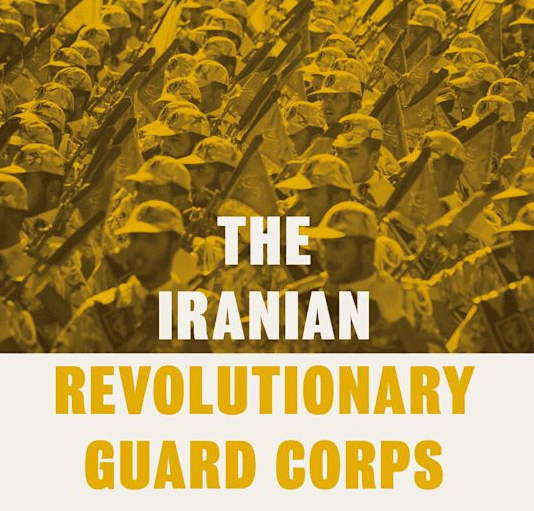
The Islamic Revolutionary Guard Corps (IRGC) stands today as one of the most powerful and controversial military organizations in the Middle East. In the context of the current war involving Iran, the United States, and Israel, the IRGC has emerged as the central institution directing Iran’s military strategy and political resilience. To understand the trajectory of this conflict, one must first understand the origins, ideology, and influence of the IRGC,an institution that is simultaneously a military force, a political actor, an economic empire, and a symbol of the Islamic Revolution.
The IRGC was created in 1979 to protect the Islamic Revolution, not merely the Iranian state. That distinction matters. While Iran’s regular military, the Artesh, remained the conventional national army, the IRGC developed as an ideological force answerable to the Supreme Leader and charged with preserving the regime internally and projecting revolutionary power externally. Over time, it grew into a parallel military establishment with its own ground, aerospace, naval, intelligence, and expeditionary arms.
The Iran-Iraq War was the institution’s crucible. Iraq’s invasion exposed Iran’s military weakness after the revolution and convinced the new regime that it could not depend on imported weapons, foreign patrons, or traditional military symmetry. From that experience emerged the core of the IRGC worldview: Iran must deter stronger enemies by making any attack costly, prolonged, and regionally contagious. The result was not a conventional army meant to defeat great powers in open battle, but a layered system meant to outlast them politically and strategically.
That is why the IRGC doctrine is best understood as asymmetric warfare with strategic reach. Its purpose is not necessarily to win quickly on a battlefield in the classical sense. Its purpose is to deny the enemy a clean victory, widen the theater of conflict, threaten energy flows, raise domestic political costs for adversaries, and preserve the regime’s survival. That doctrine explains why, in the current war, Iran’s response has not been limited to direct military exchanges but has included pressure on shipping routes, missile and drone attacks, and threats against infrastructure far beyond Iran’s borders.
At the heart of this model lies the IRGC Aerospace Force. Iran’s ballistic missile program has long been the backbone of its deterrence strategy because missiles offer reach, survivability, and psychological impact without requiring air superiority. Western and regional analysts have repeatedly noted that Iran invested in missiles precisely because its air force could not compete with advanced U.S. or Israeli fleets. Missiles became the substitute for strategic aviation. In the current conflict, even as Israeli officials claim strike campaigns have reduced launch volumes, the missile threat remains central enough that it continues to shape regional military planning and civilian anxiety alike.
Drones are the second pillar. If missiles are Iran’s blunt strategic instrument, drones are its adaptable one. They are cheaper, deniable in some contexts, available in large numbers, and effective for reconnaissance, attrition, harassment, and saturation. In recent years Iran has turned drones into one of its signature tools, both for its own forces and for allied groups across the region. Analysts have described this as part of a broader Iranian effort to offset conventional inferiority through volume, persistence, and flexible deployment. In this war, the widening use of explosive drones at sea and the concern over possible drone retaliation far from the central battlefield show how deeply this capability has matured.
The maritime dimension is equally important. The IRGC Navy has never aimed to defeat the U.S. Navy in blue-water battle. Instead, it developed tactics suited to the Persian Gulf and the Strait of Hormuz: swarm attacks, mines, fast boats, coastal missiles, and now potentially naval drones. This is classic IRGC thinking,fight where geography compresses the battlefield, where commercial traffic is dense, and where even limited disruption can produce outsized global consequences. Reuters now reports that Iran has laid naval mines in the Strait of Hormuz, and sea drones have already hit oil tankers in the region, underlining how central maritime disruption remains to Iran’s war logic.
Then comes the most politically consequential layer of all: the proxy network, often called the “Axis of Resistance.” Through the IRGC’s Quds Force, Iran spent decades building influence with Hezbollah in Lebanon, armed groups in Iraq, the Assad system in Syria, the Houthis in Yemen, and other militant partners. This network was never simply ideological theater. It was a military extension of Iran’s national defense concept. Instead of waiting for war to reach Iran’s borders, the IRGC built depth beyond those borders. That gave Tehran options: indirect retaliation, deniable escalation, regional pressure points, and the ability to stretch adversaries across multiple fronts. This also helps explain why the IRGC is so much more than a fighting force. It is a political institution, an intelligence actor, an economic empire, and a social organizer. Inside Iran, it has entrenched itself in strategic sectors and state power. That means its doctrine is not just military doctrine; it is regime-survival doctrine. The IRGC does not see war as separate from politics, economics, or social control. It sees all of them as parts of one struggle. In wartime, this integrated role becomes even more important, because the organization helps translate military pressure into political cohesion and national endurance.
In practical terms, the current war shows both the strengths and limits of that approach. The strengths are obvious: Iran has retained the capacity to retaliate, to widen the battlefield, to threaten global energy transit, and to keep rivals uncertain about the next domain of attack. The limits are also visible: sustained U.S.-Israeli airpower can degrade infrastructure, kill commanders, reduce launch tempo, and impose severe costs on Iran itself. The IRGC doctrine was designed to survive superior force, not to become immune to it. Its wager is that the enemy’s political patience, not Iran’s military symmetry, will determine the long-term outcome.
That wager has historical logic. Iran’s strategic class has long studied how stronger powers become trapped in long conflicts whose military victories fail to produce political closure. The lesson they drew was simple: endurance can be power. If Iran can keep enough retaliatory capability alive, keep oil markets nervous, keep maritime routes contested, and keep multiple actors under pressure, then even a materially stronger coalition may struggle to convert firepower into a stable end state. This is not conventional victory. It is strategic denial. The danger for the wider region is that this doctrine is inherently expansionary in wartime. Once the logic is to spread costs outward,to shipping lanes, energy routes, partner states, proxy fronts, and distant targets,the conflict becomes harder to contain. That is why the current war now appears bigger than the original decision to launch it. More actors, more domains, and more civilian exposure have been drawn in. The IRGC doctrine was built precisely to make that happen if Iran came under major attack.
So when people ask how Iran built a war machine without a conventional army, the answer is this: it did not try to build a mirror image of Western militaries. It built a system of deterrence by disruption, retaliation by dispersion, and survival through asymmetry. Missiles stand in for air power. Drones multiply pressure cheaply. Mines and sea drones weaponize geography. Proxies create strategic depth. Ideology sustains cohesion. The IRGC doctrine is not elegant in the classical military sense, but it is coherent, and in the present war, it is proving once again why Iran invested in it for decades.
 Follow our WhatsApp channel
