

Ashok Nilakantan Ayers
NEW YORK: The Middle East is on fire. Not metaphorically — literally. Since February 28, 2026, when U.S. and Israeli stealth assets struck 400 Iranian targets simultaneously in a “surgical” operation designed to decapitate the clerical regime and bury its nuclear program, the Persian Gulf has transformed from the world’s energy highway into its most dangerous graveyard. The surgery went perfectly. The patient did not die.
Supreme Leader Ali Khamenei was killed. The “joyous regime collapse” that some in Washington had whispered about never materialized. Instead, his son Mojtaba Khamenei inherited both the throne and the vendetta. Within a week, Iran’s Revolutionary Guard had seeded the Strait of Hormuz — the narrow throat through which 20% of the world’s oil flows daily — with smart mines and anti-ship missiles. Global crude breached $120 a barrel. The world’s most important energy artery had been slashed. Three weeks later, there is no endgame. There is only the abyss.
Iran cannot fight a conventional war. It knows this. Its aging air defenses were dismantled in the opening hours; its surface fleet is outgunned. But Iran is not fighting to win — it is fighting to make the cost of victory unbearable. Using swarms of cheap loitering munitions, it has struck U.S. bases in Qatar, Bahrain, and the UAE. Iranian drones have hit oil terminals in Fujairah and luxury hotels in Dubai. The message to the Gulf Kingdoms is surgical in its own way: you are not bystanders; you are targets.
The Gulf monarchies — Saudi Arabia, the UAE, Kuwait, Qatar — are caught in a devastating trap. They did not want this war. But now that Iranian missiles are falling on their infrastructure, they are privately telling Washington: do not stop now. Leave Iran with 20% of its military capacity, they argue, and it will spend the next decade burning our cities in revenge. They have stumbled into a sunk-cost war, desperate for a conclusion they cannot define.
Meanwhile, the International Energy Agency has released a historic 400 million barrels from strategic reserves — a fire extinguisher pointed at a forest fire. It buys the world roughly 20 days. The math is merciless. If the Strait remains closed past April, the global recession will not be a forecast — it will be a fact.
Europe’s industrial base is hollowing out. Japan and South Korea are watching their energy costs quadruple. And in India, the war has arrived not as geopolitical abstraction but as a kitchen-table crisis.
India imports nearly 60% of its LPG — the fuel that lights the stoves of 300 million households — from the Gulf, through the now-blockaded Strait. Domestic refill prices have already jumped by ₹60 a cylinder. The government has invoked the Essential Commodities Act. Strategic oil reserves in the underground caves of Vizag, Mangaluru, and Padur cover barely 9–10 days. The rupee is trading between 92–95 against the dollar. Every $10 rise in crude costs India 0.2% of GDP growth and 0.5% in added inflation. India’s much-celebrated 7% growth trajectory is under direct assault from a war it did not start and cannot afford. But adversity and opportunity, in geopolitics, often arrive together.
India finds itself in a position no other major power occupies. It upgraded its strategic partnership with Israel just 48 hours before the strikes began. It quietly signed the condolence book at the Iranian Embassy after Khamenei’s assassination — a gesture that baffled Western hawks and kept New Delhi’s door to Tehran open. It has a working relationship with the White House and deep civilizational ties with Iran going back millennia. It is Iran’s partner in the Chabahar Port. It is neither a regime-changer nor a predatory lender. In Tehran’s eyes, it is the only “safe” interlocutor left standing. This can be the India moment in the West Asian war.
India’s proposed roadmap has three phases, each designed to give every party a face-saving exit. Phase One — The Hormuz Blue Zone. Before ceasefires can be negotiated, the world needs a pressure valve. India proposes a neutral maritime corridor through the Strait, escorted by the Indian Navy and a coalition of non-aligned nations including Brazil and Oman — strictly for food, medicine, and energy shipments to non-combatant countries. Iran halts mining operations in the corridor; the U.S.–Israeli coalition pauses strikes on civilian Iranian energy infrastructure for 72 hours. Not peace — a pause. Enough to prevent economic freefall while diplomacy begins.
Phase Two — The Nuclear Freeze for Recognition. The core deadlock is simple: Washington and Jerusalem want a nuclear-free Iran; Tehran wants regime survival and legitimacy for Mojtaba Khamenei’s succession. India proposes splitting the difference. Iran accepts an immediate, IAEA-verified freeze on uranium enrichment above 3.67%. In exchange, the United States offers a “silent recognition” — not a formal endorsement, but a cessation of regime-change rhetoric and targeted decapitation strikes. Israel receives a cast-iron Red Line guarantee: any breach of the freeze triggers the immediate resumption of full kinetic operations. Everyone gets something. Nobody gets everything.
Phase Three — The Marshal Plan for Persia. Stability cannot be built on rubble. India proposes a West Asia Stability Summit in New Delhi — a G7+3 format, adding India, Saudi Arabia, and Iran. The Gulf Kingdoms, sitting on sovereign wealth funds of staggering size, lead the reconstruction of Iran’s civilian infrastructure. India serves as guarantor of the fund, ensuring the money rebuilds schools and hospitals rather than ballistic missile factories. Iran gets reconstruction. The Gulf gets security. The world gets an open Strait.
For Trump, it is a “frozen nukes” victory without boots on the ground. For Mojtaba Khamenei, it is domestic legitimacy and a path out of rubble. For the Gulf, it ends the missiles falling on Dubai and Doha. The West Asian was on its eighteenth day on March 17 with Trump frustrated and the Iranian regime determined to retain its sovereignty defying the joint assault of the USA and Israel.
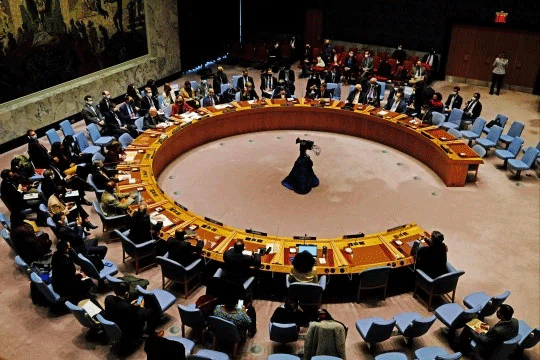
The United Nations general assembly is being convened for its emergency session on March 18, Wednesday to discuss war situation and find out an escape route for both Trump and Iran. India can play a crucial role in the session for facilitating a ceasefire, even of ad hoc nature. Indian foreign minister is in constant discussions with the Iranian foreign minister. PM Narendra Modi talked to the Iranian President twice.
A number of proposals are being considered by the Indian side, it is learnt. India may call for a neutral humanitarian corridor through the Strait of Hormuz, escorted by the Indian Navy alongside a coalition of non-aligned nations. This Blue Zone would carry food, medicine, and energy to the non-combatant world. We ask Tehran to halt the mining of this corridor. India can ask the U.S.–Israeli coalition to pause strikes on Iranian civilian energy infrastructure for just 72 hours. Not a ceasefire. Not a concession. A pause — long enough for the world to breathe, and for diplomacy to find its footing.
The second step is pragmatic. The core deadlock of this war is not complicated: one side wants a nuclear-free Iran; the other wants regime survival. India can propose a bridge between these demands — an IAEA-verified freeze on uranium enrichment, paired with credible security guarantees for Iran’s civilian population and a cessation of regime-change rhetoric. Neither side gets everything. Both sides get enough to stop the dying.
The third step is generational. Once the guns fall quiet, the rubble of this war must be rebuilt. India can propose a reconstruction architecture — a Marshal Plan for Persia — where Gulf sovereign wealth and international technology, guaranteed by neutral partners, rebuild Iran’s schools, hospitals, and civilian infrastructure. Stability cannot be declared. It must be constructed, brick by brick, in the communities that suffered most.
To Washington and Jerusalem, India says this: you have shown the world your military power. That point is no longer in question. The greater test — the harder test — is whether you now have the courage of the peacemaker.
To Tehran, India says this: the world’s energy commons cannot be a bargaining chip. Your people are suffering. Your cities are in ruins. There is a table waiting in New Delhi, and India will guarantee your seat at it.
Wednesday’s UN general assembly emergency session must focus on finding a solution after 18 days of brutal fighting and not on passing resolutions condemning one or the other. The immediate task is to end the war and the massive destruction happening. Ceasefire in whatever form has to take place, otherwise, the war will take more disastrous dimension in the coming days. (IPA Service)
 Follow our WhatsApp channel
