

Dr Anoop Singh
dranoop8998@gmail.com
On one side stand friends, trends, and the desperate need to belong. On the other, the weight of a family’s dreams. In between – a young person, gasping for breath.
Picture a fifteen-year-old sitting at her desk late into the night. On her phone, notifications pour in – her friends are out, laughing, sharing reels, living what appears to be a carefree life. On her table, a stack of textbooks and a handwritten note from her father: ‘Doctor banna hai – focus karo.’ She wants both worlds and belongs fully to neither. She smiles in school, studies in silence, and cries, sometimes, when no one is watching.

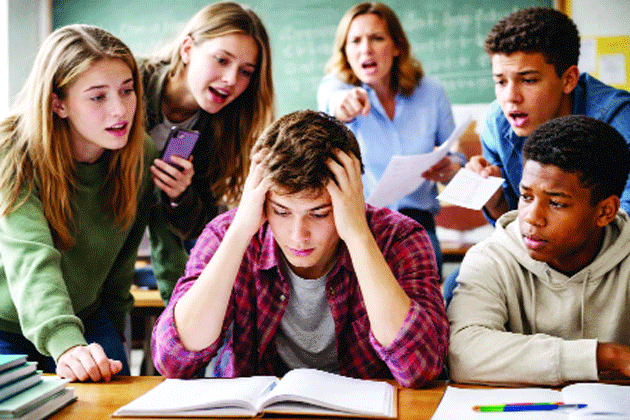
This is not a rare story. It is the daily lived reality of millions of young people across India – and it speaks to one of the most profound and underacknowledged crises of our time: the psychological burden placed upon youth by the simultaneous pressures of peer culture and adult expectation. Individually, each force is powerful. Together, they can be crushing.
“A young person today does not simply grow up – they negotiate, daily, between who they are told to be and who their world tells them they should become.”
The Invisible Hand of Peer Pressure
Peer pressure is as old as adolescence itself – the need to belong, to be accepted, to not stand out for the wrong reasons is hardwired into the social architecture of youth. What has changed dramatically in the present age is the scale and intensity of this pressure. Social media has transformed it from a localised, classroom-level phenomenon into a 24-hour, borderless force that follows young people into their bedrooms, their bathrooms, and their most private moments.
The pressure today is not only to experiment with substances or skip class – though these remain real concerns. It is subtler and in many ways more insidious. It is the pressure to wear certain clothes, speak a certain way, listen to specific music, hold particular opinions, project an image of effortless coolness. It is the pressure to have a social media presence that radiates happiness and popularity, regardless of what one actually feels inside.
Young people who resist these currents often pay a social price – exclusion, ridicule, the loneliness of not fitting in. And so many do not resist. They conform, they perform, they pretend – and in doing so, they quietly lose touch with their own values, preferences, and sense of self. The tragedy is not merely behavioural; it is deeply existential.
The Weight of a Parent’s Dream
At home, a different kind of pressure awaits. Indian parents – and teachers too – carry within them a profound and genuine love for their children and students. That love, however, is frequently expressed through expectation: the expectation of top marks, of prestigious careers, of achievements that will justify sacrifice and bring honour to the family name. ‘Log kya kahenge’ – what will people say – remains a powerful undercurrent in how many families navigate their children’s futures.
There is nothing inherently wrong with high expectations. Ambition, discipline, and a drive to excel are virtues worth cultivating. The problem arises when expectations become divorced from the child’s own identity, abilities, and desires – when a young person who loves painting is pushed relentlessly toward engineering, or when a student who struggles with mathematics is made to feel like a failure rather than an individual with different gifts.
The emotional consequences of this mismatch are severe. Research consistently shows that children raised under excessive performance pressure are more prone to anxiety, depression, low self-esteem, and in extreme cases, self-harm. India’s disturbingly high rates of student suicide – particularly around examination results – are a tragic testimony to the cost of a system that measures human worth in percentages.
“When a child fears disappointing their parents more than they fear failing themselves, something has gone deeply wrong in how we love them.”
Caught in the Middle: The Crisis of Identity
What makes the situation particularly complex is that these two pressures – from peers and from parents – often pull in diametrically opposite directions. Friends urge the teenager to stay out late; parents demand she be home by eight. Peers celebrate rebellion; parents prize obedience. The social world rewards certain kinds of boldness; the academic world demands a very different kind of conformity.
Caught between these competing demands, many young people develop what psychologists describe as fragmented identities – performing one version of themselves at home, another at school, and yet another among friends. This performance is exhausting. It leaves little room for the kind of quiet, authentic self-discovery that is the true business of adolescence. Young people who should be asking ‘Who am I?’ are too busy managing the answer they think each audience requires.
The result, in many cases, is a generation that is outwardly busy and connected, but inwardly adrift – uncertain of their values, unclear about their purpose, and desperately lonely in ways they cannot always articulate.
What Parents and Teachers Must Understand
The most important shift that parents and teachers must make is from the posture of expectation to the posture of curiosity. Instead of asking ‘Why did you score only 75%?’, ask ‘What did you find difficult, and how can I help?’ Instead of prescribing a future, explore one together. This is not softness – it is wisdom. A child who feels genuinely seen and understood is far more likely to strive, to communicate, and to seek guidance than one who lives in fear of disappointing.
Teachers, too, carry immense influence. A classroom where only toppers are celebrated, where failure is humiliating, and where creativity is subordinated to rote performance does not build confident young people – it builds anxious ones. The teacher who notices the quiet student in the back row, who praises effort as much as outcome, who creates space for honest conversation, is doing something profound: they are telling a young person that they matter beyond their marks.
Parents and educators must also make peace with a difficult truth: their child or student will face peer pressure, will make mistakes, and will sometimes choose poorly. The goal is not to build walls so high that the world cannot reach in – it is to build young people so grounded in their own values and self-worth that when the world does reach in, they have something solid to hold onto.
A Message to the Youth
And to the young people reading this: you are not alone in feeling pulled in too many directions. The pressure you feel – from friends, from family, from the endless comparisons of social media – is real, and it is heavy. But you are more than the marks on your report card and more than the number of followers on your profile. You are a person in the process of becoming – and that process takes time, patience, and above all, self-compassion.
Learn to say no – to peers who push you toward choices that feel wrong, and to the inner voice that says you must meet every expectation to deserve love. Find at least one adult – a parent, a teacher, a mentor – whom you can speak to honestly. And remember: the most admirable thing a young person can do in a world of noise and pressure is to quietly, stubbornly, remain themselves.
The world does not need more performers. It needs more people who know who they are.
(The author is a Lecturer in English at BSK School, Domana, Jammu.)
 Follow our WhatsApp channel
