

Maj Gen Sanjeev Dogra (Retd)
sanjeev662006@gmail.com
At 18,000 feet, patriotism is not a speech; it is a breath you fight for. The wind cuts through layers, the cold punishes small mistakes, and silence feels heavier than stone. On such a post, an officer stands watch, steady, alert, uncompromising. She is not there to make history. She is there to do duty. And duty has only one language. The uniform does not care about gender. It cares about standards. It demands discipline, resilience, judgment, and the ability to lead when comfort disappears.
That is why India’s women officers are not seeking applause or carving a separate identity. They are meeting the military on its own terms and earning respect the only way soldiers respect anyone: through performance.
When a nation begins to trust its daughters with its security, something shifts inside its character. And that shift is now visible on our parade grounds, in our training academies, and on our toughest frontiers.
India never lacked the idea of the woman warrior. We only delayed its institutional acceptance. Our culture has always understood Shakti not as a soft word, but power with purpose, courage that acts. In our stories, the goddess does not merely bless. She confronts. She ends what threatens the innocent. In India, strength and womanhood were never meant to be opposites.
Modern history gave us proof. In 1943, Subhas Chandra Bose raised the Rani of Jhansi Regiment, an all-women unit that trained, marched, and lived like soldiers. They carried rifles, learned tactics, and chose hardship for a higher cause. Dr. Lakshmi Swaminathan became Captain Lakshmi and led from the front. They were simply ahead of their time.
Then came a quieter revolution in 1992, when women were inducted through the Short Service Commission. There was no grand noise, just a firm step forward. But anyone who understands military training knows this: the uniform does not give respect. It demands proof.
At the Officers Training Academy in Chennai, the first batches of women met the same early mornings, the same drill square, the same tough standards. People watched closely, some with hope, some with doubt. I later served at OTA Chennai, directly associated with training women officers, and one truth stood out: when expectations are clear and training is honest, confidence and competence rise together.
The women who became officers were not those who never found it hard. They were the ones who refused to quit. They returned the next day. They trained harder. In the military, resilience earns respect faster than talent.
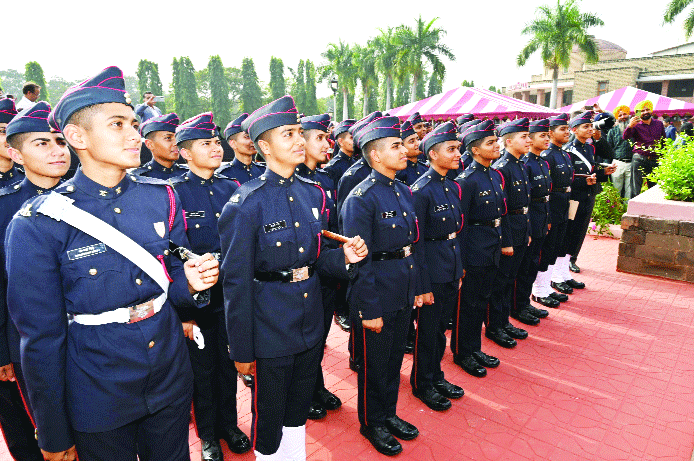
Years passed. The institution evolved. Then came a moment India watched with different eyes: the entry of girl cadets into the National Defence Academy. In late 2022, when the first batch walked into NDA, history was made. But NDA does not run on sentiment. It runs on standards. The academy’s message was quiet but firm: the uniform is the same, the expectations are the same, the grind is the same.
I was serving there as Deputy Commandant and instructor, and I saw something that made me proud. There was no soft route, no lowered bar. What the girls received was exactly what every cadet receives: discipline, field training, and the chance to earn their place.
The obstacle course has humbled generations. It is designed to expose hesitation and fear. I remember watching a girl cadet struggle at a wall. She slipped, tried again, and scraped her shin till it bled. Yet she did not step out, and she did not look for sympathy. She took one more run, gathered herself, climbed, and crossed. When she landed on the other side and moved on, the reaction from her coursemates was not polite applause; it was respect, the kind that comes only when someone fights through discomfort and refuses to quit. That is what the academy teaches: your body may fail, but your will cannot.
Even now, some ask old questions. Can women handle high altitude? Can women command men? Can women decide under extreme stress? These questions sound logical, but they are often emotional in disguise, rooted in old beliefs. And old beliefs change only when reality keeps proving them wrong.
Reality has done exactly that.
When Captain Shiva Chauhan, an Army engineer officer, was deployed at Siachen, she did not ask for a shortcut. She asked for standard acclimatisation and standard duty. In temperatures where a small mistake can cost fingers, toes, or life, she stood her watch, led her teams, enforced discipline, and endured the same cold, fatigue, and isolation as everyone else.
Something important happens in such places. The environment is too harsh for pretending. Soldiers do not follow you because of identity; they follow you because you are competent, fair, steady, and present. Over time, people stop saying “woman officer” and simply say, “our officer.”
The bigger point is that warfare has changed. It is not only about brute strength. It is about decision-making under pressure, quick learning, communication, emotional control, and adaptability. The battlefield today is complex, fast, and unforgiving. In such a world, excluding talent is not just unfair, it is strategically foolish.
A major institutional shift came when women were granted Permanent Commission across previously restricted branches. That was not merely an administrative decision. It was a statement of belonging. It said: you are not here as a temporary experiment. You are here as professionals. You can build careers. You can lead. You can command. You can be held accountable, like everyone else.
Today, thousands of women serve across the Army, Navy, and Air Force. They are part of operational readiness, training, planning, and leadership. They shape the present and future of the armed forces. The direction is clear: this journey is not reversing. It is expanding.
But beyond policies and numbers lies the most powerful impact: the signal it sends to society.
Somewhere in a small town, a girl watches a parade, a news clip, or a photograph of a woman officer standing tall in uniform. And something changes in her mind. She does not only admire. She relates. She begins to believe, “That can be me.” That belief builds ambition. It builds confidence. It builds national strength in a way speeches cannot.
When girls grow up seeing women in uniform, they learn an early lesson: courage is not borrowed, it is built. Discipline is not gifted, it is earned. Leadership is not a male property. It is a human capability. This is why the entry of women into core military spaces is not merely a reform. It is nation-building. It tells every young mind: your country will judge you by your merit and your will, not by your gender.
In the end, the uniform has only one language: duty, integrity, courage, competence, teamwork, sacrifice. India’s daughters now speak that language fluently.
They are not there to be celebrated as exceptions. They are there to be trusted as professionals. They will stand on icy posts and dusty borders; they will fly, plan, lead, and decide. They will carry responsibility without drama, and they will live the hardest truth of service: the nation does not owe you comfort; it expects commitment.
Nari Shakti is no longer a slogan on a banner. It is becoming a lived reality in boots, in uniforms, in command appointments, in quiet courage. The wind in Siachen still does not care who you are. It still asks only one question: Can you stand your ground? India’s daughters have started answering that question, every day, with a steady “Yes.”
 Follow our WhatsApp channel
