

Ankit Patel
ankitpatelkonch508@gmail.com
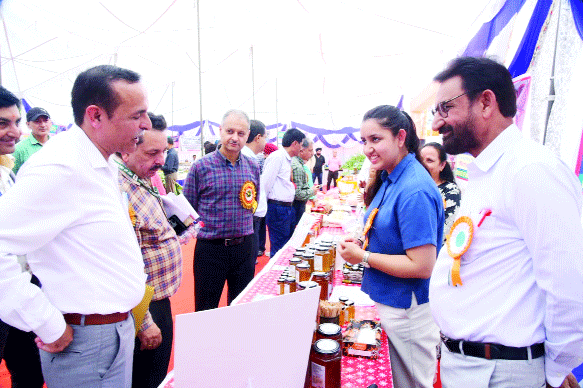
To grasp the grit of J&K’s startup boom, look at 23-year-old Prathishtha V Johar from Poonch. Forgoing a corporate architecture career in Mumbai, she returned home in 2024 to launch Johar Highlands, an agribusiness taking authentic Himalayan and GI-tagged Sulai honey to the global stage. Though she quickly built a network of 150+ local beekeepers, Prathishtha faced steep hurdles, surprisingly low honey consumption within J&K and a severe lack of advanced testing labs needed for certification. Unfazed, she pivoted her strategy outward. To build brand trust, she hit the road, marketing directly to consumers at major national exhibitions like the Pragati Maidan trade fair and Surajkund Mela.
Simultaneously, she bypassed geographical limits by selling online via Amazon and her own website, targeting health-conscious buyers in Delhi, Mumbai, and Punjab. This hybrid offline-digital strategy was a massive success. Within just six months, Johar Highlands clocked a Rs 12 lakh turnover. Her grassroots initiative which empowers rural women and farmers has since earned her support under the Holistic Agriculture Development
Programme (HADP) and a special mention from Lieutenant Governor Manoj Sinha.
But J&K’s startup boom is not limited to educated returnees in urban hubs; it reaches the most vulnerable in volatile border districts. In the heavily militarized district of Kupwara, a quiet economic rebellion called Rah-e-Niswan (The Women’s Way) is rewriting the rules of social entrepreneurship. Initiated by the Borderless World Foundation, Rah-e-Niswan is driven by young conflict orphans who lost their parents to cross-border violence. Beyond the trauma of their past, these girls faced immense socio-cultural barriers,most notably, the deep rural taboo of buying sanitary napkins from male shopkeepers. Rather than bowing to this constraint, they turned it into a business model. They established the area’s first “ladies-only” manufacturing and retail unit. Today, these young women produce their own sanitary pads, garments, and computerized embroidery. By managing the supply chain and finances themselves, these conflict orphans have created a vital micro-economy and a hesitation-free safe space for local women.
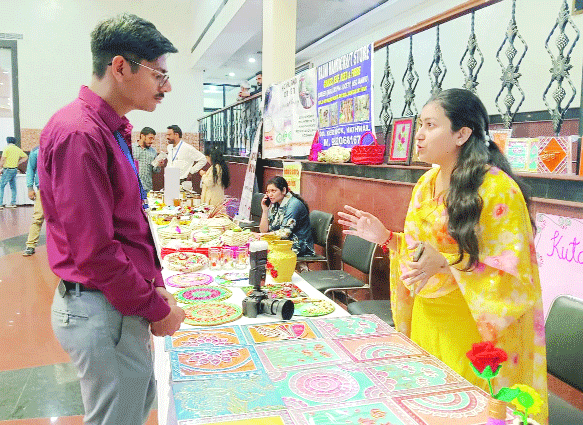
Priya, a 28-year-old Master of Education (M.Ed.) student at Jammu University, is bringing the traditional art of Gujarat and Rajasthan to Jammu. Through her Instagram page, Kutch Kala by Priya, she creates stunning Lippan art, a beautiful, centuries-old craft made using clay and mirrors. Driven by a passion to preserve culture, Priya proudly promotes the rich heritage of the Rann of Kutch, where these geometric designs traditionally decorate desert homes. She recently held her first exhibition at the university, showcasing how this ancient craft can be transformed into modern home decor and custom nameplates. What started as a relaxing hobby to balance her demanding postgraduate studies has grown into a successful business recognized by the local handicraft department. Priya’s journey is a perfect example of “vocal for local,” showing how young scholars can beautifully keep India’s diverse traditions alive.
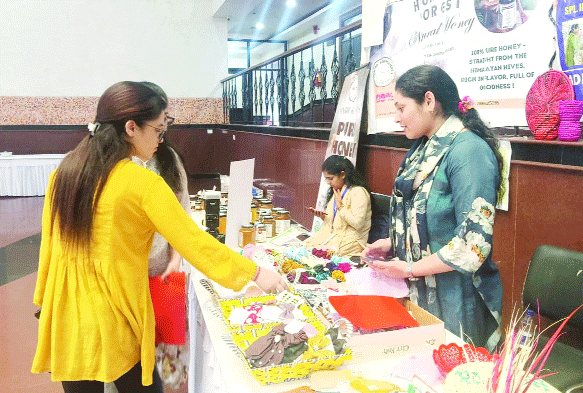
In Jammu, two 17-year-old students are weaving a creative movement. Riyanshi, from Government School Shastri Nagar, and Rimsha, from Shiksha Niketan, have turned their shared passion for crochet and handmade crafts into an inspiring local initiative.
What began as a simple hobby between classes recently blossomed into their very first exhibition, held right on their school grounds. Their vision, however, extends beyond their own art. Riyanshi and Rimsha are on a mission to spark creativity among their peers. By actively teaching and inviting classmates to join their crafting sessions, they are building a collaborative community of young artisans. These girls are not just preserving handmade crafts; they are empowering Jammu’s youth to discover their creative potential.
Sakshi Chaudhary’s journey proves that it is never too late to discover your true calling. Armed with a Master’s degree in Sociology, this married woman from Jammu realized her exceptional talent for crafting and officially launched her brand, Handcraft by NS, in October 2024. Specializing in intricately handmade roomals (handkerchiefs) and beautiful hair accessories, Sakshi’s creations quickly captured local hearts. Her very first exhibition in the Gandhi Nagar and Gol Market area was an instant blockbuster. Since that breakout moment, she hasn’t looked back. Supported by the Udhyam initiative and the local Handicraft and Handloom Department, Sakshi has now successfully showcased her work in over 70 to 80 exhibitions. Her local success has also translated into digital triumph. Taking her brand online, Sakshi listed her handmade products on Amazon and received a fantastic response. Today, she stands as a powerful example of a woman who transformed her hidden talent into a thriving, recognized business.
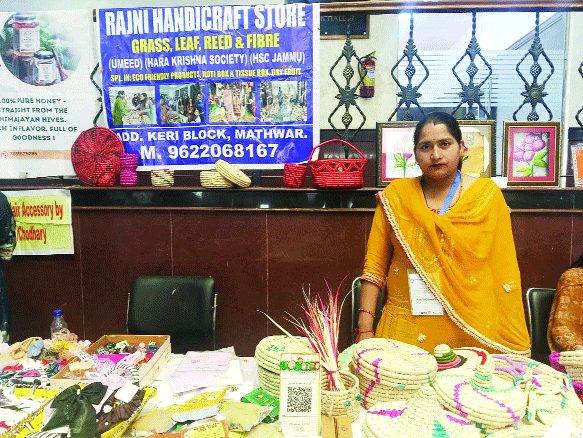
Rajni, 32, from the quiet village of Karial in Akhnoor tehsil, is proving that true artistry does not require a formal degree. An 8th-class passout, she has transformed humble grass waste into a celebrated livelihood. As a master handicraft artist, Rajni specializes in traditional grass products like the Chaabdi Binna A beautiful, eco-friendly woven containers perfect for keeping daily rotis fresh. Her journey gained serious momentum eight years ago in 2018 when she joined the Jai Baba Kalibeer Self Help Group (SHG) in Mathwar. Empowered by the government’s Umeed initiative, Rajni’s local craft quickly moved from village homes to grand stages. Today, she proudly represents Jammu’s rural heritage at Delhi Haat and various national and international expos. However, Rajni’s success isn’t just about her own growth. She is deeply committed to empowering others. Traveling to districts like Kishtwar, she conducts hands-on design workshops, training other women to turn simple grass into sustainable art and secure their own livelihoods. Rajni’s story is a brilliant reminder that rural talent, when given a platform, can shine globally.
The social landscape of Jammu and Kashmir is witnessing a profound transformation driven not merely by administrative reforms, but by a sustained grassroots movement led by women. Long confined to the private sphere and frequently portrayed as passive victims of conflict, women in the region are now emerging as decisive agents of socio-economic and political change. This shift is visible across financial inclusion, entrepreneurship, local governance, healthcare, education, and peacebuilding, signalling a redefinition of women’s role in the Union Territory’s development trajectory.
One of the most visible dimensions of this transformation lies in the rural economy. For decades, women remained largely credit-invisible, excluded from formal banking systems and dependent on informal lending. The Jammu and Kashmir Rural Livelihoods Mission (JKRLM), popularly known as Umeed, has altered this reality by institutionalising the Self-Help Group model. By 2025, Umeed had reached nearly 66 per cent of the rural population across 125 blocks, targeting the economic empowerment of approximately 9 lakh households. Through SHG-Bank Linkage programmes, women who once lacked financial identities are now recognised as bankable entrepreneurs, contributing to an average income increase of Rs 1,272.719 per member participating in SHG programmes.
A landmark moment occurred on International Women’s Day in March 2025, when banks sanctioned loans worth ?100 crore to SHGs in a single day. This unprecedented credit infusion reflected institutional confidence in women borrowers, whose repayment rates consistently outperform other lending portfolios.
At the grassroots level, these changes have translated into tangible livelihoods. In Kupwara, Shabnam used SHG-facilitated credit to expand embroidered shawl production into a local enterprise, while in Jammu’s Mathwar block, Jyoti transformed pooled savings into a retail and beauty services business that now employs other women. Such cases illustrate the shift from subsistence activities to growth-oriented micro-entrepreneurship.
In Jammu and Kashmir, a quiet economic shift is rewriting the region’s narrative. Educated women, once confined to traditional livelihoods, are increasingly steering the Union Territory’s startup ecosystem. The numbers tell a story of exponential growth: DPIIT-registered startups surged from 237 in 2020 to over 1,000 by late 2024, with women leading nearly 36 percent of these ventures.
This rise is not merely statistical; it is structural. Under the New J&K Startup Policy (2024-27), which aims to establish 2,000 startups by 2027, women entrepreneurs are now accessing specific seed funding and utilizing a new Rs 250 crore Venture Capital Fund. These financial mechanisms are accelerating a trend that began in adversity.
The true strength of these enterprises lies in their history of resilience. During the communication blockades and logistical paralysis post-2019, women-led ventures did not fold. Instead, they sustained production and turned their units into training centers for local girls, ensuring continuity despite infrastructural constraints.
Agriculture, the backbone of the regional economy, is also witnessing women-led innovation. A notable example is a young entrepreneur from Balhama who modernised her family’s beekeeping practice into a scalable organic enterprise under the Holistic Agriculture Development Programme. With a subsidy of Rs 1.2 lakh, her operation expanded from 35 to over 650 bee colonies, producing approximately 5,500 kilograms of honey per season. Monthly earnings now reach nearly Rs 2 lakh, demonstrating how traditional livelihoods can be converted into sustainable rural enterprises.
The invisible backbone of rural Jammu and Kashmir’s social system remains its women healthcare workers and teachers. Over 13,500 ASHA workers serve as the primary health interface in remote and snowbound regions, assisting in childbirth, immunisation, and pandemic response. Despite their essential role, most receive an honorarium of around Rs 2,000 per month, leading to widespread protests in 2025-26. While recent steps toward wage release and modest increments have been initiated, their “voluntary” status continues to underscore structural undervaluation. In education, women teachers quietly challenge patriarchal norms by mentoring girls and reshaping aspirations, a critical intervention in a region where female literacy, though improving, remains uneven in rural areas.
Demographic data reinforces these social shifts. Female literacy among women aged 15-49 stands at 74.3 per cent, while institutional births have shown sustained improvement. However, digital access remains unequal: only 43.3 per cent of women have ever used the internet, compared to 72 per cent of men, posing a significant barrier for women-led enterprises reliant on online platforms.
The evolving role of women in Jammu and Kashmir reflects a shift from silent endurance to visible leadership. While challenges persist from digital exclusion to economic undervaluation the foundation for inclusive growth has been firmly laid. As the region moves forward, the empowerment of women as active architects rather than passive recipients of development will remain the most reliable measure of its progress toward social justice and sustainable peace.
(The author is Student of Indian Institute of Mass Communication, Jammu)
 Follow our WhatsApp channel
