

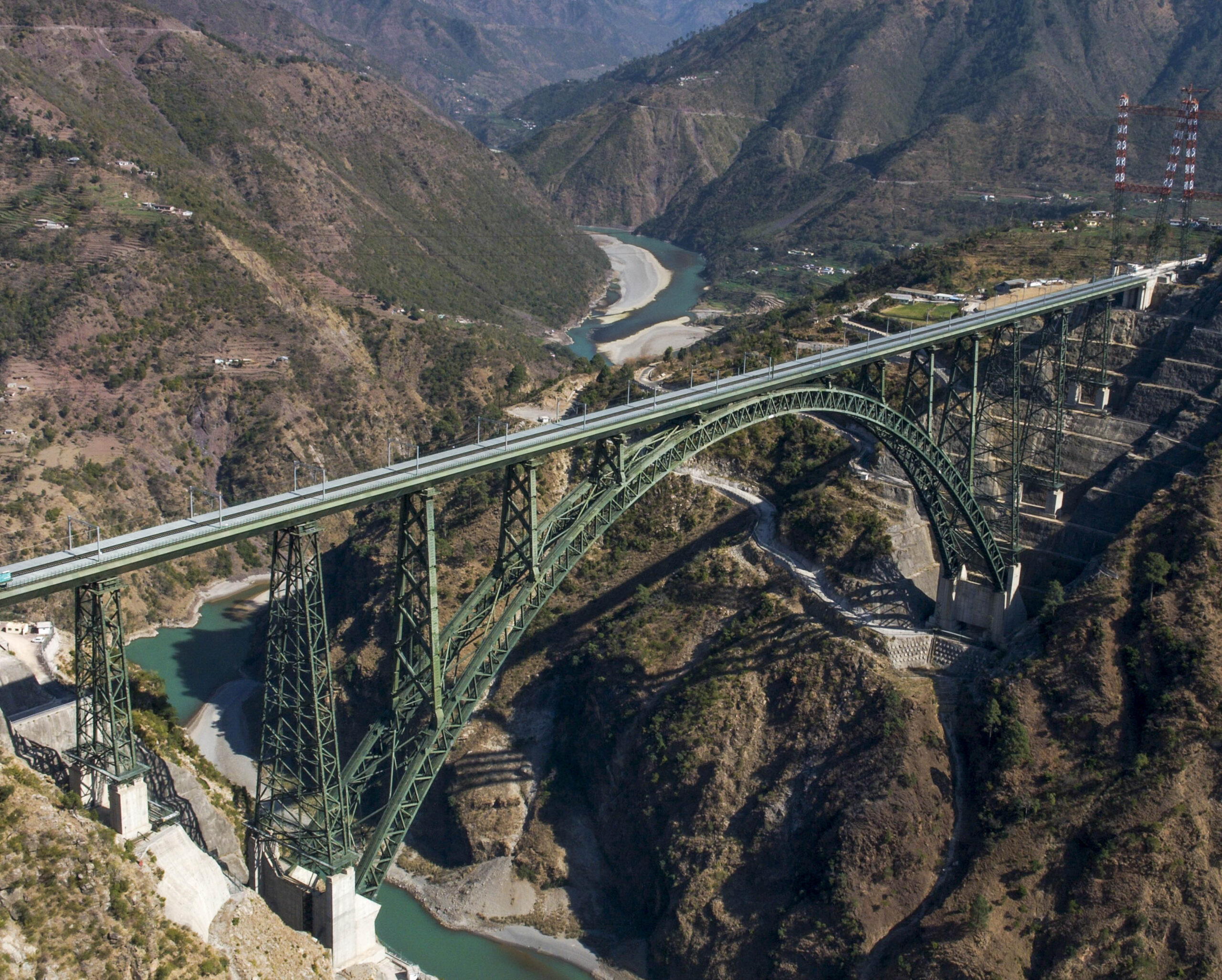
New Delhi, Feb 21: The world’s highest railway bridge over the Chenab river in Jammu and Kashmir faced turbulent times around 2008, when the Railway Board asked the construction company, Afcons Infrastructure Limited, to exit the project if it wished. However, the company decided to stay put despite apparent financial losses.
Prime Minister Narendra Modi flagged off the Vande Bharat Express train between Katra and Srinagar on June 6, 2025, while inaugurating the Katra-Srinagar section on which lies the historic and iconic Chenab Arch Bridge.
The Chenab rail bridge towers 359 metres above the riverbed and rises 35 metres higher than the Eiffel Tower in Paris. Spanning 1,315 metres, this steel-arch structure is a key part of the Udhampur-Srinagar-Baramulla Railway Link (USBRL) and marks a significant milestone in Indian engineering.
The Katra-Srinagar section is a part of the 272-km USBRL, a significant portion of which, along with the Chenab Arch Bridge, was completed by Afcons.
Afcons’ Executive Chairman Krishnamurthy Subramanian, while revisiting the over-20-year Chenab journey — from signing the contract with the Railway Board in 2004 until its launch in 2025 — said the project faced one of its most uncertain times when a legal challenge put it on hold and forced the board to explore an alternative route, possibly a tunnel instead of an arch bridge.
“The Railway Board suspended the project for more than 90 days and the contract permitted me to walk out of the project. In fact, the member (engineering) called and told me, ‘This is your chance to walk out if you choose to’. I did not make an instant decision,” Subramanian told PTI.
“I came back. Cyrus Mistry, who was the chairman at that time, and I sat together and debated for a long time,” he added.
Mistry died in a car accident on the Ahmedabad-Mumbai highway in 2022.
Subramanian believed that the Chenab project held international significance because no such project was conceptualised or constructed anywhere else in the world.
“We believed that additional money would be spent and we would see how to recover it otherwise. But we both agreed that if we walked away from the project, we felt that there would be difficulties in completing it. We took the risk to stay put and finish the job,” he said.
“I remember, at the end of the discussion, Cyrus asked me, ‘Are you confident?’ I said, ‘We of course will deliver’,” Subramanian recollected.
“I said I know there is a problem, but in the problem, the opportunities lay. Where everybody thought it was not doable, if we could show that it can be done, the company can establish itself as a pioneer in engineering,” he said, adding, “Today, for eight consecutive years, we have been recognised as a knowledge enterprise and we are the only infrastructure company which has got this distinction in the world.” Subramanian said an arch bridge over the Chenab that was operationalised in 2025 was part of the project since its inception and it was only around 2008, environmental challenges, which went up to the Supreme Court, posed a serious crisis.
“One section of the railway establishment felt that the alignment should not be changed. The Supreme Court agreed with it, the old alignment was restored and the project restarted,” he recalled.
Subramanian said the design of the bridge was left to his company and some changes in construction were made as the work proceeded.
“They (Railway Board) added a blast load, which was not there originally. So some such changes were happening because people were learning. They have not built a bridge of this magnitude in the past. So we needed to accommodate everything and get moving,” he added.
Besides the Chenab bridge, Afcons has also constructed the country’s first underwater metro tunnel at a depth of 37 metre below the Hooghly river in Kolkata.
Currently, it is working on an undersea tunnel in Maharashtra’s Thane for the Mumbai-Ahmedabad bullet train project. (Agencies)
 Follow our WhatsApp channel
