

Robin Koul
robinkoul0307@gmail.com
In the region of Ramban, every path-be it a highway, a winding trail, or a hidden link road, seems to lead to the sacred abode of a local deity. One such road, stretching from Ramban towards Gandari, ends in the scenic Kothi area. It is here that devotees are blessed with the darshan (sacred viewing) of Anosar Naag Baba, a revered local deity who resides amidst a grove of trees in tranquil surroundings.
Anosar Naag Baba’s temple is located in the village of Kothi, in the Kaitra area of Block Gandari. The ancestral roots of the Kaitrwal clan are traced back to this very village, making it not only a spiritual center but also a cultural one.
Traditions and Rituals:
According to a local elder, Krishan Chand Ji, a unique tradition of offering a Golden Tikka is observed at the temple. During this ritual, a male and a female goat are brought for a sacrificial offering. The sacrifice takes place at a sacred spot where the spiritual presence or Jogan of the deity is believed to manifest. The blood of the female goat is smeared onto the golden tikka, which is then presented to Anosar Devta. This offering is considered a bhog (divine offering) for the Birs and Jogans associated with the deity.
Every year, in the month of Badun, the tradition known as Bathuna is observed. Around 20-30 devotees gather, bringing large vessels of cooked rice to offer to the deity. Additionally, the annual fair or mela dedicated to Anosar Devta takes place nearby on the 3rd or 4th day of Badhu Ki Amavasya. The celebration includes traditional music, dance performances, and a community feast.
Ritual days hold great significance-Aitvar (Sunday) and Birvar (Thursdays) are considered most auspicious for visiting Anosar Naag Baba. On these days, offerings of Halwa and Sheerni are made at the temple.
The deity’s female spiritual power, or Jogan, is known as Mundi Wali Boli Mata, who resides in a nearby place called Mundi Dhar.
The Ancient Bowely and Mystical Legends
Just across the road, downhill from the temple, lies an ancient bowely (a traditional water source). Before reaching it, visitors encounter a stone slab imprinted with what appear to be sacred footprints. In earlier times, the bowely featured a carved stone sculpture and a stone water outlet, but the water source eventually dried up. When locals attempted to excavate the area in search of water, they instead uncovered two more remarkable stone sculptures.
Approximately 50 meters further down, another ancient bowely still flows. This source remains vital for daily village use and is surrounded by relics, stone sculptures and remnants of pillars, suggesting it may once have been part of a larger place of worship.
A curious local belief surrounds this bowely. On Sundays and Thursdays, the stones here appear mysteriously wet, even in dry weather. Locals say this is because Anosar Baba himself used to visit the bowely for a ritual bath.
According to Baldev Singh Ji, similar stone sculptures can also be found in Tanger. He shares a folk story that Anosar Baba had three brothers. After arriving in the region, each brother settled in a different area: one in Gandari, another in Tanger, and another in Sawalakot. Legend says that Anosar Devta discovered the shitearu (seed of the Kayil tree) and began consuming it, choosing to settle in Kothi. His brother, on the other hand, found kholu (a Kaw tree seed) in Sawalakot and made that his home.
Temple Architecture and Sacred Art
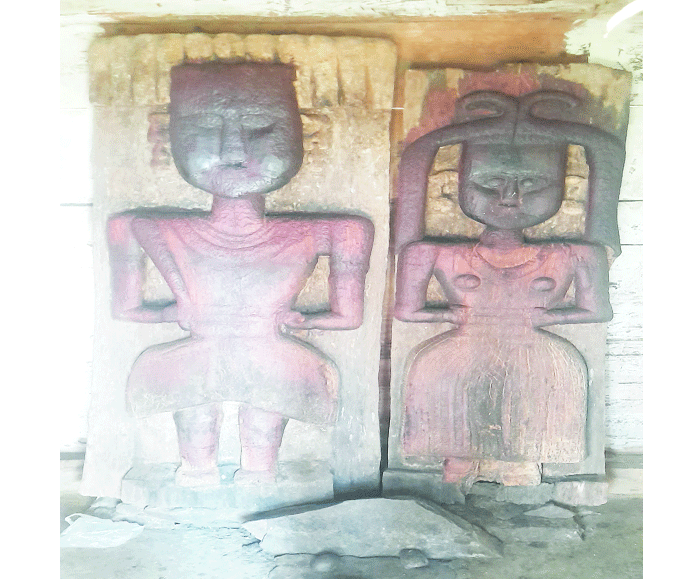
Inside the temple, two exquisitely carved wooden idols, representing a male and a female deity, stand on wooden slabs roughly five feet tall. The wood has a faint reddish hue, and the female figure is depicted wearing an unusual ceremonial headgear.
The temple showcases traditional mountain architecture, with a trapezoidal tin roof, which replaced the original wooden structure around 15 years ago. The entire renovation was a community effort, completed in just 21 days through donations and volunteer work by local villagers.
The temple walls are crafted from wooden panels, adorned with intricate geometric basket-weave and knot designs. These panels are framed with carved borders, featuring swirling, scroll-like motifs along the edges. Similar to other traditional wooden temples in the region, the ceiling is decorated with carvings of intertwined serpents, floral patterns, peacocks, Naga symbols, and smaller figurines of demigods, all adding to the sacred ambience.
Jai Anosar Naag Baba! Jai Ramban!
(The author is a Folklorist based in District Ramban)
 Follow our WhatsApp channel
