

3,000-3,500 MW hydropower potential to be harnessed in 2-3 years
‘Don’t believe in media censorship, anti-encroachment drives will begin with big fishes’
Bivek Mathur
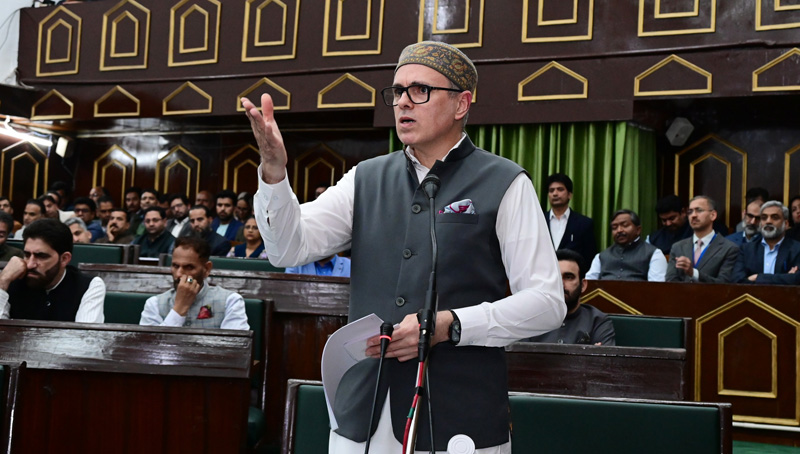
JAMMU, Feb 19: All tourist destinations closed in Jammu and Kashmir in the aftermath of the Pahalgam terror incident are likely to be reopened by May this year and 9 new tourist destinations will be developed across the Union Territory, with Jammu set to get its due share in tourism, Chief Minister Omar Abdullah announced today in the Legislative Assembly.
Click here to watch video
He further said that an additional 3,000-3,500 MW of hydropower potential will be harnessed in the next 2–3 years, in consultation with the Centre, over and above the existing 3,000-3,500 MW already tapped. This will take the total realized capacity to around 7,000 MW out of the UT’s estimated 18000 MW potential, he said.
The Chief Minister said 2-3 major housing projects will also be launched in Jammu and Srinagar with a special focus on providing affordable housing to the Economically Weaker Sections (EWS).
Follow the Daily Excelsior channel on WhatsApp
He also claimed that anti-encroachment drives will begin with big land grabbers now and the daily rated workers will be regularized in a legally and financially sustained manner this year.
Climate response, he added, will be prioritized by assigning the subject to a designated Government department to assess its impact and recommend mitigation and adaptation measures.
Meanwhile, Omar termed the existing advertisement distribution process to the media houses as “vague” and “lacking transparency”. Asserting that he does not believe in media censorship, Omar also claimed that the advertisements will not be used as a pressure tool in J&K and the process to issue them will be rationalized in consultation with the media fraternity.
Replying to the discussion on grants of his departments, the Chief Minister delivered a wide-ranging response touching on tourism revival, employment generation, fiscal management, power reforms, housing, climate adaptation, relief and rehabilitation, media policy, encroachments and administrative reforms.
Focusing first on tourism, which he described as the backbone of the Union Territory’s economy, the Chief Minister said the Government has worked relentlessly by conducting outreach campaigns across States to restore confidence among tourists after last year’s disruptions, particularly following the Pahalgam incident.
He said many stakeholders in the tourism industry had feared that tourist inflow would collapse for 2–3 years. However, he asserted that the Government’s persistent outreach efforts across States helped restore confidence.
“At a time when almost half of our tourist destinations were closed, we kept on working to revive the tourism,” Omar said, while replying to the Leader of Opposition’s (LoP) allegation that he (Omar) only enjoyed tours to the States, adding that hotels in Gulmarg and Sonamarg are currently witnessing heavy tourist footfall, while around 30–40% tourism activity has resumed in Srinagar.
He said after the Pahalgam incident, conditions were such that tourists had to be advised that certain destinations like Doodhpathri and Yusmarg were not fully accessible and that gondola (cable car) rides were restricted to certain points.
Despite these limitations, he said, the sector has shown resilience because his Government made all-out efforts to convince people to visit Jammu and Kashmir.
Thanking the Union Government for reopening several closed tourist destinations recently, the Chief Minister acknowledged that some other destinations still remain closed.
“There are certain things I cannot state openly, but I can assure the House that discussions have taken place with the Central Government. They too have certain constraints, but you can assume that by May, all these closed destinations will reopen,” he said.
On expansion of tourism infrastructure, the Chief Minister said that 9 new tourist destinations will now be developed under a centrally sponsored scheme after earlier multilateral funding proposals could not materialize due to certain issues.
He also assured legislators that Jammu will receive its due share in the new destinations.
Responding to a specific concern raised by a member, he said the names of Seven Lakes would also be included when the list of new destinations is finalized.
In the Jammu region, he said, projects including Jammu Lake and the Jammu Riverfront are nearing completion. The Chief Minister, however, said that the Riverfront Project too has certain limits and will now be extended to its full length on the pattern of the Sabarmati Riverfront Project under the SASCI or some other funding model.
He underlined that while tourists cannot be forced to visit all tourist places in the UT, the Government’s objective is to ensure that at least one well-developed tourist destination with proper infrastructure, marketing and Government support is available in every area.
Referring to the large pilgrim footfall in Jammu, he said nearly 1 crore pilgrims visit the Shri Mata Vaishno Devi shrine annually.
“If just 10% of them — about 10 lakh — can be diverted to other destinations such as border tourism areas, pilgrim circuits, golf course, and Bhaderwah, it could significantly transform Jammu’s tourism economy,” he said.
Rejecting the Kashmiri legislators’ concern that Kashmir tourism is limited to summers, he said destinations such as Pahalgam, Sonamarg, Doodhpathri and areas around Srinagar are attracting tourists even during winter months.
He also cited Asia’s largest chrysanthemum theme garden in Srinagar as an emerging attraction.
He stressed that attracting first-time tourists to J&K is not difficult, as people are keen to visit the region, but repeat tourism will determine long-term success.
He said the Government has discussed strategies with tourism industry stakeholders to promote recurring visits.
Turning to the Power Development Department, the Chief Minister said J&K has an estimated hydropower potential of 18000 MW but only 3000–3500 MW has been harnessed so far.
“In the next 2–3 years, another 3,000–3,500 MW will be realized,” he said, adding that total realized capacity will increase to around 7,000 MW.
For the remaining 11,000 MW potential, he said DPRs and project proposals will be prepared in consultation with the Government of India so that in the next 10–15 years, J&K can develop this capacity and even supply surplus power to other parts of the country during peak summer demand.
He acknowledged existing challenges, stating that the Union Territory consumes more power than it generates and that revenue realization remains lower compared to consumption.
He said the distribution network will be overhauled under the RDSS scheme to improve infrastructure.
On revenue generation, he reiterated that consumers must pay for the electricity they use, though the Government is ready to provide subsidies to those unable to pay, including AAY families.
In unmetered areas, he said around 60% of households have declared load levels insufficient even for one heater, despite heavy winter usage.
He pointed to discrepancies between declared and actual load and said the Government is examining the matter, including possible irregularities within the Department.
He urged consumers to install smart meters and use electricity as per requirement, assuring that Government support will be available for the economically weaker sections.
Clarifying concerns raised by CPI (M) MLA MY Tarigami and others, he said there is no proposal to privatize DISCOMs and the focus is on strengthening accounting, budgeting and financial discipline.
On employment, the Chief Minister said the issue of daily rated workers, ad-hoc and temporary employees has persisted for decades and was raised by members across party lines.
“These employees have struggled for 20–30 years. Some are now 50–55 years old,” he said.
He reiterated that the Government will begin the regularization process this year in a legally and financially sustainable manner.
“A committee under the Chief Secretary has been constituted to examine the matter and ensure that any policy framed does not get stuck in courts or the Finance Department,” he said.
He rejected suggestions of a hurried decision, saying regularization cannot be done overnight or by merely signing a paper without groundwork.
The registered workforce includes 69,696 casual labourers, 8,836 daily rated workers, 8,534 seasonal labourers, 5,757 Food and Civil Supplies helpers, 2,153 part-time sweepers and 1,929 persons engaged through the Hospital Development Fund.
He also reiterated that nearly 30,000 vacant posts will be filled this year without creating new positions, in coordination with the J&K Service Selection Board and the Public Service Commission, ensuring transparency and time-bound recruitment. Responding to criticism that only 653 posts were created against a promise of one lakh jobs, he clarified the distinction between creation of posts and appointments, stating that around 6000–6500 posts have already been filled.
On 24,000 outsourced posts, he said these are not included in the one lakh jobs figure and termed them additional livelihood opportunities for youth.
Addressing concerns over debt and fiscal deficit, including issues raised by BJP legislator Pawan Gupta regarding a 52% debt-to-GDP ratio, the Chief Minister defended the Government’s fiscal management.
He said past budgets presented in 2016–17 and 2017–18 included significant unfunded components, including hundees, off-budget borrowings and power debts, which increased liabilities.
He asserted that at present there is no off-budget borrowing and that last year’s expenditure was used to retire debt and reduce the interest burden.
Defending SASCI funding, he described the 50-year interest-free loan as effectively equivalent to no loan. A Rs 3000 crore loan today, he said, would be equivalent to Rs 97 crore in real terms after 50 years.
The Chief Minister said maximum utilization of SASCI funds would accelerate development.
Responding to concerns raised by MY Tarigami regarding climate change, the Chief Minister said climate response has become an obligation for the Government in light of last year’s heavy rains and drought-like conditions.
He said a dedicated fund corpus has been established for climate change mitigation and adaptation.
However, he noted that currently no single department is specifically tasked with handling climate policy.
He said the Government will ensure that at least one department first understands the subject and its potential impact on J&K before concrete budgetary provisions are made.
The Chief Minister announced that 2–3 major housing projects will be launched in 2026 in Jammu and Srinagar, including provisions for EWS categories. “Suggestions of legislators under PMAY are being examined,” he said.
On encroachments, he assured that anti-encroachment drives will now start with “big fish, big sharks and politically connected land grabbers” rather than targeting the poor first.
He said the Government will act firmly against large-scale encroachments before moving to smaller cases.
On Gair Mumkin Khad and lease issues, he said the matter will be resolved this year.
Addressing concerns about delays in retirement benefits, he said treasury constraints sometimes cause delays, but benefits are being released.
In 2025–26, the Government released Rs 3,173 crore as GPF, Rs 1,170 crore as gratuity, Rs 838 crore as commutation and Rs 424 crore as leave salary, which the Chief Minister said were better figures compared to the previous year.
He assured that CDF savings will not lapse and will remain available for legislators. On salary revision, he said a file is pending with him as he is not satisfied with the Finance Department’s proposal and will inform the House once a decision is reached.
On advertisement distribution, Chief Minister Omar Abdullah termed the existing process as “vague”, which, according to him, lacks transparency and questioned the circulation and credibility of certain newspapers receiving advertisements.
“I have never seen these newspapers that are being issued advertisements now. Who reads them? Why are advertisements issued to these newspapers? Who decides this criterion for issuing the advertisement? I have completely failed to understand this process,” he said.
He, however, said the Government will rationalize the process based on circulation, readership and reach after holding consultations with the press fraternity.
He reiterated that advertisements will never be used as a pressure tool against media houses, claiming he never tried to censor or silence media houses for their critical reporting, whether in print or electronic media. He said he has never asked any media house to report in his favour.
“I don’t believe in media censorship. I have never asked any media house to write against me or in my favour. I will never use advertisements as a pressure point,” he said.
On the suggestion of retirement benefits for working journalists, he said the Government will examine the implications and explore the possibility of contributing towards group insurance after consultations.
Meanwhile, the Jammu and Kashmir Legislative Assembly today passed grants amounting to Rs 61,575.88 lakh for the General Administration Department (GAD), Rs 47,648.38 lakh for Planning, Rs 12,408.31 lakh for Information, Rs 12,54,383.63 lakh for the Power Development Department (PDD), Rs 52,37,955.90 lakh for Finance, Rs 7,742.54 lakh for Parliamentary Affairs, Rs 75,028.93 lakh for the Law Department (excluding the Election Department), Rs 78,461.35 lakh for Revenue, Rs 4,22,783.97 lakh for Housing & Urban Development (H&UDD), Rs 66,622.88 lakh for Tourism, Rs 40,749.54 lakh for Hospitality, Protocol & Estates, Rs 17,622.31 lakh for Culture, and Rs 1,46,098.46 lakh for Disaster Management, Relief, Rehabilitation & Reconstruction (DMRRR).
The grants were passed following extensive two-day discussions in the House. The Assembly also passed 19 supplementary grants amounting to Rs 3,52,341.28 lakh.
 Follow our WhatsApp channel
