

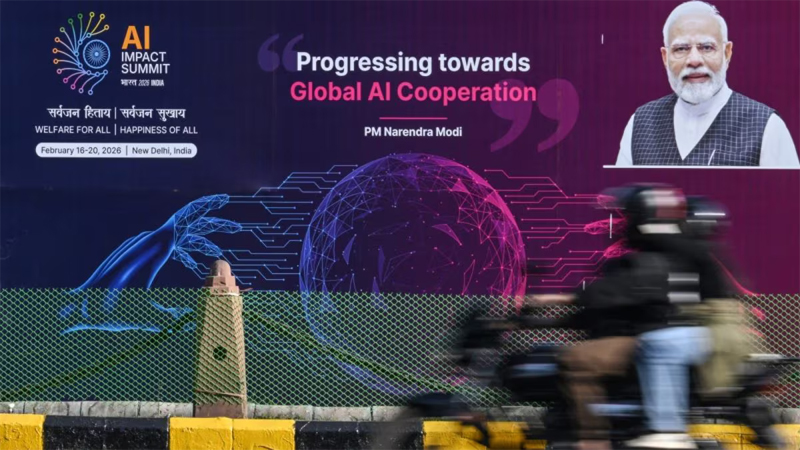
NEW DELHI, Feb 16 : At the ongoing India AI Impact Summit 2026, the Indian Army is showcasing a comprehensive suite of indigenous artificial intelligence applications currently in use, highlighting their strong dual-use potential across education, disaster management, cybersecurity, transportation safety and digital infrastructure protection.
Among the key systems on display is AI Examiner, an automated evaluation platform that integrates with Learning Management Systems to create assessments, analyse submissions, generate scores and provide structured feedback. Designed to enhance training efficiency within the forces, the tool also holds promise for universities, skill development programmes and online education platforms.
The Army has also developed SAM-UN (Situational Awareness Module for UN Operations), a web-based indigenous platform that integrates geospatial intelligence, structured reporting and AI analytics to provide unified real-time situational awareness. While built for mission planning and coordination in operational environments, it is equally suited for disaster management centres, emergency coordination hubs and smart city control rooms.
Another major innovation is EKAM: AI-as-a-Service, a secure, modular, air-gapped indigenous cloud platform offering AI chat, document and presentation generation, multilingual translation, summarisation, Retrieval-Augmented Generation (RAG) capabilities and multimedia bots. The system ensures data sovereignty and secure compute access, addressing both military and strategic civilian requirements.
In the domain of disaster resilience, the Army unveiled PRAKSHEPAN- AI-Driven Military Climatology & Disaster Prediction System, described as India’s first hybrid military climatology decision-support system. Capable of predicting landslides, floods and avalanches three to seven days in advance, it leverages multi-agency scientific datasets, terrain intelligence and AI/ML modelling. Developed in collaboration with national scientific agencies and the Ministry of Earth Sciences, the system provides location-specific hazard forecasts for sensitive operational regions while offering early warning support to disaster management authorities and vulnerable border communities.
Security-focused solutions include XFace, an AI-powered facial recognition system for rapid image and video-based verification, supporting installation security and surveillance, with applications in law enforcement and airport security. The Deepfake Video Detection System counters synthetic media and misinformation through advanced facial and signal-pattern analysis, strengthening defences against information warfare.
The Army also presented Nabh Drishti, a mobile-enabled telemetry reporting system that captures positional data and imagery for AI-driven real-time visualisation, enabling coordinated operational responses and disaster reporting by citizens. Complementing mobility safety is the Driver Fatigue Detection device, a rugged AI solution that monitors driver alertness in challenging conditions.
To ensure secure and decentralised deployment, the Army showcased AI-in-a-Box, a portable high-compute edge platform capable of running AI models locally in disconnected environments, suitable for remote hospitals and disaster-hit areas. Cybersecurity offerings include a Proactive Mobile Security System and a Machine Learning-Based Web Application Firewall, both designed to protect critical digital infrastructure, banking systems and citizen platforms from evolving cyber threats. An AI-enabled Vehicle Tracking System further enhances logistics visibility and route optimisation.
(UNI)
 Follow our WhatsApp channel
