

Ashutosh
dubey.ashutosh29@gmail.com
“I have no words to say, only ‘Thank you, thanks everybody’,” Jagjit Singh on his 70th birthday, 08.02.2011.
Jagjit, in an unusually festive mood, celebrated his 70th birthday year with 48 concerts around the world, singing:
Thukrao ab, Ke Pyar Karo, Main 70 Ka Hun”
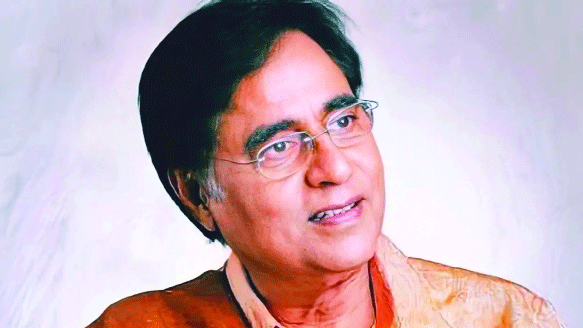
The 85th birth anniversary of the Ghazal Samrat evokes a deeper quest to understand his soul’s quenchless yearning life as a humanitarian rather than merely a singer, composer, and arranger.
“Gupt Dhan” was his practice of giving without seeking recognition, where even his left hand should not know what the right hand was giving. He never believed in publicity; no flashbulb was allowed to document his acts of generosity, which he performed with utmost secrecy.
In his words: “My father once said, ‘You are in no position to do anything. A power is making you do it.’ Helping the needy will not diminish anything.”
To accomplish his mission as a philanthropist, he often called his friend Jasbir saying, “Bhai tu aaja, aaj kuch kaam karna hai.” Jagjit would carry a bag full of cash bundled in packets along with a list of beneficiaries, specifying the amount against each name according to their needs, ranging from 0.25 to 5 lakhs. These visits would last the entire day and occurred twice or thrice a month. The recipients never knew who would knock at their doors. He continued this practice for years till the end.
Sound engineer Daman Sood recalled that Bhanwar Lal, working at Sunny Super Sounds, requested help in arranging a concert to raise funds for his daughter’s marriage. Jagjit explained that a concert might not serve the purpose and instead directly provided financial assistance for the wedding.
In another incident, a person known to Jagjit’s driver made a similar request. He was discreetly given a sweet box, which later turned out to contain Rs 2 lakh. The family later visited Jagjit’s residence for blessings.
No one looked after his fraternity-musicians and co-artists-the way Jagjit Singh did. His humility in making tea, ironing clothes, and ensuring all co-artists stayed in the same hotel as him set him apart. He helped many co-artists in owning their own homes.
Jagjit believed that in the music profession there is no pension, no medical aid, and no financial security for senior artists. Hence, his commitment and care for his fraternity remained exemplary. Whenever he performed in Mumbai and nearby cities, he ensured that his old stage companions were included in concerts so they could earn for themselves.
He ensured that Peterson, his guitarist, had a house by quietly paying the booking amount for a flat in Chembur. During Peterson’s illness, Jagjit discreetly left money for his family. When his co-artist Sheware underwent heart surgery, Jagjit bore all the expenses.
Kuldip Singh, music director and friend from college days, recalled Jagjit’s generosity during the film Saath Saath (1982). Though Jagjit was already an established name, he and Chitra sang all songs without charging any fee. Later, Jagjit encouraged Kuldip to take remuneration in his name whenever possible.
During a concert tour in Karachi, Jagjit revealed that his primary purpose was to meet Mehdi Hassan Sahib, who was bedridden and financially distressed. Jagjit visited him, offered financial help, and donated his entire concert fee-an act of deep respect from one artist to his Guru.
Listening to Jagjit was always a spiritual experience-music that healed and uplifted. At an airport security check, an unknown man touched his feet, expressing gratitude, stating that his mother had come out of a coma after listening daily to Jagjit’s bhajans.
Chitra Singh narrated that a fan in England insisted doctors play the album Beyond Time (1987) during the delivery of all three of his children.
Jagjit’s commitment to his art was evident during a Kolkata concert when his mother, Bachchan Kour, passed away a day before the show. Despite the personal tragedy, he performed after completing the last rites in Delhi. When the audience learned of this, many were moved to tears.
Jagjit stated, “Devotional music is not my bread and butter. I do it for my own happiness.” He never commercialized devotional music and performed only one devotional concert annually on Janmashtami for ISKCON, Juhu, irrespective of where he was in the world.
He refused to allow money to overshadow art. During the remix era, he declined a lucrative offer to remix his Punjabi songs, withdrawing from the project to avoid becoming part of the trend.
Jagjit was deeply concerned about poets’ royalties and pioneered the practice of paying poets a share from live ghazal performances. Sudarshan Faakir, who often lived in financial hardship, received consistent support. Jagjit credited Faakir for the bhajan “Hey Ram… Hey Ram” and ensured royalties went to him.
Throughout his life, Jagjit supported social causes through benefit concerts and personal contributions. Contrary to misconceptions, he did not charge professional fees for charity concerts and often paid fellow musicians from his own pocket. His album CRY for CRY generated ongoing royalties for the NGO Child Relief and You (CRY).
Till the end, he supported organizations such as CRY, National Association of the Blind, Alert India, Sense International, Nargis Dutt Cancer Foundation, Bombay Hospital, ALMA, Save the Children India, and El Shaddai.
Even today, tribute concerts and mehfils across the world attract large audiences and raise funds for social causes, proving that the art Jagjit left behind remains a balm for the soul.
Ashok Khosla, ghazal singer and disciple, once ran a small old-age shelter near Pune. Jagjit quietly purchased adjacent land and funded an expanded building that now houses over 100 residents. The building, named after his son Vivek, came to public knowledge only after Jagjit’s demise.
Jasbir, owner of the “Chenab” restaurant in Vashi, was helped by Jagjit through a promotional radio program. When asked for seva, Jagjit replied, “Yeh pyar ke saude hain. Jagjit Singh restaurants ke liye nahi gata.”
Jagjit’s humility was evident when he refused a government house allotment, requesting it be given to a needy artist instead.
Chitra Singh summed up his persona:
“Woh jitne bade fankar the, usse kahin zyada bade insaan the… Jo unka tha hi nahi, use dene mein kya harz hai.”
Humanity was his religion, singing his meditation, and humour his relaxation. His mastery of alaap and spiritual presence captivated audiences even before the first ghazal note.
Today, as he turns 85, we celebrate his birthday in his own words:
Happy Birthday, Papaji
(The author is a member of Jagjit Fan Club, Jammu)
 Follow our WhatsApp channel
