

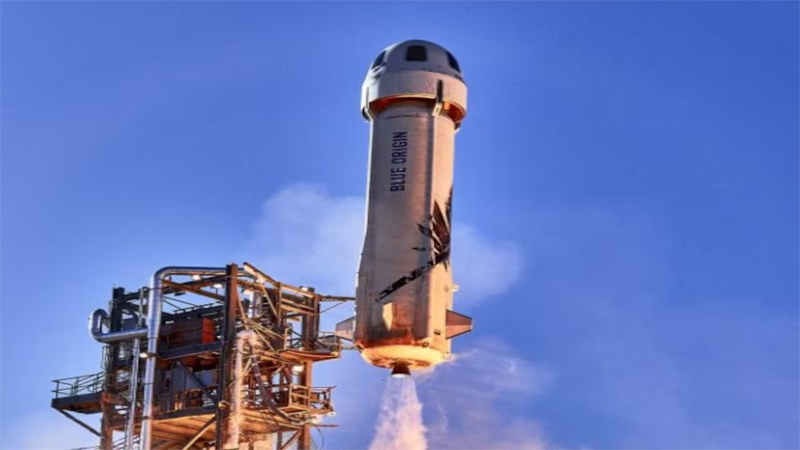
CHENNAI, Jan 31 : With the items on its plate increasing-satellite constellation, lunar mission- the US-based rocket maker and launcher, Blue Origin, has decided to pause its space tourism business for not less than two years.
The company Blue Origin, promoted by American billionaire Jeff Bezos, said it has decided to shift resources to further accelerate development of its lunar capabilities.
The decision reflects Blue Origin’s commitment to the nation’s goal of returning to the Moon and establishing a permanent, sustained lunar presence, the company said.
Blue Origin is the second company, after Elon Musk’s SpaceX, to have a contract from NASA to build a human landing system (HLS). The contract is part of the American space agency NASA’s Artemis programme, a crewed mission to the moon slated for 2029.
The NASA contract value announced in 2023 for Blue Origin is 3.4 billion USD.
As part of the contract, Blue Origin will design, develop, test, and verify its Blue Origin lander to meet NASA’s human landing system requirements for recurring astronaut expeditions to the lunar surface, including docking with Gateway, a space station where crew transfer in lunar orbit.
In addition to design and development work, the contract includes one uncrewed demonstration mission to the lunar surface before a crewed demo on the Artemis V mission in 2029.
According to NASA, for the Artemis V mission, NASA’s SLS (Space Launch System) rocket will launch four astronauts to lunar orbit aboard the Orion spacecraft.
Once Orion docks with Gateway, two astronauts will transfer to Blue Origin’s human landing system for about a weeklong trip to the Moon’s South Pole region, where they will conduct science and exploration activities. Artemis V is at the intersection of demonstrating NASA’s initial lunar exploration capabilities and establishing the foundational systems to support recurring complex missions in lunar orbit and on the surface as part of the agency’s Moon to Mars exploration approach.
Adding another human landing system partner to NASA’s Artemis programme will increase competition, reduce costs to taxpayers, support a regular cadence of lunar landings, further invest in the lunar economy, and help NASA achieve its goals on and around the Moon in preparation for future astronaut missions to Mars, NASA had said earlier.
While the company has announced its decision to pause its space tourism business vertical, it is not known what impact NASA’s contract will have on its new ambitious venture-satellite constellation.
In a forward integration rocket launch company, Blue Origin recently announced that it will be getting into the satellite broadband service Terawave, launching 5,408 optically interconnected satellites in low Earth orbit (LEO) and medium Earth orbit (MEO).
Blue Origin will begin to launch its satellite constellation in Q4 2027.
With this, Blue Origin will be taking on satellite broadband players like SpaceX’s Starlink (over 6,000 satellites) and Eutelsat OneWeb (634 satellites).
Interestingly, Amazon, also founded by Bezos, will start launching its satellite constellation Leo next month. Amazon will be launching 32 satellites with the Ariane rocket. The company’s full satellite constellation will be about 3,200 satellites.
There are several others who have announced such satellite constellations.
Be that as it may, Blue Origin said its proposed TeraWave satellite communications network is designed to deliver symmetrical data speeds of up to 6 Tbps anywhere on Earth.
The company will be targeting enterprises, data centres and government users as its customers.
“The TeraWave architecture consists of 5,408 optically interconnected satellites in low Earth orbit (LEO) and medium Earth orbit (MEO). This multi-orbit design enables ultra-high-throughput links between global hubs and distributed, multigigabit user connections, particularly in remote, rural, and suburban areas where diverse fiber paths are costly, technically infeasible, or slow to deploy,” Blue Origin said.
TeraWave enterprise-grade user and gateway terminals can be rapidly deployed worldwide and interface with existing high-capacity infrastructure, providing additional route diversity and strengthening overall network resilience, the company added.
Blue Origin claims that TeraWave addresses the unmet needs of customers who are seeking higher throughput, symmetrical upload/download speeds, more redundancy, and rapid scalability.
It complements fibre backhaul with a unique architecture that delivers both high-performance RF and optical connectivity.
“Globally distributed customers can each access speeds of up to 144 Gbps delivered using Q/V-band links from a constellation of 5,280 LEO satellites, while up to 6 Tbps can be accessed via optical links from 128 MEO satellites,” Blue Origin said.
Blue Origin said TeraWave will offer a download and upload speed of RF up to 144 Gbps, optical up to 6 Tbps, as against the current LEO constellations offering a download speed of RF up to 1 Gbps and upload speed of RF up to 400 Mbps.
Currently, Blue Origin manufactures and operates rocket engines, reusable launch vehicles, lunar landers, and satellite systems.
With its focus shifted to the lunar landing business, Blue Origin will have to wait not less than two years to score a century of carrying space tourists on its reusable spaceflight system, New Shepard. This is just two short of Blue Origin scoring a century of space tourists on its craft, New Shepard.
The company said New Shepard has flown 38 times and carried 98 humans above the K?rm?n line to date. New Shepard has launched more than 200 scientific and research payloads from students, academia, research organisations, and NASA. This consistent and reliable performance, combined with an exceptional customer experience, has resulted in a multi-year customer backlog.
It is said the cost per passenger is about 1 million USD though Blue Origin has not announced it publicly. If that is the case, it is logical for Blue Origin to consider the NASA contract as more important in terms of business.
(UNI)
 Follow our WhatsApp channel
