

Mandeep Chouhan
mmandeepsingh1999@gmail.com
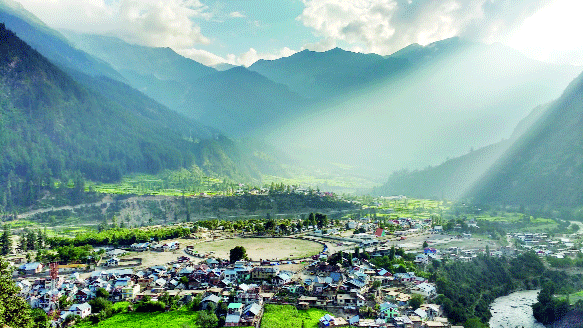
“Ratnu, you know that you are my subject. Why did you observe mourning ritual of tonsuring your head and shaving your beard upon the demise of the Raja of Chamba while living within my borders?” asked the Maharaja of Jammu. “Maharaj, you yourself know that he was my master” answered Ratnu, the Palsar of Paddar. Maharaja of Jammu was so pleased with the fearless answer of Ratnu, that he was forgiven for the patriotic feelings and fidelity towards his former master, Raja Charhat Singh (1808-1844) of Chamba. The title of Palsar was given to the representative of the Raja of Chamba who supervise the administration of small areas like Paddar during the nineteenth century. Paddar persisted as a centre for trade with Central Asia through Zanskar and Ladakh during the reign of Chhatra Singh (1664-1690), the Raja of Chamba. The expansionist policy of Raja Chhatra Singh extended his territory to Paddar while visiting Pangi. It has been known through the medium of story-tellings that Paddar was predominantly ruled by the Ranas and they used to fight with each other. Raja Chhatra Singh removed the Ranas from all authority and appointed his own officials. He also founded a town on the plain of Paddar valley and named it Chhatragarh after his name. The contacts of the valley were ensured continuity through the Nurpur-Chamba-Pangi route and were viable for the tradesmen. Therefore, Paddar remained an “Emporium of Central Asian Trade” on the Central Asian route (Reference: Gazetteer of India, Chamba, edited by Thakur Singh Negi, 1963-64). Paddar was a craggy, mountainous valley popular for its distinct culture and complex terrain. Between 1820 AD and 1825 AD, under the orders of Raja Charhat Singh of Chamba, Ratnu Palsar seized the Zanskar region from Ladakh and made it a taxpayer/tributary to Chamba. Meanwhile, the town Chhatragarh grew and flourished until 1836 AD.
The history of Himalayas in the nineteenth century is a melange woven with the threads of rising warlords, declining empires, and the shifting borders of mountain kingdoms. By the 1830s, a new power was rising in the Jammu region, Raja Gulab Singh a superb strategist and a feudatory of Sikh Empire who harboured imperial ambitions and sent an army under Wazir Zorawar Singh Kahluria to invade and conquer Ladakh in 1835 AD. The campaign was splendidly handled by the Wazir and is considered legendary for the provisions of moving the army through frozen passes. After the Ladakh conquest, a secondary force under Wazir Lakhpat Rai was detached from the main army to annex Zanskar, which was still holding out against the Dogra regime. To reach Zanskar, Wazir Lakhpat Rai deployed his forces through the Umasi Pass (or Omasi La). This pass connects Paddar to Zanskar. It is believed that Maharaja Gulab Singh reckons Chamba as a friendly state (or at least did not wish to fight while focused on Ladakh) and had no intentions of encroaching Paddar. The Dogra army’s passage through Paddar was intended merely as a transit route to Zanskar. However, the presence of foreign army, even one just ‘passing through’ is rarely welcomed. The people of Paddar became suspicious and offered an opposition to the passage of the Dogra army.
Despite the tension, the primary body of the Dogra force passed through Paddar successfully. In order to maintain a line of communication and supply between Jammu and their forward positions in Zanskar, the Dogras left a small garrison of about thirty men in Chhatragarh, the administrative headquarter of Paddar. The decision to leave such a small force in hostile territory proved to be a tactical error and it was probably on hearing this that Ratnu, the fiercely loyal Palsar attacked the small force in Chhatragarh through inciting the local population. The skirmish was uncompromising. It seized the Dogra soldiers. Ratnu did not execute the captured soldiers but sent them to Chamba as prisoners. Upon arriving at Chamba, Raja Charhat Singh, the then Raja of Chamba, understood the seriousness of the situation, disowned the act of his officials. He realized that provoking Gulab Singh who is backed by the Sikh Empire was dangerous but the mischief had been done. Relations between Chamba and Jammu were good at that time, therefore Raja Charhat Singh expressed displeasure with Ratnu. When the news of the attack of Chhatragarh garrison reached to Wazir Zorawar Singh who was in Ladakh or Zanskar at that time, irked him as this uprising threatened his rear supply lines and his reputation. In the spring of 1836, he returned from the north with a large force to avenge the insult done by Ratnu Palsar at Paddar.
Ratnu presupposing the retaliation, had destroyed the bridge (probably ‘Kunsiyau Pol or Aakhar’ it is called in the Paddari dialect) over the Chander Bhaga and in this way kept the Dogra army at the bank of the river for three months. Zorawar Singh however skilled in strategic warfare, found himself beached on the bank, and unable to attack the Paddar forces on the other side. After three months, Zorawar Singh was helped by some local villagers to cross the river. It is not explicit if the local villagers were coerced, bribed or simply held a grievance against Ratnu. They guided and helped the Dogra forces to a jhula across the river, a few miles lower down. Zorawar Singh triumphed in transferring a portion of his force to the other bank bypassing Rantu’s main defences. The Dogra army thus advanced into the Chhatragarh through the bridge (probably from ‘Maitte Aakhar’ as in Paddari dialect) over the Bhotna. (a river tributary which was not interfered with because Ratnu did not expect the attack from that direction). Under the cover of the night, the Dogra forces entered Chhatragarh and razed the town along with the Fort to the ground. The assault was brutal and unconditional. To emblematise the conquest and the wiping out of the old order, the name of the place was changed to Gulabgarh, after the name of Raja Gulab Singh. Several of the people of Paddar in this armed conflict were hanged and maimed, annexing Paddar to Jammu. (Reference: Gazetteer of India, Chamba, edited by Thakur Singh Negi, 1963-64).
Following the defeat at Chhatragarh, Ratnu fled to Chamba. Under political pressure, Raja Charhat Singh arrested his loyal Ratnu and sent to Jammu as prisoner to appease Raja Gulab Singh. In an unexpected turn of events, he was not prosecuted but allotted a small jagir in Kishtwar. When his relations with Raja Gulab Singh progressed, he was given permission to return to Paddar. Hence, the conflict eventually redrew map of the region, solidifying the sovereignty of the Dogra dynasty of Jammu and diminishing the control of the ancient state of Chamba. It also marked the end of Chamba’s influence in Zanskar. The annexation of Paddar proved to be more significant to the Jammu state than just a strategic victory. Decades later, in 1880 A.D., a discovery was made that would make Paddar well-known worldwide. A sapphire mine was discovered in the high altitudes of Paddar popular as Paddar Sapphire. These gems became a source of substantial gains to the Jammu State. Had Ratnu held off the Dogras, or had Chamba kept-up the control, this enormous wealth would have pertained to Chamba.
(The author is a PhD Scholar from the Department of English, University of Jammu)
 Follow our WhatsApp channel
