

Dr. Bhavna Singh
PM Carney’s statements at the World Economic Forum at Davos are an outcome of the sense of shock and surprise that gripped the world because of Trump’s neo-nationalist proclamations on trade and geopolitics around the globe. The reactions from other countries equally shocked by Trump’s stance on Greenland has stirred a debate on resuscitating the old adage ‘survival of the fittest’ which is being moulded and redesigned to fit the current international relation scenario under the ‘survival of the Richest’ or the Gunboat capitalism narrative. In fact, Carney strongly voiced concerns on how powerful nations were using economic coercion to get what they want at the World Economic Forum at Davos. This shock and awe has significantly pushed Canada to recalibrate its geo-economics and pushed it closer to China, which was reflected in his recent visit to Beijing.
On 14 January 2026 when the Canadian PM Mark Carney visited China, the emphasis was not only on ‘strategic autonomy’ in bilateral relationships but to move beyond the prison of history that had been woven by Trudeau’s blind aping of the US tariff policies. Mark Carney made a significant remark on how the ‘old world order was not coming back’ and that countries needed to find a new paradigm to engage beyond the traditional system of friends, allies and enemies. Carney acquiesced that “middle powers must act together because if they are not at the table, they are on the menu.”
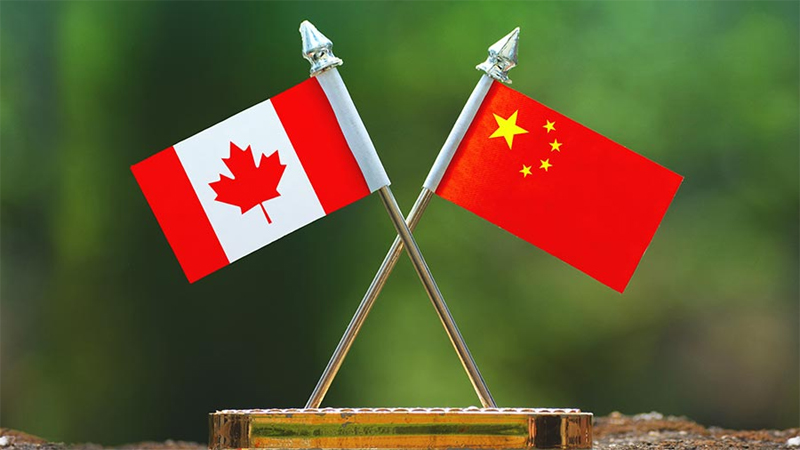
China, for its part, made every attempt possible to wean away Canada from its long-term ally, the US, especially seeking the pretext of the Venezuela crisis. President Xi Jinping proclaimed that China and Canada should chalk out a new path and “be partners of mutual respect, common development, mutual trust and collaboration” in his speech marking Carney’s arrival. Despite China emerging as its second largest trading partner in 2024, their bilateral relationship had remained strained by historical misunderstandings and diplomatic feuds with not much scope for transformation. But now with political reversal in Canada, the two sides announced a “new strategic partnership”. Both the statements in China and at Davos, reaffirm Canada’s choice to uphold long-term strategic commitment rather than adopting a policy shaped by US pressure tactics. At this juncture, it is pertinent to look at the trajectory of the events and the factors responsible for Canada’s sudden desire to re-engage with China.
A difficult History
Relations between the two countries had nose-dived in 2018 when the CFO of Huawei company – Meng Wanzhou was detained by Canada in Vancouver on a US warrant on fraud charges related to Iran sanctions violations; on charges of intelligence theft. Subsequently, Michael Spavor and Michael Kovrig, two of alleged Canadian spies were detained by China. More recently, China was accused of meddling in Canada’s internal politics, but China has repeatedly denied allegations of foreign meddling. A public inquiry on foreign interference found China’s impact in recent federal elections to be minimal.
The visit between 14-17 January 2026 was expected to achieve a rapprochement after Canada and China struggled to forge meaningful ties in the past. It restores a level of prime-ministerial dialogue and marks a big step in the acknowledging China with a major country status, with both countries reinforcing commitment to multilateralism. The choice for Canada was realistic as it cannot reduce its economic dependence on the US until and unless it increases its trade with China. For China also it entailed a diplomatic victory as Canada relented some space in terms of their contacts with the Taiwanese government. Two MPs from Canada were reported to have cut short their sponsored trip to Taiwan ahead of Carney’s visit, ostensibly to avoid confusion within its foreign policy though Canada’s official position on Taiwan “had not changed.” The Canadian PM was also cognisant of the timing to show solidarity with the global South through a third path where “the power of legitimacy, integrity and rules will remain strong, if the nations choose to wield them together” and hence the urgent necessity to come together with China.
Economics Takes Precedence
Senior Canadian officials have described the trip, the first to China since 2017, as “consequential and historic” and part of a “bold” plan to double Canada’s non-US exports over the next decade. This trip marked a reset in the economic ties with cooperation agreements signed on several fronts. For China, Canada is an important trading partner, with trade between the two countries valued at around USD118bn in 2024. The two countries issued a joint statement emphasizing their commitment to enhancing cooperation across various sectors and drafted a China-Canada Economic and Trade Cooperation Roadmap. Canada agreed to cut it steep tariffs on Chinese electric vehicles (EVs) allowing up to about 49000 EVs at a much lower tariff (6.1%). In return China agreed to reduce tariffs on Canadian agricultural exports such as canola seeds, canola meal, lobsters, crabs and peas.
The deal partly reverses previous protectionist measures and represents a major step toward re-building economic ties. Eight cooperation documents were signed in other areas which include – energy, finance, food safety and related regulations, culture and forestry and crime prevention and public safety frameworks, under which a counternarcotics dialogue is a key part and media. The two sides also decided to reinvigorate the high-level China-Canada Economic and Financial Strategic Dialogue (EFSD) to discuss wide ranging related issues to strengthen bilateral economic relations.
On the cultural front Beijing’s foreign ministry said the two countries have “shared interests” and will work to “increase people-to-people ties and cultural exchanges.” The two sides decided to restart the China-Canada Joint Committee on Culture. The meetings were elaborate with Carney meeting the Premier of China, Li Qiang, as well as the Chairman of the Standing Committee of the National People’s Congress of China, Zhao Leji. Later, the prime minister met Chinese President Xi Jinping, this is their first bilateral effort after the pair met last year on the sidelines of an Asia-Pacific Economic Cooperation summit in South Korea.
The US has watched this shift in Canada’s foreign policy with much interest and skepticism and strategists like Eric Miller, a Washington DC based trade adviser and president of the Rideau Potomac Strategy Group, commented that the Canadian PM’s actions showcase how ‘Canada has an agency too, and that it’s not going to just sit and wait for the United States’, which basically meant that US has taken note of Canada’s attempt to recalibrate its stance on China.
Nevertheless, China has welcomed Canada’s prioritisation of its own national interests and has charted a stricter framework for itself vis-à-vis the US. The local media stated how Canada’s stance signals ‘trust in China as a responsible stakeholder in global affairs while acknowledging it as a structural pillar of the international system’. Moreover, China stringently denied any extra-territorial role in the arctic that the US accused it of, and stated that the US is unnecessarily hyping the ‘China threat theory’ for personal gains in Greenland and other territories that have become victim to US’ neo-protectionist measures. So far, Canada had kept its ties with China on the backburner due to its proximity to the US, but with Canada’s decision to cooperate with China given its needs for economic self-reliance, the US will be tempted to test the waters. The US would not restrain from using instruments of economic coercion as Canada’s own economic deals are up for renewal later this year after having shown its propensity to go by ‘might is right’. This would, as a corollary, enhance China’s attractiveness as an ally for other countries besides Canada.
(The columnist is a visiting fellow)
 Follow our WhatsApp channel
