

Dr. D.K. Giri
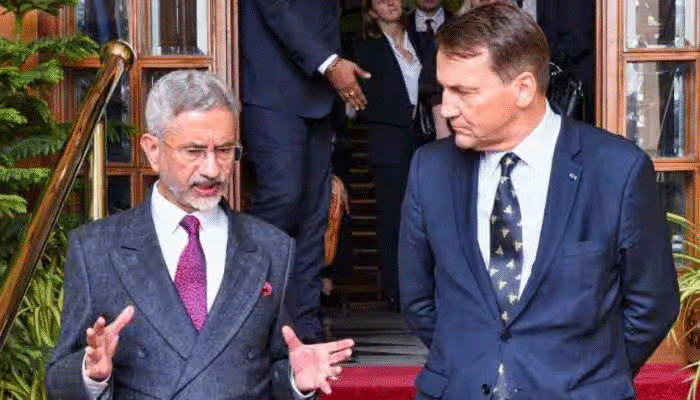
India and Poland relations seem to have taken a nosedive in the last few months, especially since October 2025, the Polish Foreign Minister, Radoslaw Sikorski, who is also the Deputy Prime Minister of his country, visited Pakistan. This visit happening a few months after the India-Pakistan conflict (May 2025) had ruffled feathers in South Block, New Delhi. The unease and the strain between the External Affairs Ministers of India, S. Jaishankar and Sikorski came out into the open in the joint press conference held on 19 January.
In the televised press conference, Jaishankar made a sharp remark on Sikorski’s observations on India’s transactions with Russia. Secondly, Jaishankar picked on the Foreign Minister for his initiatives in renewing ties with Pakistan. Jaishankar referred to India’s imports of Russian oil which Sikorski had been speaking about publicly during his visit. He quoted Polish Foreign Minister on latter’s remarks in Jaipur that “he was pleased that India had cut its purchase of Russian oil….” Jaishankar said, “I have repeatedly underlined that selective targeting of India is both unfair and unjustified. I do so again today”.
Jaishankar in his opening remarks in the press conference, while referring to Polish Foreign Minister’s aforesaid trip to Pakistan, said he wanted to “discuss some of (Sikorski’s) recent travels to the region”. He elaborated, “Poland should display zero tolerance for terrorism and not help fuel the terrorist infrastructure in our neighbourhood”. In his response, the Polish FM agreed that the two sides were on the same page on terrorism. He admitted that the conversation about India and Poland’s respective regions had been open and frank. But he pointed out, perhaps as a retort, “India’s participation in Zapad 2025 military exercises in Russia and Belarus was seen as ‘threatening’”.
Polish Foreign Minister expanding on his response said, “We all have regional concerns and we all have neighbours, and with neighbours you have opportunities and challenges. While we are of one mind on terrorism, we have concerns that India took part in the Zapad exercises in Russia that we find threatening.” It was also reported that the Foreign Minister walked out in a huff from a debate on NDTV, news channel. Admitting that the channel anchors could be uncomfortable and combative, the Foreign Minister as a politician should know better to handle them than walking away. Even the journalists in the West are equally aggressive.
At any rate, the sharp exchange of divergences between two Foreign Ministers of two democracies was bit unusual for the observers of international relations, the India-Poland ties in particular. The relations between both countries have been steadily growing in multiple sectors since the visit of Indian Prime Minister to Warsaw en route to Kiev to meet Zelenskyy, the President of Ukraine. That said mutual concerns about their respective neighbours are in fact not out of order. These have to be addressed by both counties if the ties have to be taken to new heights.
Poland is certainly and genuinely concerned about Russian military actions in the neighbourhood. It has won and lost battles to Russia in the past. But in the recent past, Poland has been colonised by Russia, its predecessor Soviet Union, to be more precise. Russia under Putin has expressed off and on to extend Moscow’s influence across Eastern Europe which includes Poland as an immediate neighbour bordering it. Putin’s intentions are revanchist in nature as Soviet Union used to have political suzerainty over Eastern Europe including Poland. It is natural for Warsaw as a sovereign, independent, a fast-growing economy and democracy to be alarmed by Russia’s neo imperialist designs.
Europe, especially Poland is concerned about India’s position on Ukraine war. The oil purchase has become a thorn in the flesh of European countries. As a matter of fact, many countries in the world are driven in their geo-political relations by their respective national interests. India is no exception to that trend as it is evidenced in New Delhi’s response to Ukraine war. European Union countries have been guided by their national economic interests. Their trade and investment in China testify to the mismatch between their avowed international political principles and economic policies. Having written extensively about it, I am a bit surprised that Jaishankar does not raise the China obsession of Europe in his remarks on partner countries dealing with New Delhi’s hostile neighbours.
It is in order that New Delhi raises China question with EU countries including Poland whenever the latter brings up India’s policy on Ukraine war. That is a better bargain than raising European engagement with Pakistan, which is of course, of no less concern to India. But Pakistan exists only as a satellite country of one big power or the other. Islamabad was clinging to the apron-strings of the United States, now it is China or a couple of cash-rich countries in the Middle-East. The bigger threat in terms of China looms large on India’s interests and security. Raising the China card, should put the European powers on the defensive.
On the brighter side, India-Poland relations have been steadily growing despite such irritants. Under the India-Poland strategic partnership framework, both countries have agreed to review their Action Plan 2024-2028 focusing on cooperation in trade, investment, defence and security. The two have also emphasised the importance of education, linguistic and cultural exchange in building mutual understanding. More important, Poland has expressed support for stronger India-EU ties as both Union of India and the European Union are about to sign a Free Trade Agreement.
In economic ties, the bilateral trade has grown by 200 per cent in the past decade, touching 7b USD. India’s investment in Poland has crossed 3b USD creating job opportunities for Polish citizens. While both countries are committed to upholding international law and promoting global peace and security, they have divergent views on Russia’s actions in Ukraine. In defence cooperation, both countries have scope in expanding their collaboration. Poland’s defence industry with established companies like PZL and WZL having expertise in Aero Space and defence equipment manufacturing can collaborate with India on co-development and co-production of aircrafts, helicopters and drones.
As India is becoming an exporter of defence equipments, both countries have potential scope in naval cooperation. Poland’s experience in building naval vassals can compliment India’s growing naval capabilities. Thus, Poland can play a role in India’s ‘Make in India’ defence initiative. However, the challenges that the defence cooperation may encounter consist of differences in defence procurement processes, export controls and licensing – Poland’s membership of the EU and NATO may incur export controls and licensing requirements. Both countries have limited industry-to-industry engagement, technology transfer and IIPR issues.
However, these challenges can be addressed by regular dialogue and consultations encouraging industry-to-industry engagement and providing government support and facilitation in promoting cooperation. India and Poland have similar growth aspirations and security concerns. It is, therefore, strategic for both countries to deepen their ties. —INFA
 Follow our WhatsApp channel
