

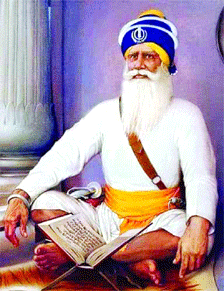
A Timeless Sikh Warrior & Spiritual Scholar
Inderjeet S Bhatia “Prince”
paramedicalcounciljammu@gmail.com
India’s history is enriched by countless figures who sacrificed their lives to uphold faith, dignity and justice. Among these towering personalities stands Dhan Baba Deep Singh Ji Shaheed, a revered Sikh saint-warrior whose life and martyrdom form an integral part of India’s spiritual and resistance traditions. Baba ji’s legacy transcends religion, representing the collective Indian ethos of courage in the face of oppression.
EARLY LIFE AND ASSOCIATION WITH GURU GOBIND SINGH JI
Baba Deep Singh Ji was born on 26th January , 1682 in Pahuwind village, located in present-day Tarn Taran district of Punjab. From an early age, Baba ji displayed deep spiritual inclination and a disciplined lifestyle. Drawn by the teachings of Sikh Gurus, he reached Anandpur Sahib, where he came under the direct guidance of Sri Guru Gobind Singh Ji, the Tenth Sikh Guru.
At Anandpur Sahib, Baba Deep Singh Ji was trained in both spiritual wisdom and martial skills, in accordance with the Sikh doctrine of MIRI-PIRI -the balance of temporal authority and spiritual responsibility. Guru Gobind Singh Ji envisioned Sikhs as protectors of righteousness, and Baba Deep Singh Ji emerged as a prime example of this philosophy.
SCHOLAR, TEACHER AND PRESERVER OF SIKH SCRIPTURE
While widely remembered for his battlefield valour, Baba Deep Singh Ji was also a distinguished scholar. He acquired proficiency in Gurmukhi, Persian and Sanskrit, enabling him to engage deeply with Sikh religious literature and contemporary intellectual traditions. He played a significant role in the preparation and preservation of handwritten copies of SRI GURU GRANTH SAHIB JI, ensuring the sanctity and accuracy of Sikh scripture. Later, Baba Deep Singh Ji was entrusted with the leadership of Damdama Sahib, one of Sikhism’s five Takhts, which served as a major centre for religious learning and dissemination of Sikh teachings.
In an era of political turbulence, his work helped preserve India’s pluralistic spiritual heritage and ensured continuity of Sikh thought for future generations.
HISTORICAL CONTEXT: FOREIGN INVASIONS AND RELIGIOUS PERSECUTION
The mid-18th century was a time of great upheaval in northern India. Repeated invasions by Afghan ruler Ahmad Shah Abdali brought destruction, instability and religious persecution. Sikh shrines were targeted, and the Sikh community faced systematic repression.In 1757, news reached Baba Deep Singh Ji that SRI HARMANDIR SAHIB (GOLDEN TEMPLE) at Amritsar had been attacked and desecrated by Afghan forces. For Sikhs, this act was not merely a physical assault but an attempt to undermine religious freedom and cultural identity. Despite his advanced age, Baba Deep Singh Ji resolved to lead a group of Sikhs toward Amritsar to reclaim the sanctity of the shrine. Before departing, he made a solemn vow that he would either reach Sri Harmandir Sahib or lay down his life in the attempt.
THE MARTYRDOM THAT SHAPED HISTORY
The decisive battle took place near Ramsar, on the outskirts of Amritsar on 13TH November, 1757 .In this fierce combat, Baba Deep Singh Ji suffered a grievous blow to the neck. According to Sikh historical tradition, Baba ji continued advancing toward the Golden Temple while holding his severed head, ultimately attaining martyrdom near the holy complex.
This episode, symbolic of ultimate sacrifice and spiritual resolve, has become one of the most powerful narratives in Indian history. It reinforced the Sikh commitment to protect religious institutions and resist tyranny, inspiring generations of freedom-loving people across the subcontinent.
Today, the site of his martyrdom is commemorated by GURDWARA SHAHEED BABA DEEP SINGH JI, which attracts devotees from across India and abroad.
ENDURING LEGACY AND NATIONAL RELEVANCE
Baba Deep Singh Ji’s sacrifice strengthened Sikh resistance and contributed to the eventual emergence of Sikh sovereignty in Punjab. His life embodies values deeply rooted in India’s civilisational ethos-self-sacrifice, moral courage, spiritual discipline and resistance to injustice.
In modern India, his legacy continues to resonate. At a time when unity, tolerance and constitutional values are vital, Baba Deep Singh Ji stands as a reminder that faith and courage, when guided by ethical principles, can defend both freedom and human dignity.
CONCLUSION:
Dhan Baba Deep Singh Ji Shaheed was not merely a Sikh hero but a national figure whose life forms part of India’s shared historical memory. His story underscores the role played by spiritual warriors in safeguarding India’s cultural and religious diversity.
As India remembers its past to shape its future, the life and martyrdom of BABA DEEP SINGH JI continue to inspire generations to stand firmly for Truth, justice and the sanctity of faith.
 Follow our WhatsApp channel
