

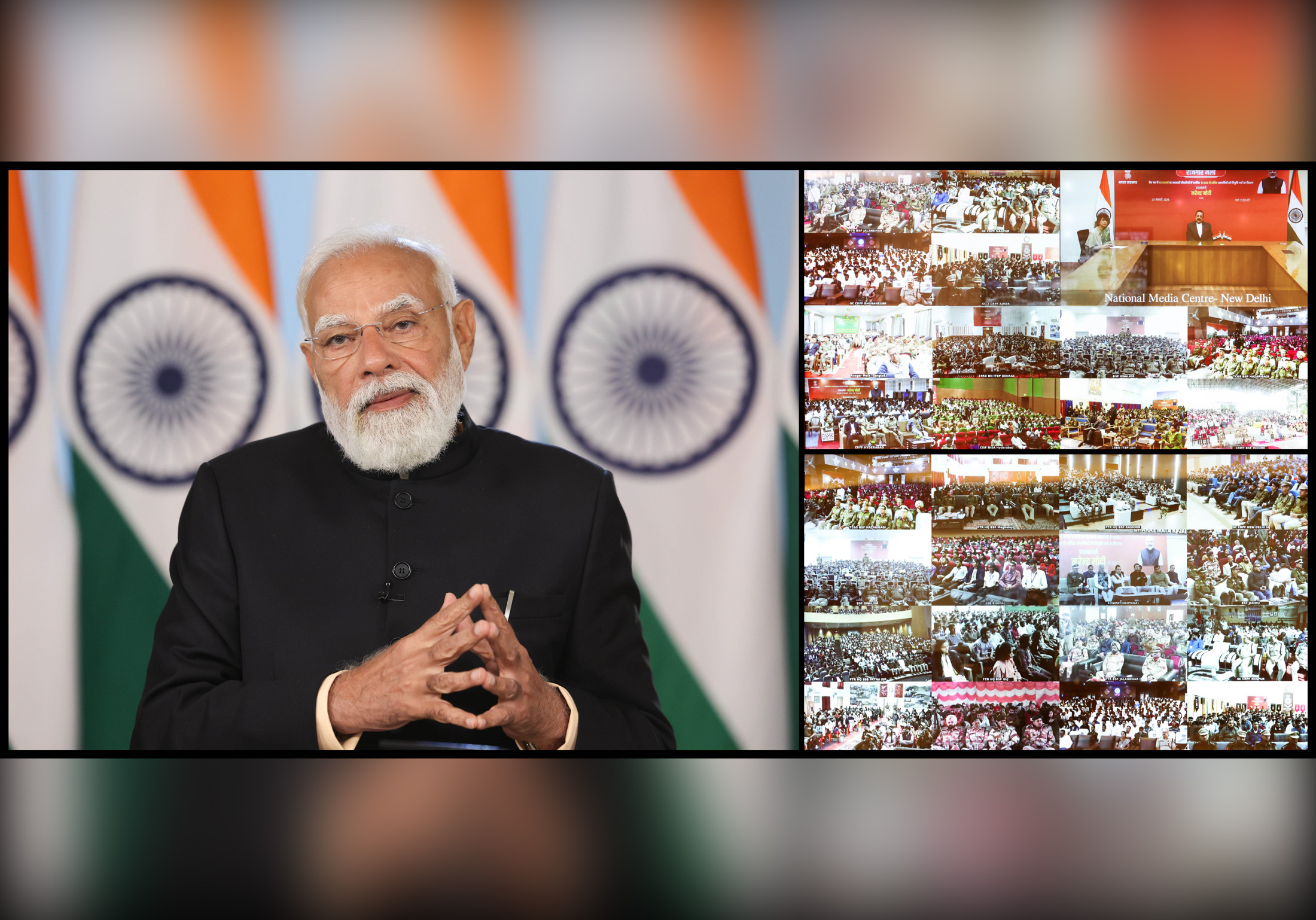
NEW DELHI, Jan 24 : More than 20 lakh long-pending promotions have been cleared in the last 11 years, ending a prolonged phase of stagnation that once saw many government employees retire from the same post at which they were appointed, Union Minister of State for the Ministry of Personnel, Public Grievances and Pensions, Dr. Jitendra Singh, said while delivering the welcome address at the 18th Rozgar Mela today.
At the 18th edition of the Rozgar Mela, more than 61,000 appointment letters were issued with the press of a button, of which 49,225 relate to the Ministry of Home Affairs and the central armed police forces. Drawing attention to the growing induction of women constables, Dr. Jitendra Singh said enabling provisions introduced over the past 11 years have led to increased participation of women in security forces. He noted that women personnel are now deployed even along the zero line on the border in the Border Security Force, and that at the Republic Day parade on January 26, an all-male CRPF contingent will be led by a woman Assistant Commandant.
Referring to promotions, Dr. Jitendra Singh said the clearance of over 20 lakh cases reflects a broader transformation in the government’s human resource management, alongside faster recruitment and greater transparency. He said these steps have addressed long-standing concerns related to career progression within government services.
The Minister recalled that the Rozgar Mela was conceptualised by Prime Minister Narendra Modi on October 22, 2023, with the objective of accelerating government hiring and making the recruitment process more efficient and fair.
Citing comparative data, Dr. Jitendra Singh said that appointments made through the three major central recruiting agencies — the Union Public Service Commission (UPSC), Staff Selection Commission (SSC) and Railway Recruitment Boards — have risen sharply. During the last decade (2004–14), these agencies together made 7.22 lakh appointments, whereas during the period since 2014, the number has increased by one-and-a-half times to 10.96 lakh.
Referring to backlog vacancies related to reserved categories, the minister said that while only 1.08 lakh such appointments were made earlier, the figure has increased nearly four-fold to 4.79 lakh over the last 11 years. He said these measures have helped address delays and inequities in government recruitment and representation.
Dr. Jitendra Singh detailed several reforms aimed at making recruitment more candidate-friendly. The Staff Selection Commission has launched a new digital portal allowing candidates to choose preferred examination centres and dates, access answer keys and register grievances online. UPSC has introduced a unified one-time registration system integrated with Aadhaar and DigiLocker. For candidates with disabilities, guaranteed allotment of examination centres of their choice anywhere in the country has been provided. He also highlighted the “Pratibha Setu” initiative, under which candidates who qualify in final examinations but do not secure appointments are linked to alternative employment opportunities suited to their qualifications.
The minister said the success of the Rozgar Mela has encouraged several state governments to adopt similar initiatives, and emphasised that public sector jobs are only one part of a wider employment strategy. Under the Startup India initiative, over 2.08 lakh start-ups have been established, generating more than 21 lakh jobs. Under the Pradhan Mantri Mudra Yojana, 56.03 crore loans have been disbursed, with more than 60 per cent going to women. The Pradhan Mantri Street Vendor’s AtmaNirbhar Nidhi has benefited over 70 lakh street vendors, while under the Pradhan Mantri Vishwakarma scheme, 2,72,64,494 individuals engaged in traditional skills have registered to expand their livelihoods.
Dr. Jitendra Singh also highlighted higher inclusion of Scheduled Tribe candidates, stating that around 14.6 per cent of the appointees at this Rozgar Mela belong to the ST category, about double the prescribed reservation level, reflecting focused attention on tribal communities.
Concluding his address, Dr. Jitendra Singh said that policies today are being framed with the goal of a developed India in mind, and that the youth receiving appointment letters would be at the peak of their careers and energy in 2047, when the country marks 100 years of Independence. He said their contribution would shape the country’s long-term development trajectory.
 Follow our WhatsApp channel
