

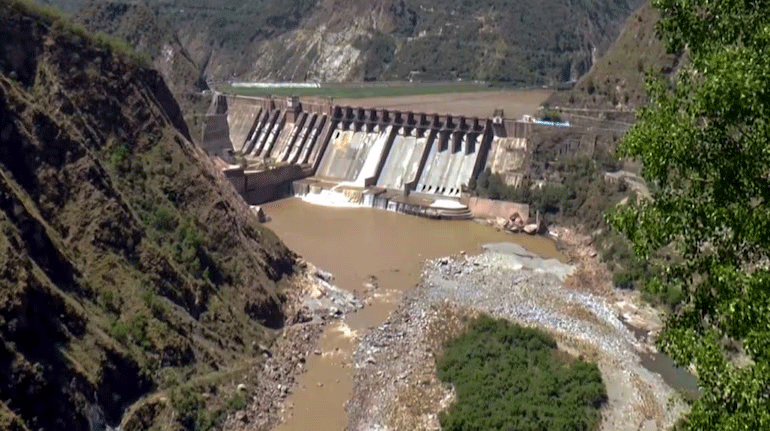
New Delhi : (Jan 21) With India refusing to budge on the Indus Waters Treaty suspension, concern is mounting in Pakistan. Islamabad has now said that India’s move has triggered an “unprecedented crisis” for its water security and poses risks to regional stability.
Usman Jadoon, Pakistan’s United Nations representative, described India’s decision as “weaponisation of water” and claimed that New Delhi’s actions breach the landmark 1960 treaty brokered by the global body.
India held the treaty in abeyance following the deadly Pahalgam attack on April 22, 2025 by a Pakistan-based terror outfit, which is an offshoot of Lashkar-e-Taiba.
Jadoon, who was addressing the Global Water Bankruptcy Policy Roundtable hosted by Canada, accused India of committing “several violations of the treaty”, claiming that it led to “unannounced disruptions of downstream water flows and the withholding of critical hydrological data”.
As per the treaty, India was allowed unrestricted use of all the water of the “eastern rivers” of the Indus system—Sutlej, Beas and Ravi. Pakistan, meanwhile, was allowed to receive water from the “western rivers”— Indus, Jhelum and Chenab.
From April 23, India stopped sending flood warning messages regarding the rivers to Pakistan, something that was normally shared by India every year, especially from July 1 to October 10. Other information sharing that has been stopped includes some irrigation statistics of the western rivers for the kharif and rabi seasons.
The Pakistani ambassador said that the treaty was a time-tested framework for equitable and predictable management of the Indus River basin.
Raising concerns over its suspension, he said that the basin provides over 80% of Pakistan’s agricultural water needs, supporting the livelihoods of over 240 million people.
He said “water insecurity” is a lived reality for people in Pakistan, noting that the country — a semi-arid, climate-vulnerable lower riparian — is grappling with floods and droughts, accelerated glacier melt, groundwater depletion, and rapid population growth, all of which are putting immense strain on already stressed water systems.
India’s decision to hold the treaty in abeyance had laid bare Pakistan’s water vulnerabilities, further exacerbated by its inability to store water efficiently.
Last year, Pakistan PM Shehbaz Sharif urged provinces to take steps to address the water security issue prompted by India’s actions.
Meanwhile, India decided to suspend the treaty as part of its new doctrine of dealing with terror emanating from Pakistani soil. In his address following Operation Sindoor, Prime Minister Narendra Modi on May 12 made it clear that India will not hold talks with Pakistan on Indus Waters Treaty (IWT) until the neighbouring country takes action on terrorists hiding in its country. He said that “blood and water” cannot flow together, outlining India’s austere stance. (Agencies)
 Follow our WhatsApp channel
