

Excelsior Correspondent
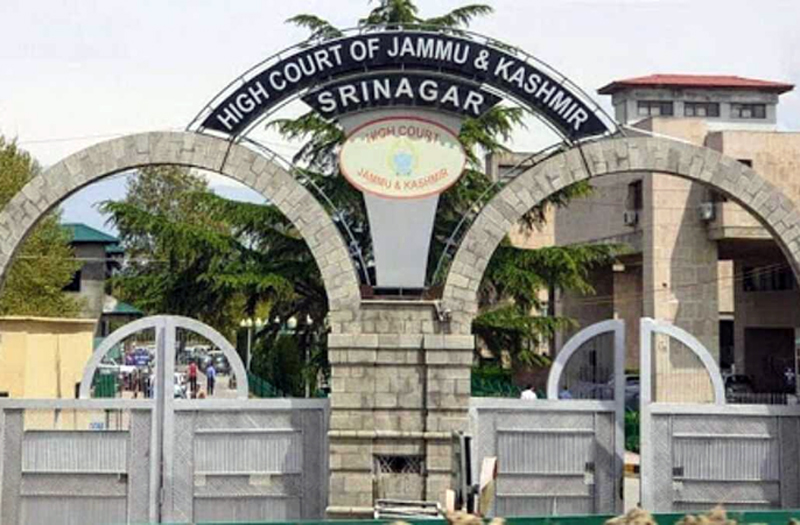
Srinagar, Jan 20: The High Court has ruled that action can’t be taken against a third party merely using the land with the permission from the landowner.
Justice Moksha Kazmi held that coercive action can’t be taken against a third party who merely used land with the permission from its recorded owner, especially when the statute invoked is inapplicable.
This has been held by the court in a plea challenging an order directing seizure of his building material and registration of an FIR for alleged encroachment of common land under the J&K Common Lands (Regulation) Act.
The court observed that the petitioner was not claiming ownership or title over the land and had acted on the authority of the recorded owner, whose ownership was reflected in the revenue records and admitted by him.
The building material had been stored on land recorded as ‘Gair Mumkin’ in the Revenue records with the consent of the recorded owner. The court noted that it was an admitted position that the Common Lands Act did not apply to the land in question, as it fell within the limits of Municipal Council, Udhampur.
The court further added that if the land in question, falls within the purview of J&K Common Lands, the official respondents are free to take recourse under the Act, if permissible. Even, name of Municipal Council, Udhampur is not reflected anywhere in the revenue record produced before this Court.
“The writ petition succeeds and is, accordingly, allowed. Consequently, the impugned order dated 04.03.2017 as against the petitioner is set aside”, the court concluded.
“Any action, if required, ought to have been taken against the recorded owner and not against the petitioner, and said the order under challenge as legally unsustainable”. The Court also rejected the argument that the land vested in the Government under the J&K Water Resources (Regulation and Management) Act, 2010, noting absence of any corresponding revenue entry or action under the Act.
The Court set aside the impugned order insofar as it related to the petitioner. The petitioner was seeking quashing of Order No.TUDR/OQ/16-17/2951-54 dated 04.03.2017, issued by the Water Resources Authority, directing there for visiting the spot and lifting and seizing of all building material owned by the petitioner.
It was also directed in the order under challenge to lodge FIR against the petitioner for allegedly encroaching upon the common land of the village/community in violation of apex court ruling.
The petitioner states that it is on the authority of the land owner that he had stored building material viz. iron rods, flat iron, and iron angle etc on the land in question and all of a sudden, the concerned authority, issued impugned notice alleging therein that the petitioner had dumped huge TMT bars, angles iron, pipes etc illegally on the land in question, which, according to the official respondents is a common land to be used by inhabitants of the locality/village, when the fact of the matter is the land pertains to a private person.
The official respondents stated that as per the Revenue record land under Khasra No.1 measuring 18 marlas is recorded in ownership column of Des Raj and others and in cultivation column of Khasra Girdawari as Des Raj as shareholder, but the nature of the said land is recorded as Gair Mumkin Talai.
On the other hand, the private respondent (land owner), in his objections, has stated that he is the owner in possession of land measuring 17/18 marlas recorded in the revenue record as Gair Mumkin Talai i.e. uncultivable pond, not a village common land or gram Panchayat land/Shamlat land, which fact is apparent from the Khasra girdawari of 1971 till 2016. He has also admitted that the petitioner has stored the building material on the land in question with his consent/authority, as he is the recorded owner of the said land.
“Regarding plea of counsel for representing Water Resources Authority that under the Jammu Act, the land in question vests in the Government, suffice it to say the record does not reflect any action taken under the said Act, because there is no such entry in the revenue record”, Justice Kazmi noted.
 Follow our WhatsApp channel
