

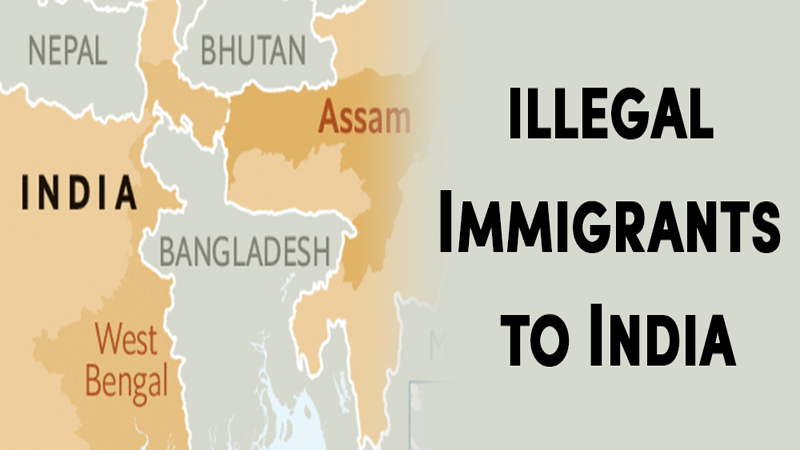
Illegal migration into India’s eastern border states, particularly West Bengal, is not a recent phenomenon. It has unfolded steadily over decades, largely unchecked, creating deep demographic, social, and administrative consequences. The most visible impact of sustained illegal migration is the alteration of demographic balance in several border districts. In parts of West Bengal, locals have increasingly found themselves numerically outpaced by illegal migrants, leading to cultural, linguistic, and social shifts. What was once gradual has now become stark, feeding anxieties about identity, security, and governance. Such demographic changes are not merely statistical; they reshape electoral politics, local power structures, and administrative priorities.
Complicating matters further is the gradual legalisation of this demographic invasion. Over the years, a large number of illegal migrants have obtained Aadhaar cards, voter IDs, and, in some cases, even Government jobs. Once embedded into official databases, identification becomes blurred, making corrective action politically sensitive and administratively complex. Despite repeated assurances and policy interventions by successive Governments, the ground reality has largely remained status quo. The strain on public resources is the net result. Welfare schemes, food security programmes, schools, hospitals, and employment opportunities are designed for legal Indian citizens. However, with illegal migrants increasingly integrated into local systems, these limited resources are being stretched far beyond intended capacity. This excessive sharing dilutes benefits meant for the poorest citizens, breeding resentment among locals who feel deprived in their own land.
The ongoing Special Intensive Revision of electoral rolls is an attempt to introduce some semblance of accountability. However, past experience, particularly in Bihar, suggests limited outcomes. Names may be struck off voter lists, but without accurate identification and deportation mechanisms, such exercises remain cosmetic. The Prime Minister’s assurance that stronger action would follow in West Bengal, therefore, carries significance, both politically and administratively. At this juncture, political parties must rise above vote-bank considerations and confront the issue as a national challenge. India already faces immense population pressures of its own, a point the Supreme Court has underscored in recent observations. The problem has lingered far too long and now demands a logical conclusion. The first imperative is to establish accurate data on illegal migrants. Only then can repatriation be meaningfully planned. Simultaneously, borders must be rendered impregnable; otherwise, the cycle of infiltration will continue unabated. Without sustained political will and coordinated action, the issue will remain unresolved.
 Follow our WhatsApp channel
