

Lokesh Dhar
dharlokesh@gmail.com
Jammu & Kashmir today sits at the intersection of water, power, and geopolitics. With nearly 15 GW of assessed hydropower potential most of it concentrated in the Chenab basin the Union Territory holds one of South Asia’s most consequential energy endowments. Yet for decades, this natural abundance translated into scarcity on the ground. What has changed since 2025 is not merely execution speed, but a decisive break from the policy paralysis that defined earlier political dispensations.
J&K’s rivers the Chenab, Jhelum, and Ravi together offer 14,867 MW of hydropower potential, of which 11,283 MW lies in the Chenab basin alone. Despite this, operational capacity entering 2026 stands at just 3.36-3.54 GW, barely a quarter of what is technically feasible. The consequences were economically irrational. Each winter, J&K imported 1,500-2,000 MW of electricity from the national grid, spending Rs 3,000-4,000 crore annually, while earning only Rs 400-500 crore from hydropower royalties and free power allocations. The region exported raw water but imported costly energy-an inversion sustained not by geography, but by political indecision.
While difficult terrain and decades of terrorism played a role, the most binding constraint was governance failure under successive UPA Governments and their local partners. During this period, hydropower development became hostage to bureaucratic caution, fear of Pakistani objections, and an absence of strategic resolve. Between 2004 and 2014, when the Indian National Congress led the Union Government and governed J&K in alliance with the National Conference, hydropower policy stagnated despite favourable technical assessments. There was no expansion of storage-based capacity even where it was technically permissible, repeated acquiescence to Pakistani objections that delayed projects such as Baglihar, Kishanganga, and Ratle for years, weak bargaining on royalty structures that left J&K fiscally dependent despite bearing social and ecological costs, and no serious strategic push to renegotiate or reinterpret the Indus Waters Treaty even as Pakistan actively weaponised dispute-resolution mechanisms. This was not treaty compulsion alone; it was political risk aversion. Instead of treating hydropower as a strategic asset, UPA-era policy reduced it to a diplomatic liability, resulting in a lost decade for Chenab Valley development.
The April 2025 decision to place the Indus Waters Treaty in abeyance marked a structural rupture with this legacy. By suspending notification, inspection, and dispute-settlement obligations, New Delhi dismantled the procedural vetoes that had paralysed hydropower construction for six decades. The timing proved decisive. During Operation Sindoor in May 2025, coordinated flushing at Baglihar and Salal temporarily reduced downstream Chenab flows by an estimated 20-30 per cent.
Though short-lived, the episode demonstrated a new reality: operational discretion over timing and sequencing of releases now rests upstream. For Pakistan whose Punjab heartland depends on Indus waters for 70-80 per cent of irrigation the signal was unmistakable. Water had entered the deterrence equation, not as denial, but as uncertainty.
Even under treaty-era constraints, J&K’s legacy hydropower assets Salal, Baglihar, Dulhasti, Kishanganga, and Uri generate 12-14 billion units annually and provide critical peaking support to North India. Yet these projects also expose the failure of earlier policy choices. Designed with minimal pondage to appease external objections, they delivered electricity but denied leverage. J&K absorbed displacement, ecological stress, and political unrest without receiving commensurate economic or strategic returns.
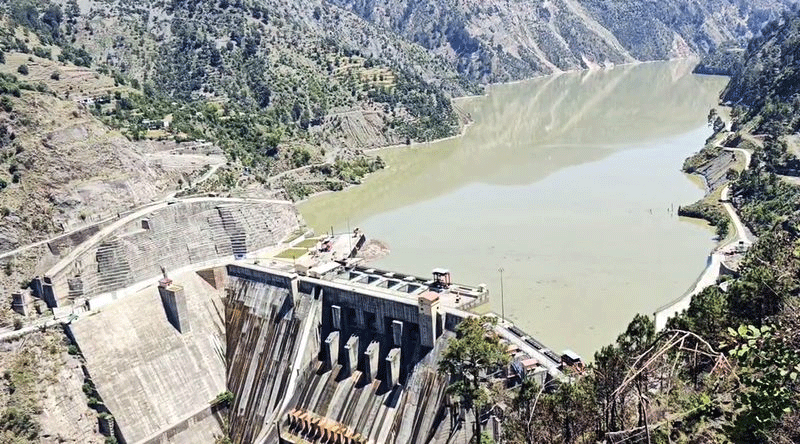
Post-2025, the Chenab region has emerged as India’s most intensive hydropower construction zone. Projects stalled for years are now advancing simultaneously. Between 2026 and 2029, 4-5 GW of additional capacity is expected from Pakal Dul, Kiru, Kwar, Ratle, and Dulhasti-II, with Sawalkote positioned as the next mega-stage. This is no longer a collection of isolated dams, but an integrated system of reservoirs. Once complete, it could add 20 billion units annually, raise hydropower royalties to ?1,200-1,500 crore, and convert J&K from a chronic power importer into a net exporter to the northern grid.
The most consequential shift, however, is strategic. Sequential reservoirs along the Chenab allow India to influence when water moves downstream, even if how much remains hydrologically constrained. Monsoon surges can be absorbed, winter flows timed, and maintenance or flushing cycles synchronised without third-party veto. This is not weaponisation of water. It is the exercise of state capacity that was conspicuously absent during the UPA-Congress-NC era.
The irony is sharp. Displacement, ecological stress, and political contestation now blamed on “rapid development” are in fact the deferred costs of earlier inaction. Had these projects been executed on schedule a decade earlier, today’s social and environmental pressures would have been far more manageable.
The Chenab is no longer just a river flowing out of the Himalayas; it is an engineered system embedded in India’s energy security and South Asia’s strategic balance. For Jammu & Kashmir, this marks a delayed but decisive transition from hydropower paradox to hydropower sovereignty. For India, it underscores a hard lesson: treaties do not weaken states – indecision does. The real failure was not geography or international law, but the absence of political will during years when Congress-led governments chose caution over capacity.
(The author is a Jammu & Kashmir-based policy consultant and political analyst.)
 Follow our WhatsApp channel
