

Chancellor Merz’s Visit
Dr. D.K. Giri
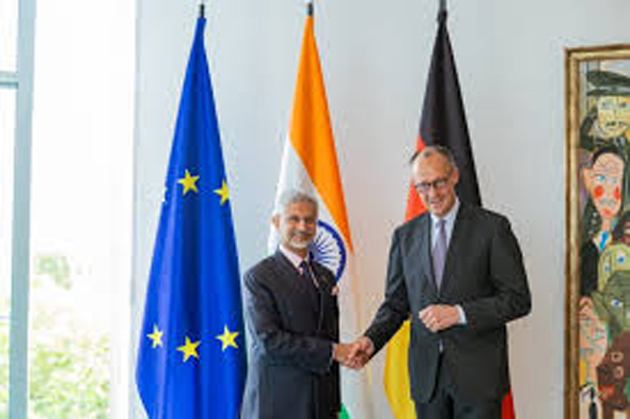
German Chancellor Friedrich Merz two-day visit to India marked a significant milestone in the bilateral relations. Accompanied by 23 CEOs of German companies from various sectors, Merz landed in Ahmedabad on 12 January. Having spent a full day in multiple events, in the company of Indian Prime Minister Narendra Modi, the Chancellor flew to Bengaluru. The intent and composition of the delegation was reflected in signing number of MoUs and Joint Declaration of Intents which aimed at strengthening economic, technological and security cooperation between the two countries.
For Chancellor Merz, it was his first trip to India and Asia as the Head of the German Government. Merz chose India for his first Asian trip as Chancellor, indicating a shift in strategy among European leaders, who previously focused on China. Prime Minister Modi, however, pointed out that Chancellor Merz’s visit coincided with India and Germany acknowledging 25 years of strategic partnership and 75 years of diplomatic relations between two countries. New Delhi is also preparing to receive the EU leaders as the guests in the ensuing Republic Day parade. Their visit should coincide with the India-EU summit later this month. Soon after, the French President Emmanuel Macron is visiting India.
The new year seems to be starting with bonhomie between Indian and the European leadership. German Chancellor suggested that India and the EU could be concluding the FTA by the end of January. Germany being the largest economy in the Union, German Chancellor’s voice carries considerable weight. The strategic shift in German foreign and trade policy could be detected in Chancellor’s poignant remarks that the world is experiencing “a renaissance of unfortunate protectionism” that harms Germany and India. He did not name any country, but the reference was obvious.
While the United States has imposed heavy tariff on trading partners, China introduced export controls on minerals used in auto manufacturing causing months of supply chain disruption last year due to the US-China trade war. This has badly affected German car makers. Germany has signalled diversification of its trade and search for alternatives to Chinese exports and market. More than once, the German leadership have revealed their preference for India as a democratic alternative to Chinese authoritarian state. Germany has also expressed interest in building trade relations with India, treating latter as a new source of supply chain.
That said, Germany has not been able to divert its trade away from China with its bilateral trade pegged at 287b USD in 2024-25, compared to 50b USD with India in the same year. Germany remains the largest trading partner of China, whereas Germany is the largest trading partner of India in Europe. The delay in German disinvestment from China and in deepening trade and economic ties with India may be attributed to the strategic divergence between India and Europe that includes Germany on the war in Ukraine.
While Europe treats Russia as the main security threat, New Delhi puts China on the table as an aggressive and aggrandising neighbour. Germany is yet to take a concrete call on its attitude towards China, if Bonn wants to have strategic partnership with New Delhi. The geo-political approach has to be matched with trade and economic strategy. Admittedly, Germany has pursued a China plus strategy to reduce the excessive dependence on a single partner. Its trade with China is declining reflecting both emerging challenges in political engagement and Germany’s diversification efforts.
Chancellor Merz may have overstepped as he decided to characterise the growing India-German defence relationship as a means to reduce New Delhi’s dependence on Russian defence hardware. At the same time, the MoUs and JDIs included strengthening bilateral defence industrial cooperation, a semi-conductor eco system partnership, cooperation on critical minerals and the bio-economy, a roadmap for higher education, easier visa access for health professionals, India-Pacific and scaling up triangular development cooperation in third countries.
The key highlights of the visit include defence cooperation: both countries signed a Joint Declaration of Intent to develop a defence industrial cooperation roadmap, focusing on long-term technology partnerships, co-development and co-production of defence equipment. In trade and economy, the two countries aim to conclude the India-EU Free Trade Agreement by the end of January which should also boost bilateral trade. On critical technologies, agreements were signed on semi-conductor, eco-system development, critical minerals and telecommunications, underscoring the growing cooperation in critical and emerging technologies. Germany will contribute technology, funding for equipment manufacturing, precision engineering and work force training.
On critical minerals, a JDI was signed focussing on exploration, R&D, processing, recycling as well as acquisition and development of critical mineral assets in both countries as well as third countries. Both the countries emphasised on collaboration on internet and data governance, AI and emerging technologies. Agreements were signed on green hydrogen, renewable energy, climate-resilient urban infrastructure with Germany contributing 1.24b Euro under the Green and Sustainable Development Partnership.
A major off-take deal was signed between India’s AM Green and Germany’s Uniper Global Commodities for the supply of green ammonia. On space cooperation, the Indian Space Research Organisation (ISRO) and the German Space Agency (DLR) agreed to enhance Space Industry Level Engagements.
The visit underscores the growing importance of India-Germany relations with Germany emerging as India’s strategic and trade partner. Strengthened bilateralism between India and Germany automatically leads to deepening India-EU ties. Faced with the capricious US trade and security policies, mainly diluting NATO and the traditional trade ties with Europe, Germany and European Union are looking for new partners. While China remained for a long time the strongest trade partner of Germany and the EU, this may no longer be the case for at least two reasons, one, the growing trade and strategic rivalry between the US and China, and the ‘systemic threat’ posed by Beijing.
Germany and the EU will have no other option than giving up their China obsession while correspondingly reducing their trade with the country. In that scenario, India emerges as the strongest candidate for an alternative to China. This has been a potent expectation but has not been transformed into reality. With the visit of German Chancellor followed by the India-EU Summit, the strategic shift in Europe should reflect in the deliberations between and EU, conclusion of the long-awaited FTA, and European Union using New Delhi to pivot to India-Pacific region.
In India-EU exchanges in the past, China was the elephant in the room, but now it is Russia, and US as well. So, the eyes of the world powers will be focused on the India-EU Summit later this month. New Delhi is certainly bracing up for it and should not let this opportunity slip out of hand.—INFA
 Follow our WhatsApp channel
