

Refusal Is the Rule, Bail an Exception
Ranbir Singh Pathania
rspathanimla@gmail.com
Amid a cacophony of dissenting voices and competing constitutional commentaries surrounding the denial of bail to prime accused in the 2020 North-East Delhi riots case, the Supreme Court of India has delivered a judgment of considerable legal and institutional consequence. The ruling does not merely decide individual bail pleas; it re-calibrates the jurisprudential compass governing bail in terror-related offences and, in doing so, quietly but firmly reaffirms India’s policy of zero tolerance towards terrorism in all its contemporary forms.
By denying bail to key accused Umar Khalid and Sharjeel Imam, while simultaneously granting conditional bail to five other co-accused-Gulfisha Fatima, Meeran Haider, Shifa-ur-Rehman, Mohd. Saleem Khan, and Shadab Ahmad-the Court underscored a vital constitutional truth: liberty is individual, culpability is graded, and national security is paramount.
The refusal of bail was grounded in a sober reading of the Unlawful Activities (Prevention) Act, 1967 (UAPA) and an accused-specific appraisal of the evidentiary material placed before the Court. The verdict thus steers clear of both absolutism and appeasement.
A Contextual Interpretation of “Terrorist Act”
At the heart of the judgment lies the Court’s purposive and contextual interpretation of Section 15 of the UAPA, which defines a “terrorist act.”
Beyond Conventional Violence
The Court clarified that terrorism under the UAPA is not confined to conventional imagery of guns, bombs, or explosives. The statutory language-“by any other means of whatever nature”-was rightly read as encompassing non-traditional, indirect, and orchestrated methods that threaten public order, national integrity, or essential civic life.
Intent and Effect Over Instrumentality
What matters is not merely the weapon employed, but the intent, design, and impact of the act. Coordinated disruptions, when prima facie shown to be part of a larger conspiratorial architecture aimed at destabilising society, may legitimately fall within the statutory ambit of terrorism. The law, therefore, extends to those who conceptualise, mobilise, and engineer the build-up to such acts.
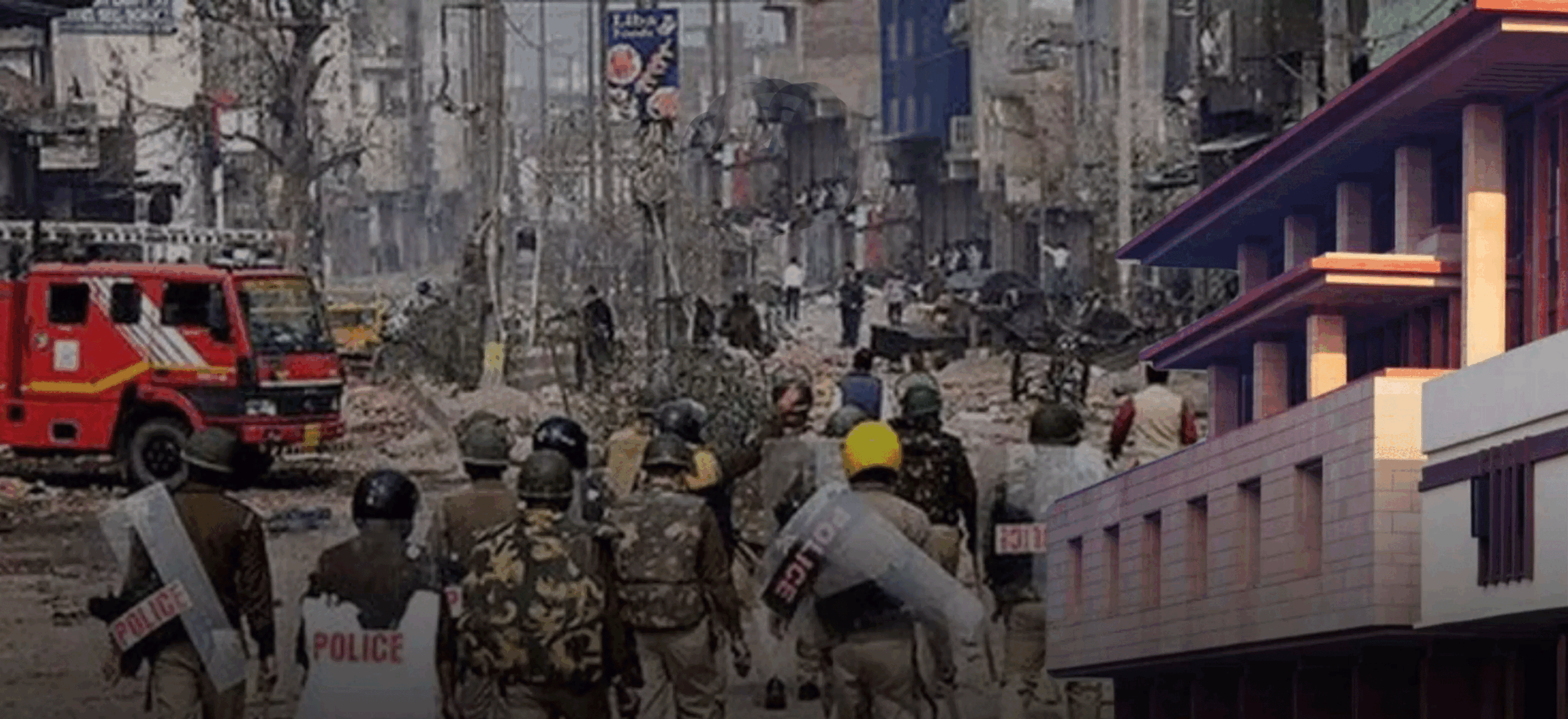
The Court’s reasoning resonates with lived experience: the CAA protests, which initially claimed constitutional dissent, ultimately degenerated into violent riots-fuelled by incendiary slogans, digital mobilisation, and targeted disruption of civic life. Democracies protect protest; they cannot legitimise chaos masquerading as dissent.
The Statutory Architecture of Bail under UAPA
The judgment reaffirms the stringent legislative design of Section 43D(5) of the UAPA, which places a high threshold for the grant of bail.
Once the Court is satisfied, on a prima facie evaluation, that the accusations are true, judicial discretion stands statutorily curtailed. This is not judicial abdication; it is legislative command-one consciously enacted to deal with offences posing existential threats to the State.
This marks a necessary evolution in bail jurisprudence, shaped by the realities of modern terror networks where planning, propaganda, and psychological mobilisation are as lethal as physical violence.
Hierarchy of Culpability: A Nuanced Judicial Approach
A defining feature of the verdict is the Court’s recognition of a hierarchy of culpability.
The Bench of Justices Aravind Kumar and N.V. Anjaria distinguished between:
Central and formative actors, alleged to have conceptualised and steered the conspiracy, and
Peripheral participants, whose roles, though not exculpatory, did not cross the statutory threshold justifying continued incarceration.
This accused-specific inquiry rejects any mechanical application of UAPA’s bail embargo and preserves the constitutional requirement of individualised justice, even within a stringent statutory regime.
Delay Is Not a Trump Card
The Court decisively held that long incarceration and trial delays, though regrettable, do not automatically entitle an accused to bail under UAPA. For those alleged to be the “masterminds” of terror-linked conspiracies, the gravity of the offence and the statutory bar outweigh the factor of delay.
In doing so, the Court clarified the limited and exceptional nature of precedents such as Union of India v. K.A. Najeeb, reaffirming that the right to speedy trial cannot be converted into an unconditional escape hatch from a carefully crafted anti-terror statute.
Public Interest and the Sovereign’s Duty
The reasoning aligns with long-standing judicial principles where public interest supersedes individual liberty in exceptional circumstances.
In State (CBI) v. Anil Sharma (1997), the Supreme Court denied anticipatory bail in a major corruption case, emphasising that custodial interrogation is qualitatively different from questioning a protected accused. This principle was later echoed in serious economic offences, including decisions of the J&K High Court upheld by the Supreme Court.
If such considerations apply to financial fraud, they apply with greater force to terror-related offences, where the threat is not merely economic loss but the destabilisation of the constitutional order itself.
Conclusion
The Supreme Court’s verdict reflects a mature constitutional balance: firm against terror, fair to liberty, and faithful to the rule of law. It sends an unmistakable message that India will not be soft on terrorism-whether it manifests through brute violence or through meticulously orchestrated civil disruption-while remaining anchored to democratic values.
Law, like society, is never static. Jurisprudence evolves with changing social realities, political challenges, and international threats. Laws endure not because they are rigid, but because they are capable of protecting civilisation itself-keeping societies intact, nations stable, and freedoms meaningful.
As the maxim aptly reminds us:
“Salus populi suprema lex esto” – the welfare of the people shall be the supreme law.
That, ultimately, is the constitutional promise this judgment seeks to uphold.
(The columnist is member of Legislative Assembly of J&K)
 Follow our WhatsApp channel
