

Suhail Bhat
SRINAGAR, Jan 11: Farmers extracting lotus stems from Dal Lake in Srinagar say falling harvests, rising health risks, and worsening working conditions are threatening one of Kashmir’s most important aquatic crops.
Known locally as Nadru, the lotus stem has supported livelihoods around the lake for generations and remains central to Kashmiri cuisine. Cultivators, however, warn that deteriorating water quality, untreated sewage, and invasive plant growth are putting its survival at risk.
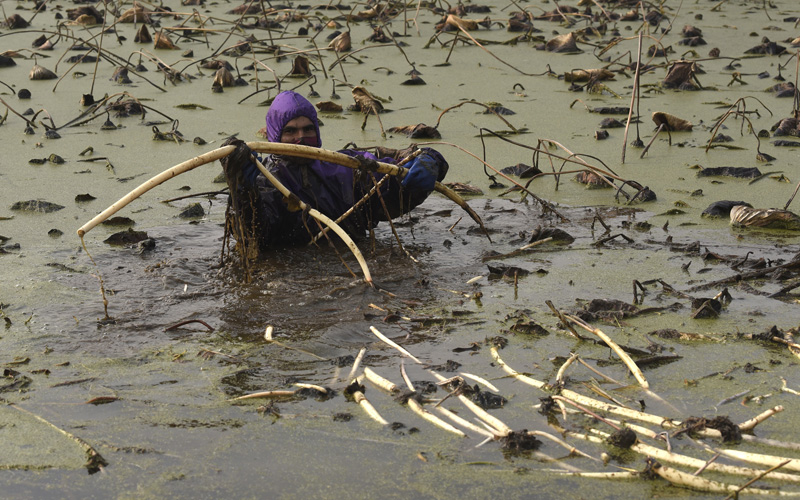
Amid the ongoing Chilai Kalan, Kashmir’s harshest winter period, farmers enter Dal Lake early in the morning and wade into sub-zero waters in search of lotus stems buried beneath thick lake filling. Working for hours in freezing conditions, they rely on bare hands and traditional tools to extract the crop.
Once abundant, Nadru has become increasingly difficult to find. Pollution and unchecked urban growth have altered the lake’s ecology, threatening a livelihood that once sustained hundreds of families.
Firdous Ahmad, who has been extracting Nadru for the last 12 years, said the decline is visible each season. “This lake is our lifeline, but the water quality keeps getting worse. If this decline continues, Nadru will not survive,” he said.
Ahmad said families dependent on the lake are worried about their future. Despite government efforts, he said waste continues to flow into the lake, while returns remain low. “The hard work we put in is not reflected in the prices we get,” he added.
Sixty-year-old Hajji Mohammad Abbas, who has cultivated lotus stems for nearly six decades, said Nadru cannot survive in polluted water. He explained that traditional cultivation relies on natural regeneration, with seeds left behind after harvesting and aquatic grass known as chass used as manure.
Lotus begins growing in early April, matures by mid-September, and is harvested through winter until spring. In compact soil, farmers work by hand, while in looser soil they use a traditional tool called Kaeshum (a long hooked wooden rod), which requires years of practice.
Abbas said production has dropped by more than 50 percent, from about 750 kilograms per kanal to less than half that amount. He also linked pollution to growing health problems among lake workers, including chest infections, diarrhoea, and eye ailments. “Earlier, we never faced such illnesses,” he said, adding that a neighbour recently lost an eye due to a severe infection.
Environmental scientist Dr. Akhter Malik said Dal Lake had healthy lotus production three to four decades ago, before rapid urbanisation. “Large volumes of untreated waste now enter the lake, causing eutrophication and the spread of invasive weeds,” he said.
“These weeds have taken over areas that once supported lotus,” Malik said, calling Nadru an indicator species. “Its decline shows how badly the lake’s ecosystem has been damaged.” He added that the quality of lotus stems today is inferior to that of earlier decades.
 Follow our WhatsApp channel
