

Ravi Rohmetra
ravirohmetra@gmail.com
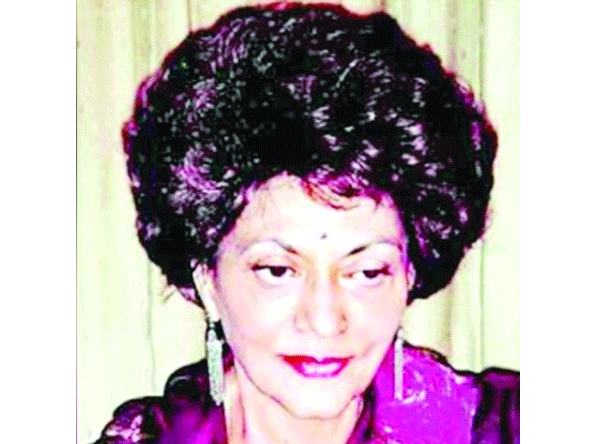
Maharani Yasho Rajya Lakshmi was a rare blend of grace, compassion, and dignity. Endowed with a charming disposition and deep empathy, she touched the lives of people across social and economic strata. Her kindness towards the poor, widows, orphans, and the differently abled was not ceremonial but heartfelt, and social service became her lifelong mission.
24 May 2009 remains one of the saddest days for the people of Jammu and Kashmir, Delhi, and Nepal. On this day, Maharani Yasho Rajya Lakshmi, the wife of Dr. Karan Singh, Padma Vibhushan awardee and former Sadr-e-Riyasat of Jammu and Kashmir, left her mortal frame and attained eternal peace. On her death anniversary, her life and legacy evoke deep reverence and gratitude for her immeasurable contribution to society.
Born on 9 January 1937 into the illustrious Rana family of Nepal, Maharani Yasho Rajya Lakshmi was the granddaughter of Sir Mohan Shamsher Jang Bahadur, the last Rana Prime Minister of Nepal, and daughter of General Sharda Shamsher Singh. Raised in a royal yet disciplined environment, she imbibed values of humility, responsibility, and compassion from an early age. At the tender age of 13, on 5 March 1950, she was married to Prince Karan Singh of the Dogra royal family of Jammu, son of Maharaja Hari Singh.
The marriage symbolically united two historic royal lineages-Nepal’s Sisodia and Jammu’s Kachawaha traditions. Despite linguistic, cultural, and social differences, Maharani Sahiba adapted with remarkable ease and grace. Though initially a Nepali-speaking young girl, she soon mastered Dogri, Hindi, and English, becoming an accomplished hostess and a dignified representative of the Dogra royal household. Her refined conduct and simplicity endeared her to people from all walks of life.
Maharani Yasho Rajya Lakshmi dedicated her life to public welfare, especially the upliftment of women, children, and marginalized sections of society. She worked relentlessly for the welfare of widows, orphans, the blind, deaf and dumb, mentally challenged children, and economically weaker sections, both in Jammu and Kashmir and in Delhi. Her work was marked by sincerity and personal involvement rather than formality or publicity.
She served as Chief of the Jammu and Kashmir Social Welfare Board and was closely associated with numerous charitable and social institutions. These included women’s industrial units, hospital welfare societies, organizations for the deaf and dumb, and institutions for mentally challenged children. She also played an active role in the Dharmarth Trust, the Maharaja Gulab Singh Memorial Trust, and several women-centric initiatives. Her ability to manage multiple institutions with efficiency and empathy reflected her exceptional organizational skills.
During the Indo-Pak War of 1965, Maharani Sahiba extended unwavering support to Indian Army personnel. She spent long hours with soldiers under trying circumstances, distributing essential supplies and offering moral support. Her presence during those difficult times left a lasting impression on the armed forces and the public alike.
A deeply religious person and a devotee of Maa Durga, Maharani Yasho Rajya Lakshmi believed in spiritual service alongside social work. In 1979, she and Dr. Karan Singh installed the idol of Natraj in the Raghunath Temple complex in Jammu, reinforcing the region’s rich spiritual heritage. She remained closely connected to the cultural and religious sentiments of the Duggar land throughout her life.
She was also a constant companion to Dr. Karan Singh during his long and demanding public life, including election campaigns in Udhampur and Kathua. Her ability to connect naturally with women, elders, and grassroots communities significantly strengthened public support for her husband.
Several memorials stand today as reminders of her legacy. On 24 May 2012, Yasho-Karan Park was inaugurated near the historic Rabireshwar Temple in Jammu. In 2013, a Shiv Mandir was reconstructed at Kankhal, Haridwar, along with the establishment of the Maharani Yasho Rajya Lakshmi Sanskrit Pathshala. These monuments continue to reflect her commitment to culture, education, and spirituality.
Maharani Yasho Rajya Lakshmi’s demise was a profound personal and collective loss. For nearly six decades, she enriched the social and cultural life of Jammu and Kashmir with her presence, elegance, and moral strength. Though she is no longer with us physically, her ideals, compassion, and selfless service continue to guide and inspire society.
She remains, in every sense, a queen with a difference-a timeless symbol of dignity, service, and humanity.
 Follow our WhatsApp channel
