

By T N Ashok
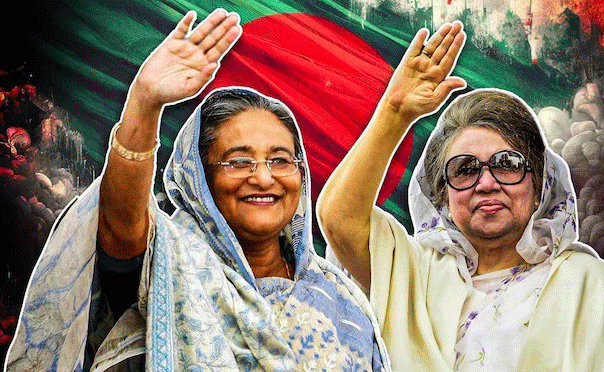
By the end of 2025, Bangladesh finds itself without the two women figures who defined it. With the death of Khaleda Zia at 80 and the exile of Sheikh Hasina after her dramatic fall from power, Bangladesh has entered a political interregnum unlike any it has known since independence.
For more than three decades, the country’s fate was shaped—some would say trapped—by the rivalry of two women whose lives were forged in assassination, grief, and inherited power. Now, in a short but turbulent period of just six months, both are gone from the stage. What remains is a nation searching for authority, legitimacy, and direction.
Khaleda Zia’s passing on December 30 closed the final chapter of what Bangladeshis long called the era of the “battling Begums.” Her rival, Sheikh Hasina, once the most powerful woman in South Asia, now lives in political exile in India, sentenced to death in absentia by a Bangladeshi court following her violent crackdown on student protests in 2024. Between them lies a vacuum—dangerous, uncertain, but also pregnant with possibility.
Khaleda Zia and Sheikh Hasina were not born politicians. They became political symbols because history left them little choice. Khaleda was a shy homemaker until 1981, when her husband, President Zia-ur-Rahman, was assassinated in a failed military coup. Hasina’s fate was sealed earlier: in 1975, her father, Sheikh Mujibur Rahman—the founding leader of Bangladesh—was murdered along with most of his family. Hasina survived only because she was abroad.
These parallel tragedies did more than define their personal lives; they hardened their politics. Each woman came to see the other not merely as a rival but as an existential threat to her family’s legacy—and, by extension, to the nation itself.
In the late 1980s, there was a fleeting moment when that animosity gave way to cooperation. Khaleda and Hasina joined forces to lead a mass uprising against military ruler Hussain Muhammad Ershad. Their alliance helped topple the dictatorship in 1990 and restore parliamentary democracy. It was the last time they would stand together.
From 1991 onward, Bangladesh became a country governed by rotation rather than resolution. Khaleda ruled from 1991 to 1996, lost power, returned triumphantly in 2001, and exited again in 2006. Hasina alternated in between, then dominated politics after returning to office in 2009, ruling uninterrupted until 2024.
Each woman claimed democratic legitimacy; each accused the other of corruption, authoritarianism, and betrayal. Courts became political weapons. Elections turned into zero-sum contests. Parliament hollowed out as boycotts became routine. Governance often took second place to survival.
Yet their rule also delivered stability of a kind. Under Hasina, Bangladesh posted strong economic growth, expanded infrastructure, and improved social indicators. Under Khaleda, parliamentary democracy was restored, foreign investment encouraged, and primary education expanded. The problem was not the absence of achievement—but the absence of trust.
That brittle equilibrium finally collapsed in August 2024. Student-led protests against rising authoritarianism, economic inequality, and political repression spread rapidly across the country. Hasina’s government responded with force. Dozens were killed. The violence triggered mass outrage, defections within the state, and ultimately her ouster.
Hasina fled the country and eventually surfaced in India, where she remains in political exile. A Bangladeshi court later sentenced her to death in absentia for her role in the crackdown—a verdict that underscored both the ferocity of her fall and the unresolved nature of Bangladesh’s justice system.
An interim government headed by Nobel laureate Muhammad Yunus took charge, tasked with stabilizing the country and preparing elections. For the first time in decades, neither Begum was in control.
By then, Khaleda Zia was already a shadow of her former self. Years of imprisonment, house arrest, and illness had drained her strength. Released after Hasina’s fall and acquitted earlier this year in corruption cases widely viewed as politically motivated, she returned from medical treatment in London frail but symbolically potent.
Her death now removes the last living anchor of the old political order. With her passing, the rivalry that once dominated Bangladesh’s streets, headlines, and institutions ends not with reconciliation, but with absence.
Bangladesh today is bereft of towering political figures. Hasina’s Awami League is leaderless, fractured, and tainted by its authoritarian excesses. Khaleda’s Bangladesh Nationalist Party (BNP) retains popular support but must now prove it can govern without its matriarch. Into this space steps Tarique Rahman.
Long reviled by opponents, tried and convicted in absentia during Hasina’s rule, and exiled for nearly 17 years, Rahman returned to Dhaka in December 2025 after being cleared by the Supreme Court of major charges. As the acting chairman of the BNP, he is widely expected to lead the party into the February 2026 general elections.
For supporters, Rahman represents continuity without paralysis—a chance to revive democratic competition without reopening the vendettas of the past. For skeptics, he remains an untested figure burdened by dynasty and allegations that once dogged his mother.
Yet the reality is stark: he is the only national leader with both organizational reach and electoral momentum at a time when the Awami League appears destined for defeat.
The coming election may be Bangladesh’s most consequential since 1991. It will test whether the country can move beyond personality-driven politics toward institutional renewal—or whether it simply replaces one dynasty with another.
International attention is intense. India watches warily, aware that Hasina was a reliable partner. The United States and Europe have signalled that electoral credibility, not allegiance, will shape future relations. China, pragmatic as ever, waits.
Inside Bangladesh, the public mood is weary but alert. Years of strikes, street violence, and political repression have exacted a heavy toll. The question is no longer who wins—but whether the system itself can recover.
Khaleda Zia’s death and Sheikh Hasina’s exile mark the end of Bangladesh’s most defining political duel. For a generation, the country lived under the shadow of two women whose personal losses became national fault lines. Their rivalry brought both democratic revival and democratic decay.
Now, with both gone, Bangladesh faces its most profound test: can it fill the vacuum not with another strongman—or strongwoman—but with stronger institutions? History offers no guarantees. But for the first time in decades, Bangladesh’s future is no longer hostage to the past. That alone makes the moment extraordinary.
Bangladesh’s present uncertainty is not unfolding in isolation. As the old order collapses, three external powers—India, China, and the United States—are quietly recalibrating, each with stakes that run far deeper than public statements suggest.
For India, Sheikh Hasina was more than a neighbour; she was a strategic asset. Under her rule, Dhaka cracked down on anti-India insurgent groups operating along the northeastern frontier, expanded connectivity projects linking India’s landlocked states to the Bay of Bengal, and resisted overtures from Islamist forces hostile to New Delhi. Her sudden exile to India has placed the Modi government in an awkward position—host and protector to a fallen leader, yet increasingly aware that her return to power is politically improbable.
New Delhi now faces a dilemma. Open support for Hasina risks alienating a future government in Dhaka, while distancing itself from her could be seen as abandonment of a long-standing ally. Officially, India has emphasized “democratic processes” and “stability.” Privately, Indian strategists are hedging—opening channels to the BNP while preparing for a Bangladesh no longer anchored by Hasina’s predictable alignment.
China, meanwhile, has played the long game. Beijing invested heavily in Bangladesh’s infrastructure over the past decade—ports, power plants, bridges—careful to cultivate ties with both major parties while avoiding overt identification with either Begum. Hasina welcomed Chinese capital even as she balanced relations with India, making Bangladesh a quiet but important node in China’s Belt and Road Initiative.
With Hasina gone, China’s advantage lies in its transactional flexibility. It is less concerned with who governs than with continuity of contracts and access to the Bay of Bengal. A BNP-led government under Tarique Rahman would likely seek to rebalance foreign ties, reducing overdependence on India while maintaining Chinese investment—an outcome Beijing would find acceptable, even desirable.
It is the United States, however, whose role is most contested—and most suspected. In the months leading up to Hasina’s fall, Washington had grown openly critical of her government’s democratic backsliding. U.S. sanctions on Bangladeshi officials, visa restrictions tied to election integrity, and repeated public warnings about human rights were interpreted by Hasina’s supporters as pressure tactics designed to engineer regime change.
When student protests erupted in August 2024 and the security forces responded brutally, those suspicions hardened into belief. Within the Awami League, and among Hasina loyalists now in exile, a narrative took hold: that Washington had at minimum tolerated—and at maximum quietly encouraged—the unrest that brought her down.
American officials deny any role, insisting that the movement was organic and that U.S. policy merely aligned with democratic norms. Yet in Bangladesh, a country with long memories of Cold War interventions and post-9/11 strategic manipulation, denials carry limited weight.
The interim government led by Muhammad Yunus—globally admired, Western-educated, and deeply respected in Washington—has further fueled speculation, even if no evidence supports the idea of orchestration. Perception, in geopolitics, often matters more than proof.
Against this complex backdrop, Tarique Rahman’s return has added another layer of intrigue. Once portrayed by Hasina’s government as corrupt and reckless, Rahman now presents himself as a reformer shaped by exile—more cautious, more internationally aware, and keen to restore Bangladesh’s credibility abroad.
His challenge, should he win in February, will be diplomatic as much as domestic. He will need to reassure India that Bangladesh will not become strategically hostile, signal to China that existing investments are safe, and convince the United States that democratic restoration—not revenge politics—is his central aim.
Early signs suggest a deliberate balancing act. BNP insiders speak of recalibrated foreign policy—less personal, more institutional; less ideological, more pragmatic. Whether this represents genuine transformation or tactical repositioning remains an open question.
Bangladesh today stands at a crossroads not just of leadership, but of alignment. The disappearance of the two Begums has loosened the rigid certainties that once defined its politics. In their place is a fluid, unsettled landscape—one vulnerable to manipulation, but also open to reinvention.
The danger is that the power vacuum invites overreach: from ambitious generals, populist demagogues, or external patrons eager to shape outcomes. The opportunity is that Bangladesh, freed at last from a rivalry rooted in personal tragedy and dynastic pride, might finally build politics on institutions rather than individuals.
Whether it succeeds will depend on what happens next—at the ballot box, in the barracks, and in the backrooms of diplomacy from New Delhi to Beijing to Washington. (IPA Service)
 Follow our WhatsApp channel
