

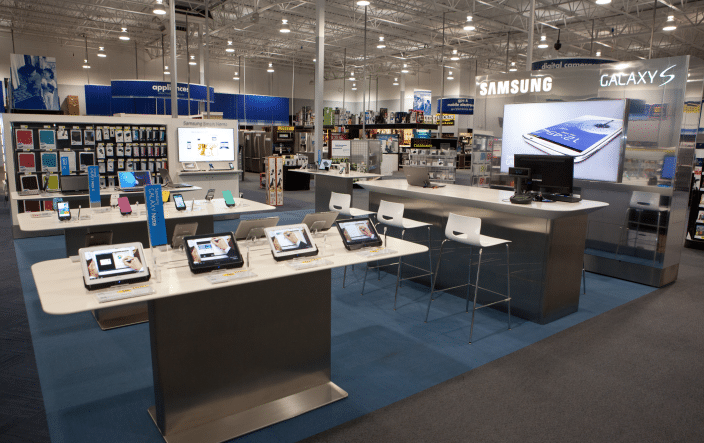
NEW DELHI, Dec 28: The Indian appliances and consumer electronics sector is set to emerge as the fourth-largest market globally by FY27 as revenues are projected to scale Rs 3 lakh crore by FY29 driven by rising household incomes, aspirational rural regions, and easier access to consumer finance.
Looking ahead, 2026 promises steady, quality-led growth as the industry adapts to stricter BEE energy efficiency norms effective January 1. Companies are investing aggressively in localisation, manufacturing capacity, and AI-enabled innovation to meet evolving consumer aspirations.
With Tier II & III markets driving the next wave of demand and connected homes becoming mainstream, India’s consumer durables sector is positioned not just for scale, but also poised to rival global markets in both depth and dynamism.
“India is expected to become the fourth-largest consumer durables market globally by FY27, with the industry projected to grow to Rs 3 lakh crore by FY29 at a CAGR of around 11 per cent,” said Sunil Vachani, Chairman – CII National Committee on Consumer Electronics & Durables.
Growth is likely to be increasingly broad-based, with rising demand from rural markets supported by electrification, improved access to consumer finance and steady income growth, he added.
However, Vachani, who is also Co-Founder and Executive Chairman of Dixon Technologies said:” At the same time, the continued dependence on imported components — particularly in critical areas such as display panels and compressors — highlights the opportunity to further strengthen the domestic component ecosystem and enhance value addition.”
The year 2025 also has milestones as – LG Electronics India’s record-breaking IPO, Haier’s strategic divestment, and Samsung’s unprecedented Rs 1 lakh crore sales achievement, along with big-ticket investment plans which highlighted the sector’s scale and investor confidence.
2025 was a year of “hits and misses” for the consumer durables industry, said Manish Sharma, an industry veteran and Chair for FICCI Electronics & White Goods committee. Sales of cooling products as AC and refrigerator were impacted due to weather-led volatility.
However, the sales picked up significantly during the festive season, backed by GST reforms, which reduced duty for large appliances like air conditioners, TV (above 32 inch screen), dishwashers, among others.
The trend which started with the pandemic continues to stay with consumers upgrading to higher-efficiency ACs, larger-screen TVs, and smarter appliances when the proposition is clear on lifetime cost, service and reliability.
Year 2025 would also be known for the historic listing of LG Electronics India, the massive IPO, which was oversubscribed by over 54 times.
Moreover, by the end of year Chinese Haier Group divested its 49 per cent stake in Haier Appliances India to Bharti Enterprises and Warburg Pincus in a deal estimated at USD 2 billion.
“2025 has been a defining year for LG Electronics as the company was listed and our customer response has been consistent through the year, despite challenges that impacted the overall industry. Timely incentives that reduced GST on products including ACs & TVs helped in boosting sales during festive season,” said Sanjay Chitkara- Co-Chief Sales & Marketing officer LG Electronics India.
As per industry reports, average monthly spends on consumer durables soared 72 per cent in FY25, fuelled by a growing wave of home ownership and demand for furnishing new homes with appliances, he said.
LG Electronics, which is setting up its third factory in Sri City with a planned investment of Rs 5,000 crore , is fully “geared up” to address this future demand, said Chitkara.
Haier also announced investment of around Rs 3,500 crore to set up a new plant in South India. It is increasing the domestic value addition of its products by integrating local components.
“We are trying, as much as possible, to not only produce in India, but also produce within our own factories,” said NS Satish, President, Haier Appliances India.
In 2025, Samsung Electronics India’s total sales in India crossed Rs 1 lakh crore, a feat which no other company operating in the appliance and consumer electronic vertical in India has been able to achieve so far.
The leading firm will continue to invest in the Artificial Intelligence (AI) ecosystem in the country, besides also participating in the PLI scheme for display modules.
“India market will be comparable to the US, European market and China once the GDP goes up and crosses USD 5 trillion,” said JB Park, President and CEO of Samsung Southwest Asia.
Similarly, Kamal Nandi, Business Head and EVP at the Appliances Business of Godrej Enterprises Group, said the trend of premiumisation will continue in segments like frost-free refrigerators, split air conditioners, front load washing machines, performing better than mass segments.
“Consumers are largely looking for value-driven offerings for more convenience and comfort,” he said, adding “aesthetics is another aspect that continues to gain consumer attention.”
Moreover, 2026 will start with new BEE norms (Bureau of Energy Efficiency), from January 1, aimed to bring stricter energy efficiency for appliances like refrigerators, ceiling fans, ACs, and solar inverters.
However, companies are unfazed from this new transition. “The upcoming BEE star rating revision…is expected to further stimulate demand. Our refreshed BEE-compliant AC portfolio and continued manufacturing investments position us to lead this transition,” said Mukundan Menon, Managing Director, Voltas.
Saif Khan, MD & CEO, BSH Home Appliances, said 2025 has been a defining year for premium home appliances in India, driven by category creation and an aspiration-led shift in consumption.
“Dishwashers emerged as the breakout category with over 40 per cent pan-India growth and our highest-ever festive sale,” he said.
Leading appliances retailer Croma said 2025 marked a clear shift by Indian households toward upgradation.
“What’s changing fast is aspiration, with Tier 2 and Tier 3 markets driving the next wave of growth and offering significant headroom for smarter, future-ready upgrades,” said Shibashish Roy, CEO and MD, Infiniti Retail (Croma).
“As we look to 2026, we expect this momentum to strengthen further, driven by AI-enabled devices, smarter connected homes, and solutions that combine efficiency, wellness, and convenience.” (PTI)
 Follow our WhatsApp channel
