

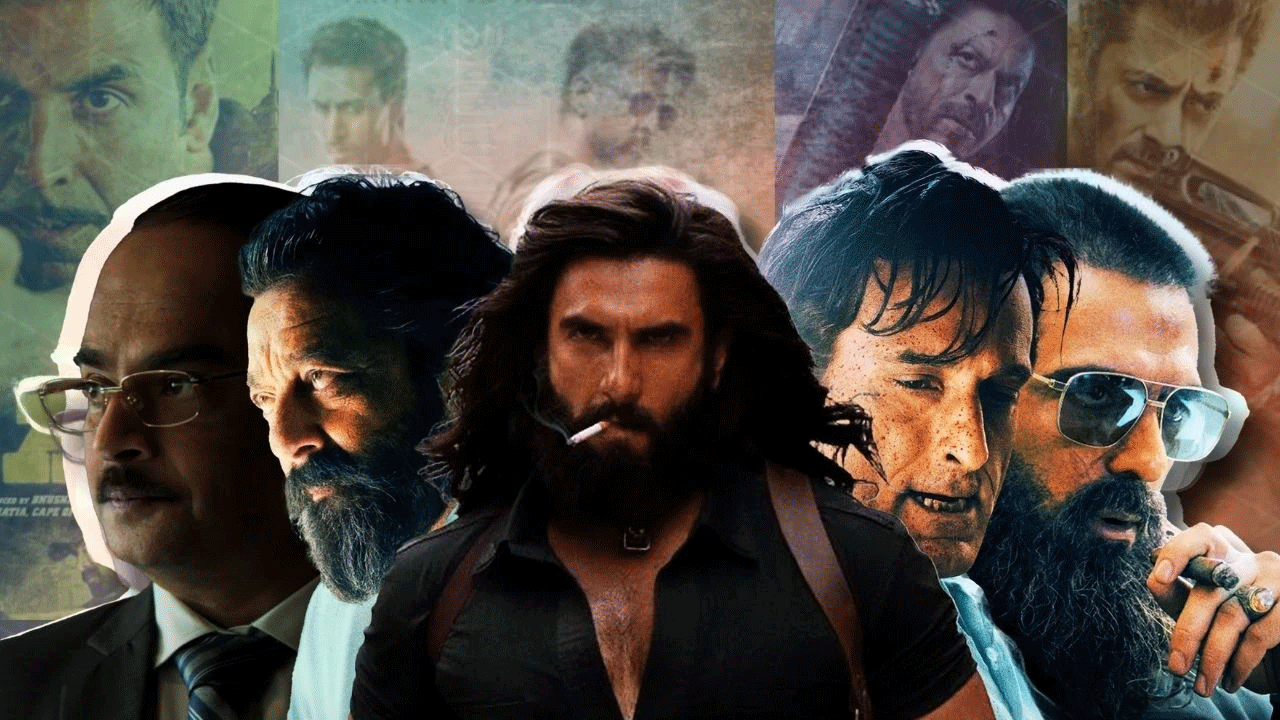
By T N Ashok
On a humid evening in Mumbai, the applause began before the final scene had ended. The screen was still soaked in gunfire, bodies still falling, when the clapping rose—hesitant at first, then thunderous. For many in the audience, Dhurandhar was not simply a film. It was vindication.
In the months since its release, Dhurandhar has become one of the most commercially successful and politically consequential Indian films in decades. It has also become one of the most polarising—hailed by supporters as a long-overdue reckoning with cross-border terrorism, and condemned by critics as a cinematic brief for the prosecution in an unresolved geopolitical trial.
At stake is not merely the reputation of its director, Aditya Dhar, or the box-office fate of Bollywood’s newest juggernaut. What Dhurandhar represents is a broader shift: the transformation of India’s terror history into a mass-consumption narrative, one that collapses intelligence failures, diplomatic ambiguity and regional complexity into a single, muscular story of cause and effect.
For international audiences, especially in the United States and Britain, the film offers a window into how India now sees itself—and its neighbour Pakistan—after decades of violence that have rarely been understood in the West on India’s own terms.
Dhurandhar traces a bloody arc from the 1999 hijacking of Indian Airlines Flight IC-814 to Kandahar, through the 2001 attack on India’s Parliament, and into a shadowy presence of terror financing, sleeper cells and smuggling routes that crisscross Pakistan’s cities.
The film’s central thesis is unambiguous: that Islamist militant groups, Pakistani crime syndicates, and elements of the country’s intelligence apparatus form an overlapping ecosystem that has sustained anti-India terrorism for decades.
“This is not presented as rogue actors,” said a former Indian intelligence official, now retired, who spoke on condition of anonymity because he still advises government agencies. “The film argues for structure. That’s what makes it powerful—and controversial.”
In Dhurandhar, the Lahore–Karachi corridor is portrayed as the logistical spine of this system: arms and narcotics move through ports and border towns, profits laundered through hawala networks, while handlers speak the language of ideology and balance sheets with equal fluency.
These allegations are not new. Indian governments across party lines have made them repeatedly in international forums. What Dhurandhar does is dramatise continuity—suggesting that Kandahar, Parliament, and later attacks were not episodic failures but parts of a single, long war.
For Pakistani critics, the film’s depiction of their country borders on defamation. There are few civilians, fewer dissenters, and almost no suggestion of internal resistance to militancy.
“The film erases Pakistanis who have suffered from terror themselves,” said a London-based South Asia scholar who has studied militancy in Punjab and Sindh. “It reduces a complex society into a permanent antagonist.”
Yet Indian security officials counter that complexity has long been a luxury paid for in blood. “For 30 years we’ve been asked to prove what we already know,” said another former official, who served in counterterrorism roles after 9/11. “This film isn’t diplomacy. It’s a memory.” That distinction—between diplomatic caution and public memory—lies at the heart of Dhurandhar’s appeal.
The Kandahar hijacking sequence is staged with near-documentary attention to detail, echoing widely reported timelines. The Parliament attack, by contrast, is treated as a moral rupture rather than a forensic case study. Historians and journalists note the compressions. Composite characters stand in for multiple figures; debates inside India’s own security establishment are sidelined.
But Dhurandhar does not pretend to be a tribunal. It presents itself as something more dangerous and more effective: a moral narrative. “The risk,” said a veteran Indian journalist who has covered militancy since the 1990s, “is that moral certainty replaces institutional accountability. When the enemy is always external, internal failures fade into the background.”
No aspect of the film has generated more astonishment than its violence. Torture scenes linger. Retaliation is filmed with grim intimacy. That much of it survived India’s censor board has raised eyebrows even within the industry.
A senior film executive involved in the certification process said the board faced immense pressure. “There was a sense that cutting the violence would itself be seen as political.” Supporters argue the brutality is the point—that sanitising terror is a lie. Critics respond that the film risks turning vengeance into virtue, and spectacle into sanction. Either way, the violence functions as argument. It demands emotional alignment, not distance.
Aditya Dhar has denied being a mouthpiece for the ruling Bharatiya Janata Party (BJP), and there is no evidence of formal coordination. Still, the symbiosis is hard to ignore. Ruling-party leaders praised the film. Local party outfits organised screenings. Social-media networks aligned with the government amplified its themes aggressively. Is the BJP leveraging Dhurandhar, or is Dhurandhar leveraging the BJP’s ideological climate?
“The relationship is transactional, not conspiratorial,” said a political strategist in New Delhi. “The film benefits from an audience primed for this story. The party benefits from a cultural product that validates its worldview.” It is worth noting that Dhar was not involved in The Kashmir Files, a film that ignited similar debates. But in the current climate, distinctions blur easily.
English-language critics, particularly in metropolitan and international outlets, have largely dismissed Dhurandhar as inflammatory and simplistic. Audiences, meanwhile, have made it a phenomenon. This divergence exposes a fault line familiar to American and British readers: the gap between elite discourse and popular grievance. “For many viewers,” said a sociologist who studies media and nationalism, “this isn’t about ideology. It’s about recognition. They feel their suffering was explained away for years.”
For Western audiences accustomed to viewing South Asian militancy through the prism of Afghanistan or al-Qaeda, Dhurandhar offers an uncomfortable reframing: terrorism as a bilateral, state-adjacent conflict, not merely a transnational one. Whether that framing is complete—or dangerously partial—is precisely the point of contention.
What cannot be disputed is the film’s impact. Dhurandhar has done what policy papers and diplomatic briefings rarely manage: it has turned history into something felt, not footnoted. Cinema has always been a blunt instrument. In Dhurandhar, India has chosen bluntness over ambiguity, fury over finesse. The question for global audiences is not whether the film is fair—but whether, after decades of violence and denial, fairness was ever the currency its makers intended to trade in. (IPA Service)
 Follow our WhatsApp channel
