

Animesh Rohmetra
animesh.rohmetra1@gmail.com
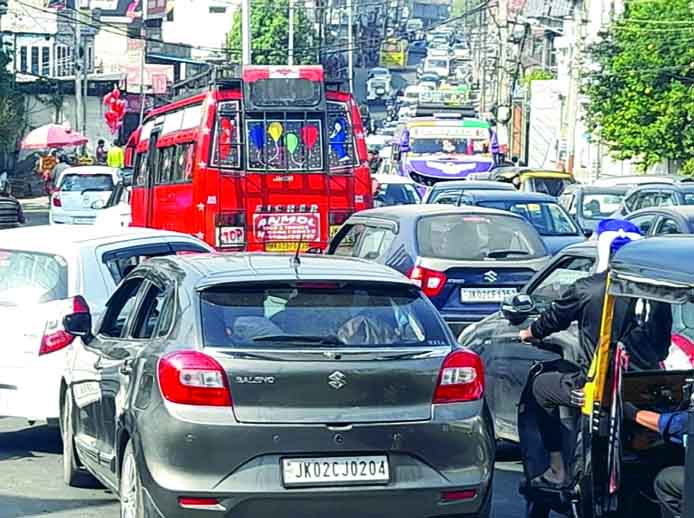
The quality of a region’s governance gets often reflected not in policy announcements or infrastructure blueprints, but in the everyday experiences of its citizens. In Jammu & Kashmir, one such everyday experience-the daily commute has increasingly become a source of frustration, delay, and risk. From damaged roads and fragile highways to unplanned traffic stoppages and uneven enforcement, the gap between what the law guarantees, and what citizens endure, on the ground continues to widen.
India’s traffic and road safety framework, applicable in Jammu & Kashmir, is comprehensive and unambiguous. The Motor Vehicles Act lays down clear obligations for drivers and authorities alike, while constitutional jurisprudence has firmly established that the right to life under Article 21 includes the right to safe roads and free movement. These principles are not abstract ideals; they are binding duties. Yet, for a large section of the population, commuting remains an uncertain and often hazardous activity.
Official data underscores the seriousness of the situation. In 2024, Jammu & Kashmir recorded more than 5,800 road accidents and over 800 fatalities. These figures point to a systemic problem rather than isolated incidents. While individual negligence plays a role, the larger causes lie in poor road engineering, inconsistent maintenance, inadequate signage and lighting, and traffic management that is reactive rather than planned. Each accident is a reminder that enforcement without infrastructure, or infrastructure without enforcement, cannot deliver road safety.
Road conditions across many parts of the Union Territory remain a persistent concern. Urban commuters regularly encounter potholes, uneven surfaces, broken edges, waterlogging, and unfinished repair works that resurface after every spell of rain. Lane markings are either faded or absent, signboards are missing or poorly placed, and speed breakers appear without warning or scientific design. For pedestrians and two wheeler riders, these deficiencies translate into daily risk. In semi urban and rural areas, narrow carriageways, lack of shoulders, and insufficient protective barriers further compound the problem.
The situation becomes even more acute on major highways, particularly the Jammu Srinagar National Highway (NH-44), the region’s primary economic and logistical lifeline. Recurrent landslides, shooting stones, flash floods, and slope failures have turned highway closures into a routine occurrence. Vehicles remain stranded for hours or days, ambulances struggle to move through congested stretches, and supply chains suffer repeated disruptions. The economic and social costs are substantial: missed flights and examinations, delayed medical treatment, spoiled perishable goods, and mounting losses for transporters and small traders.
Alongside infrastructure challenges, traffic regulation practices have emerged as a major source of public dissatisfaction. Frequent and sudden traffic halts, particularly due to VIP movements, have become a defining feature of urban commuting. Security considerations are undeniably important, especially in a sensitive region like Jammu & Kashmir. However, security cannot become a justification for routine and prolonged disruption of civilian life.
Established guidelines clearly state that traffic stoppages on public roads are meant to be rare and strictly limited, even for high security movements. The principle is minimal disruption, not blanket road closures. In practice, however, commuters regularly face complete stoppages, rolling convoys, and unannounced diversions for movements extending well beyond the narrow category for which such measures are intended. Office goers are left stranded mid route, schoolchildren reach late or miss classes, patients on their way to hospitals lose critical time, and commercial activity grinds to a halt without warning.
This is not merely an inconvenience; it is a question of proportionality and governance. The Supreme Court has repeatedly emphasised that public convenience cannot be sacrificed unnecessarily and that public roads exist primarily for the movement of citizens. When traffic regulation appears swift and absolute during VIP movements but lax when it comes to everyday violations such as wrong-side driving, illegal parking, signal jumping, and encroachments the perception of unequal treatment deepens.
Inconsistent enforcement undermines both deterrence and trust. Law-abiding citizens feel penalised for following rules, while habitual violators operate with relative impunity. Effective traffic management requires predictability, consistency, and visibility. Policing must focus on routine commuter routes and peak hours, not merely on high-profile events.
What Jammu & Kashmir urgently needs is not a new set of laws, but disciplined implementation of existing ones. Roads must be built and maintained to uniform safety standards rather than subjected to temporary, cosmetic repairs. Traffic advisories should be timely, transparent, and widely disseminated. VIP movements must be planned with intelligent routing and rolling clearances instead of prolonged roadblocks. Emergency vehicles should enjoy uninterrupted passage as a matter of non negotiable policy. Above all, accountability must be fixed at every level for lapses that affect public safety and daily life.
The daily commuter in Jammu & Kashmir is not seeking special privileges. The demand is straightforward: safe roads, fair enforcement, and respect for time and dignity. These are fundamental civic rights, not discretionary concessions. Delivering them consistently will do more to restore public confidence than any number of announcements. Governance, ultimately, is judged on how smoothly and safely the public is allowed to move.
 Follow our WhatsApp channel
