

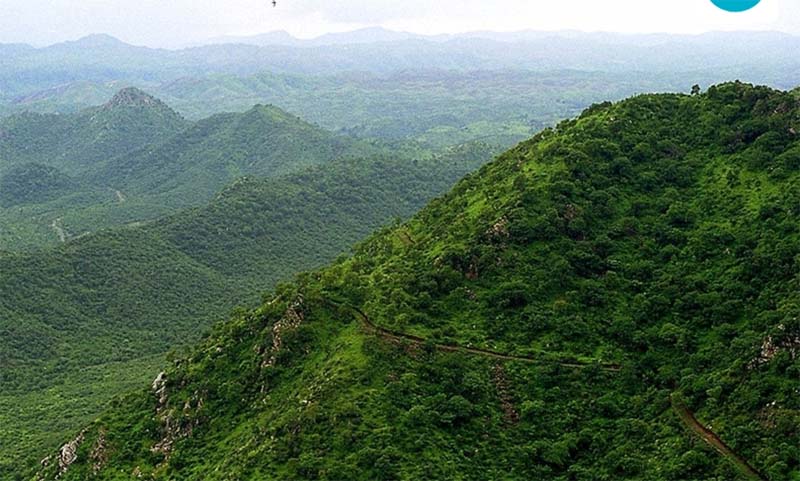
NEW DELHI, Dec 21 : The government has issued a detailed rebuttal to allegations of weakening protection for the Aravalli mountain range, asserting that a recent Supreme Court-backed process has, in fact, brought over 90 per cent of the ecologically sensitive area under a consolidated protective regime.
The clarification states that mining is potentially permissible in only about 2 per cent of the Aravalli’s total area, and only under stringent conditions for specific minerals.
The position was outlined in a comprehensive document from the Ministry of Environment, Forest and Climate Change, which describes recent steps as a Supreme Court-mandated effort to create a uniform definition of the Aravalli hills and ranges across Delhi, Haryana, Rajasthan, and Gujarat.
The government denies creating any new, relaxed definition, arguing instead that the process closes regulatory loopholes by applying Rajasthan’s existing stringent criteria-in place since 2006-uniformly across all four states.
A key clarification addresses widespread confusion over the “100-metre” rule. The document explains that the criterion refers to the base structure of a hill, not its top. Protection applies to all landforms within the “lowest binding contour” that surrounds a hill with 100 metres or more of local relief. Furthermore, the protective net has been widened: if two or more such qualifying hills are within 500 metres of each other, the entire zone between them is also considered a protected part of the mountain range.
The Supreme Court has also accepted the designation of “inviolate zones” where mining is completely prohibited. These include Protected Areas, tiger corridors, Eco-Sensitive Zones, areas within one kilometre of Protected Areas, and plantations created using government or environmental funds.
The document emphasizes that mining remains completely banned in Delhi’s Aravalli areas and that following a Supreme Court order in November 2025, no new mining leases will be granted until a comprehensive “Management Plan for Sustainable Mining” is finalized by a central research body.
Quantifying the scope, the document notes the Aravalli spans approximately 1.47 lakh square kilometres across 37 districts. It states that only about 2 per cent of this area, or roughly 2,170 square kilometres, could be considered for mining, restricted to “critical, strategic, and atomic minerals” as defined by law.
All such activity would require strict environmental safeguards and sustainable mining plans. The clarification concludes by framing the new framework as a significant enhancement of conservation, asking how it can be claimed that protection has been diluted when the stated outcome is that over 90 percent of the range is now under a clearly defined protective umbrella. (UNI)
 Follow our WhatsApp channel
