

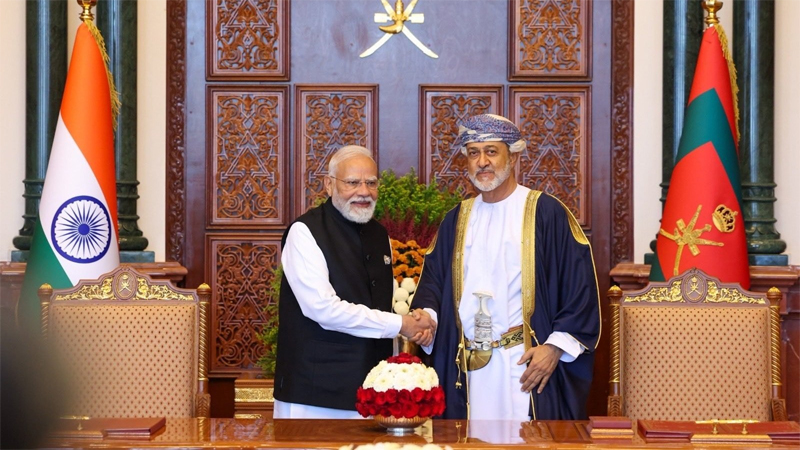
The signing of the Comprehensive Economic Partnership Agreement between India and Oman marks a significant moment in India’s evolving trade diplomacy. Coming at a time when the global economy is unsettled by tariff wars, protectionist policies and slowing growth, the agreement reflects India’s pragmatic search for new markets and resilient trade partnerships. For a developing economy like India, which has faced the adverse fallout of steep tariffs-particularly in major export destinations such as the United States-the Indo-Oman pact is both timely and strategic. The imposition of high tariffs, supply-chain disruptions and geopolitical tensions has hurt export-oriented economies across the developing world. India, despite its growing domestic market, cannot afford inward-looking trade policies. In an increasingly competitive and interdependent world, trade agreements are necessarily reciprocatory, balancing national interests with global integration. Seen in this light, the India-Oman CEPA stands out as a well-calibrated and forward-looking deal.
The important takeaway is the agreement offers India duty-free access to over 98 per cent of Oman’s tariff lines, covering more than 99 per cent of India’s current exports to the country. This is a substantial gain for Indian exporters, especially in labour-intensive sectors such as textiles, gems and jewellery, leather, footwear, sports goods, plastics, furniture and agricultural products. Engineering goods, pharmaceuticals, medical devices and automobiles also stand to benefit from complete tariff elimination. For an economy seeking to generate jobs and expand manufacturing, this preferential access is of great importance. Equally significant is India’s ability to safeguard its sensitive sectors. While offering tariff liberalisation on around 78 per cent of its tariff lines, India has consciously protected products where it intends no compromise. Key agricultural items, such as dairy, tea, coffee, rubber, and tobacco, along with gold and silver bullion, jewellery, and certain labour-intensive goods, have been excluded from the category. For exports of interest to Oman-such as dates, marble and petrochemical products-India has opted for tariff-rate quotas rather than full liberalisation. This demonstrates that the agreement is not a one-sided opening but a carefully negotiated pact aligned with India’s domestic priorities.
One of the strongest pillars of the Indo-Oman CEPA is the services sector, an area where India enjoys a clear comparative advantage. Oman’s services imports stand at over $12.5 billion, yet India’s share is just over 5 per cent, highlighting vast untapped potential. Under the agreement, Oman has made substantial commitments across various sectors, including computer and IT-related services, business and professional services, research and development, education, health, and audio-visual services. Perhaps the most notable feature of the pact is the enhanced mobility framework for Indian professionals. The increase in the quota for intra-corporate transferees from 20 per cent to 50 per cent, along with the extension of the permitted stay for contractual service suppliers from 90 days to two years (with a possible two-year extension), is a major win. These provisions will directly benefit Indian professionals, service providers and migrant workers, strengthening people-to-people and economic ties between the two countries.
Credit must be given to Prime Minister Narendra Modi, whose leadership and personal diplomatic engagement have been instrumental in concluding the agreement. The pact underscores India’s growing confidence in negotiating trade deals that reflect its strengths-particularly in services-while protecting vulnerable sectors. As traditional markets become more uncertain due to tariff barriers and geopolitical risks, India is rightly looking towards the Gulf, Africa and other emerging regions. Oman, strategically located and economically stable, can serve as a gateway for Indian businesses into the wider Gulf and West Asian markets. In this sense, the CEPA can act as a stepping stone for similar agreements with other Gulf and African nations.
However, free trade agreements alone cannot guarantee success. Simultaneously, India must focus on making its products globally competitive. There is little point in securing market access if Indian goods remain overpriced or fail to meet international standards. Industrialists, businessmen and farmers must adapt to the rapidly changing global trade scenario by improving productivity, quality and innovation. As the saying goes, only the fittest ultimately survive. In an uncertain world economy, such balanced and forward-looking agreements are not just desirable-they are essential.
 Follow our WhatsApp channel
