

Prof. Virender Koundal
virender_koundal@rediffmail.com
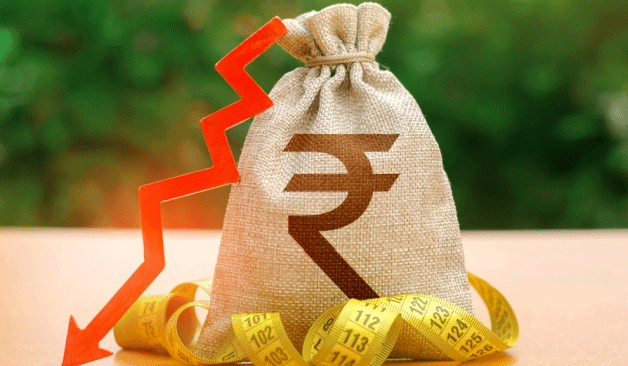
The Indian rupee has entered a phase of sustained weakness, triggering concern across financial markets, policy circles, and the business community. On 15 December 2025, the rupee slipped to around ?90.6 per US dollar, marking its lowest level in the last eleven months. This sharp depreciation is not a standalone event; rather, it reflects a convergence of global uncertainties and domestic structural pressures. A fall of over 5 per cent in such a short span signals deeper stress in India’s external sector and capital flows, raising critical questions about macroeconomic stability, inflation, and growth prospects
One of the primary triggers behind the rupee’s recent slide is mounting uncertainty surrounding business negotiations and tariff policies in the United States. Renewed ambiguity over trade arrangements, coupled with the possibility of higher tariffs, has unsettled global markets. For emerging economies like India, such uncertainty translates into heightened risk perception. The US dollar traditionally strengthens during periods of global uncertainty as investors seek safe-haven assets. This “flight to safety” has pushed up demand for dollars, exerting downward pressure on emerging market currencies, including the rupee. For India, which is deeply integrated into global trade and capital markets, the spillover effects are particularly pronounced. Moreover, unpredictable US trade policy has implications for India’s export outlook. If tariffs rise or market access becomes more restrictive, India’s export earnings could face pressure, further weakening the rupee by reducing dollar inflows.
A second, and arguably more immediate, factor behind the rupee’s decline is the large-scale withdrawal of Foreign Institutional Investors (FIIs) from Indian equity and debt markets. Over recent months, FIIs have been consistently offloading Indian assets, driven by higher interest rates in advanced economies, stronger dollar returns, and concerns over global growth. When FIIs exit, they convert rupee-denominated assets into dollars, increasing the demand for foreign currency and putting direct pressure on the exchange rate. The current episode of capital outflows has amplified the rupee’s fall, as domestic markets struggle to absorb the sudden reversal of foreign capital. This trend also reflects a broader reallocation of global portfolios. With attractive yields available in the US and other developed markets, India’s relative appeal has weakened in the short term. While India’s long-term fundamentals remain strong, currency markets respond swiftly to capital flow dynamics, often overshooting underlying economic realities.
The trade deficit forms the third critical pillar explaining the rupee’s weakness. India’s imports have been rising steadily, outpacing export growth. Higher imports mean increased demand for dollars to pay foreign suppliers, which naturally exerts pressure on the rupee. Energy imports, particularly crude oil, remain a major contributor. Despite diversification efforts, India continues to rely heavily on imported oil. Any increase in global oil prices directly widens the trade deficit and raises dollar demand. Additionally, imports of electronics, machinery, and intermediate goods have grown alongside domestic consumption and industrial activity. The depreciation of the rupee, ironically, can further worsen the import bill in the short run by making imports more expensive. This creates a vicious cycle: higher imports increase dollar demand, weakening the rupee, which then inflates the rupee value of imports even more.
A weaker rupee has direct inflationary consequences. Costlier imports raise input prices for industries, which are often passed on to consumers. Fuel, fertilizers, edible oils, and electronic goods are particularly sensitive to currency movements. Persistent rupee depreciation can therefore complicate inflation management at a time when price stability is already a challenge. For businesses, exchange rate volatility increases uncertainty in planning and pricing. Import-dependent sectors face margin pressure, while exporters may benefit in the short term due to higher rupee earnings per dollar. However, if global demand weakens simultaneously, even exporters may not fully gain from a depreciated currency. From a macroeconomic perspective, prolonged rupee weakness can strain corporate balance sheets with unhedged foreign currency borrowings, increasing repayment burdens and financial stress.
The responsibility of managing currency volatility largely falls on the Reserve Bank of India (RBI). The central bank has traditionally adopted a calibrated approach intervening in the foreign exchange market to curb excessive volatility rather than targeting a specific exchange rate. India’s foreign exchange reserves provide a crucial buffer, enabling the RBI to smooth sharp fluctuations. However, sustained intervention can deplete reserves and must be balanced against long-term external sustainability. The RBI also uses interest rate policy and liquidity management to influence capital flows indirectly.In the current scenario, the challenge for policymakers is to strike a balance between defending the rupee and supporting economic growth. Aggressive tightening could stabilize the currency but may slow domestic investment and consumption.
The rupee’s fall has broader implications for India’s growth trajectory. While a competitive exchange rate can boost exports over time, the benefits materialize only if global demand remains robust. In an environment of global uncertainty and protectionist tendencies, export-led gains may be limited. On the fiscal front, a weaker rupee raises the cost of servicing external debt and subsidies linked to imported commodities. This can strain government finances, particularly if depreciation persists. At the same time, India’s ambition to attract long-term foreign investment hinges on macroeconomic stability. Sharp currency movements can deter investors, even if structural reforms and growth prospects remain favourable.
Stabilizing the rupee requires a multi-pronged strategy. In the short term, managing volatility through prudent intervention and clear policy communication is essential to prevent panic in markets. Ensuring adequate dollar liquidity and discouraging speculative attacks should remain priorities. In the medium to long term, addressing structural issues is critical. Reducing dependence on imports especially energy through renewable expansion and domestic production can help narrow the trade deficit. Boosting export competitiveness via infrastructure development, technology adoption, and stable trade policies will strengthen dollar inflows. Equally important is restoring investor confidence. Predictable policy frameworks, fiscal discipline, and sustained reforms can attract stable long-term capital, reducing reliance on volatile portfolio flows.
The current depreciation of the Indian rupee to ?90.6 per US dollar, its lowest level in eleven months, reflects a complex interplay of global uncertainty, FII outflows, and a widening trade deficit. While external factors such as US trade and tariff uncertainty are beyond India’s control, domestic policy choices can mitigate their impact. A weaker rupee is both a warning signal and an opportunity highlighting vulnerabilities while underscoring the need for deeper structural reforms. How India navigates this phase will determine not only the rupee’s future path but also the broader stability and resilience of the economy in an increasingly uncertain global landscape.
 Follow our WhatsApp channel
