

By Tirthankar Mitra
Pakistan’s ruling dispensation is dropping even the pretence of a civilian democracy. The country’s 27th constitutional amendment rushed through Parliament and signed by its President, Asif Ali Zardari is a clear pointer to it.
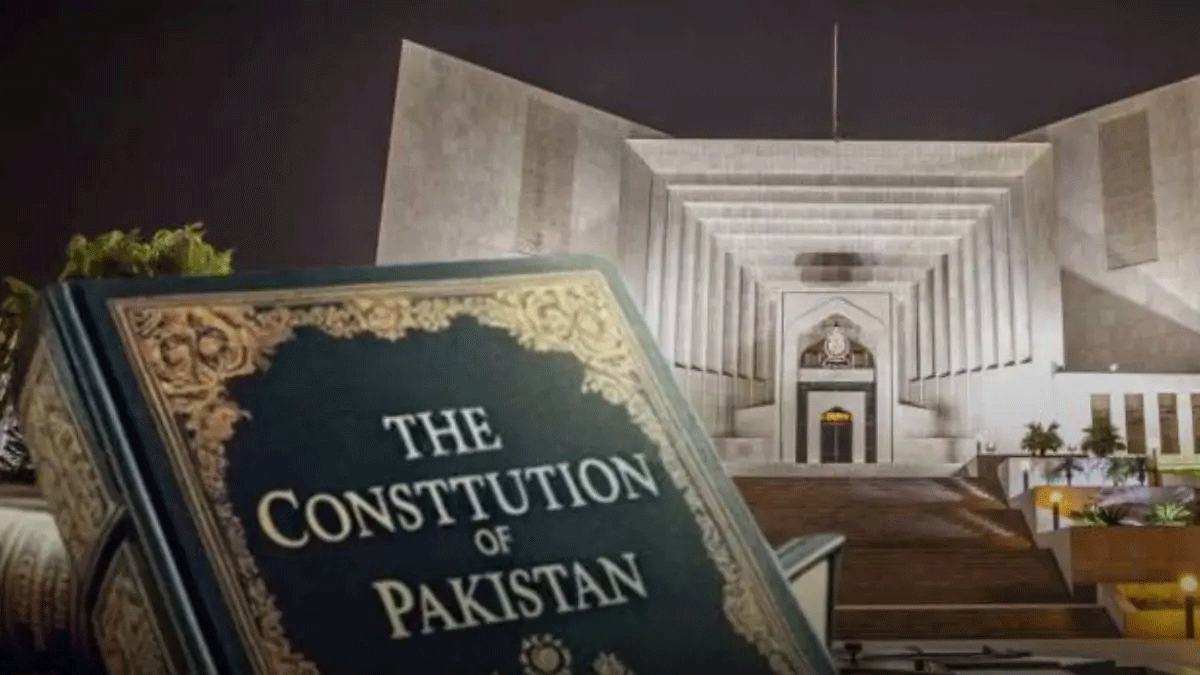
The amendment fires a broadside at Pakistan judiciary. It creates a new Federal Constitutional Court and gives the executive effective control at the selection of its judges. This about to be set up court appears to have been designed to reduce the influence of the Supreme Court. The powers that be in Pakistan seems to have cast a long look back before they decided to move this amendment.
After all, the Supreme Court in any democracy is the last fora of appeal against any transgression of the Legislature and Executive. The Supreme Court of Pakistan is no exception.
Time and again it has stood upto the country’s military Establishment and political leadership. On face of it, the Supreme Court remains the apex court of Pakistan. But separately the Amendment changes Article 243 of the Constitution. It governs the relation between the army and civilian leadership.
This amendment grants lifelong immunity from criminal prosecution to five-star ranked military officers. This is absurd. It challenges the very foundation of natural justice. It operates on the long laid down principle that everyone is equal before the law.
One cannot resist the temptation to ask what necessitates this legal safeguard. Are not the men in uniform law abiding citizens of Pakistan as men in mufti?
Field Marshal, Asim Munir, the current army chief, is the only one five star general in Pakistan now. He is the second in the country’s history after Ayub Khan, the late military dictator and the only gainer from this amendment
Removing a five-star military officer will need a two-third majority in the Parliament. But a elected government can be ousted if it loses simple majority.
The amedment places Field Marshal Munir and the officers to be elevated to five star rank on a higher pedestal than the civilian leadership. It may be pointed out that it is to this civilian authority the men in uniform are ostensibly supposed to report to.
The amendment creates a new position, the Chief of Defence Forces. It makes it clear that the army chief will concurrently hold this office. This formalises control of the army chief over Pakistan’s navy and air force. It transgresses against the democratic norm of decentralising power and authority.
The military has been the most powerful institution of Pakistan since it came into being. But in the not too distant past, political parties including Pakistan People’s Party;(PPP) have resisted further consolidation of the military’s power.
Times have changed. This time, the PPP, a partner of Pakistan Muslim League-Nawaz (PML-N) of Prime Minister Shehbaz Sharif has gone along the amendment. There was not even a smallest sign of protest though both PPP and PML-N leadership had got the rap of the military.
There has been protests from some sitting judges and civil society groups. Yet the government got the amendment through in the Parliament.
The amendment is in keeping with the challenges which democracy faces in the sub-continent. Bangladesh and Nepal have already faced popular protests. In Pakistan, democracy is at stake as the military gets more powers to consolidate its position against the civilians and the so called political masters. (IPA Service)
 Follow our WhatsApp channel
