

By Rohini Vaishnavi
Batt Koch, gently intertwines the ache of longing with the enduring hope of return, telling a story of displacement through a light-hearted, humour-infused narrative. Even as it touches on conflict and the trauma of being uprooted, the film treats its sensitive themes with remarkable restraint, compassion and emotional clarity.
The film centres on Bittoo (Anil Chingari), a middle-aged man juggling the demands of work and family. His wife Neelam (Kusum Tickoo) is the emotional backbone of the household, caring for their teenage children and ageing in-laws with quiet resilience. Their everyday banter—missed school uniforms, teenage secrets, and household chaos—brings warmth and relatability to the narrative.
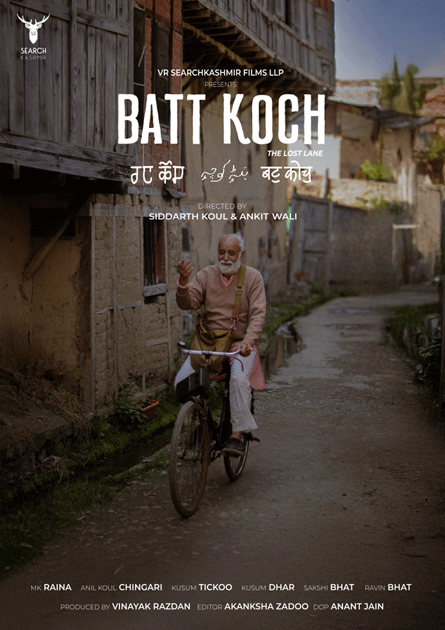
The emotional core, however, rests with the elderly couple, Jai Kishori Koul (Kusum Dhar) and Pushkarnath Koul (MK Raina). Their affectionate squabbles and quiet companionship lend the film both humour and poignancy. Jai Kishori’s repeated attempts to pack for an elusive trip to Kashmir and Pushkarnath’s simmering anger over the past reflect a generation caught between longing and heartbreak. When a much-awaited family trip is cancelled due to their son Bittoo’s work call, the disappointment leads to Jai Kishori’s sudden death, leaving the family devastated and awakening Pushkarnath’s buried desire to return home.
The loss becomes the catalyst for the family’s eventual journey back to the Kashmir valley—an emotional homecoming marked by both pain and pleasure.
Some of the film’s most moving scenes unfold on this journey. The breathtaking Kashmiri landscape prompts Bittoo’s son to ask why the family ever left such a place. Bittoo’s response—linking their departure to the survival of their identity—leads to an unexpectedly humorous exchange, demonstrating the film’s gift for handling sensitive themes with a light, human touch.
The homecoming sequence is especially powerful. Pushkarnath, once a postman, reunites with his old Muslim neighbour who has preserved his bag and his beloved radio. In a beautifully written moment, the neighbour reassures Bittoo seeing him anxious to see his father riding a bicycle, “Don’t worry about him… he is in Kashmir ,he will be cured now.” Pushkarnath riding his bicycle through the abandoned, dilapidated homes of exiled Pandits—leaving letters, that he wrote while in Jammu, describing the real conditions of the family members at each doorstep—is a haunting visual metaphor for memories suspended in time. The letter he leaves at his own ruined home, a message he had once written to himself, brings the narrative to an emotional crescendo.
Batt Kochis ultimately a story of longing—for a home, a culture, a life that ended abruptly. Its strength lies in its ability to balance grief with humour, nostalgia with everyday realism. The performances feel deeply authentic, in part because many cast members have lived experiences of the exodus. The film lays bare wounds that were often concealed in an attempt to move forward and shield younger generations.
The storytelling by Siddarth Koul is understated yet powerful. Directors Ankit Wali and Siddarth Koul made this a visual treat using humour as a narrative device to explore a painful chapter in history without sensationalism. The evocative lyrics by Ravi Bhat and the music by Saurabh Zadoo add emotional resonance, enhancing the film’s reflective tone.
In all, Batt Koch, produced by Vinayak Razdan, a production of VR SEARCHKASHMIR FILMS LLP is a tender, sensitively crafted film that pays homage to a generation shaped by displacement. It invites viewers to remember—not with bitterness, but with humanity, dignity, and a quiet hope for reconciliation.
 Follow our WhatsApp channel
