

By Subrata Majumder
Japan’s new Prime Minister and the first female Prime Minister Sanao Takaichi is unlikely to be moved by the historic gender inequality. She is not a staunch supporter for gender equality because of her social conservation and opposition to key reforms. She has long opposed legislation that would have allowed married couple’s separate surnames.
During the eight year period of late Prime Minister Shinzo Abe (2012-2020), Prime Minister Sanao Takaichi played key role in development of digital economy, smart city projects and cyber security in India. Given India’s rising stake in Indo-Pacific region, Japan’ key support to develop technology and manufacturing partnership with India for development of alternative supply chain proved prudent for closer ties between the two countries.
Although Prime Minster Sanao Takaichi never visited India, she is understood to keep close contact with India through diplomatic channel to increase self reliance and economic revival through bilateral relation.
Notwithstanding Japan underwent a critical situation after facing USA’s high tariff, mounting pressure for big Japanese investment in USA and defence burden sharing, which strained the relation between the two countries under Trump’s Presidency, India and Japan steadily deepened their strategic partnership , expanding collaboration in infrastructure , digital economy and labour mobility.
Prime Minister Sanao Takaichi’s primary focus on anti-China move, which stems from Shinzo Abe’s strategic shift in Japanese investment to India and other Asian countries from China, is a case in point. In a recent statement in Japanese Diet (Parliament), she stated that a Chinese attack or blockade of Taiwan could constitute a “survival threatening situation” for Japan.
Till now, China and ASEAN were the prime destinations for Japanese investment in Asia. Given the global tension deepening, leading to geo-political turmoil, Japanese investors vowed to shift to India, leaving behind China.
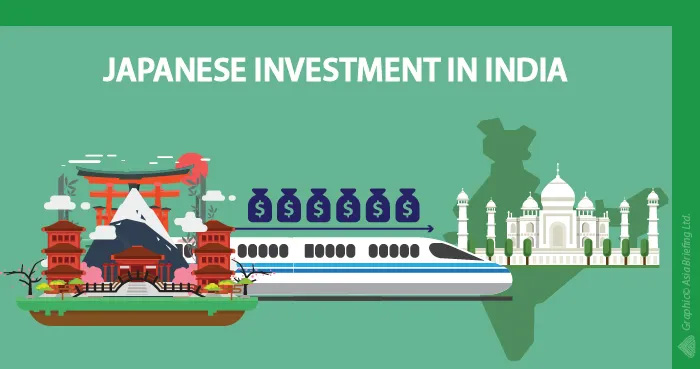
Japanese investment made a steep downturn in China and erratic trend in ASEAN in the post Abe period. Japanese investment in China dropped by 70 percent, from US$11,024 million in 2020 to US$3,305 million in 2024 and in ASEAN -4 (Thailand, Indonesia, Malaysia and Philippines), increased marginally from US $ 7686 million in 2020 to US$ 9249 million in 2024. In contrast, Japanese investment in India surged by 267.0 percent in the post Abe period, from US$ 1,570 million in 2020 to US$5,341 million in 2024. These unfold India as the second single biggest nation for receiving Japanese investment after Singapore in Asia.
The seeds of new era of India-Japan relation were sown with diversification from bilateral to multilateral during Abe period. The relation extended for a joint partnership for economic development in third countries, such as development of AAGC project (Asia Africa Growth Corridor) and the joint cooperation for development of Chabahar Port in Iran. The new era gave strong backbone to India-Japan special strategic and global partnership in political dynamism.
India was hailed by Deloitte, Japan, CEO Keinichi Kimura, as an important and attractive destination for Japanese investment. Its massive domestic market, young talent and its strategic location, which link to Middle Eastern and African market, enamour its significance for investment. These leased out to Japanese investors a new global landscape for investment in China+1 strategy and diversify supply chain and reduce dependence on single country.
Caught in the crossfire between USA’s MAGA and Japan’s historical political conflicts with China, India emerges a new economic ally for Japan. It opened new opportunity for Japan to combat Trump’s threat of tariff war and reduce dependence on China for supply chain.
India’s growth relies on domestic demand, unlike China. Japan relation with China, which emerged as close economic ally for low cost workshop, despite historical political bitterness, went into despair with unfolding of COVID pandemic. Japanese government granted huge subsidy to encourage Japanese companies to disperse their manufacturing sites from China to other Asian region.
This paved the way for India to capitalize China+1 strategy. Japanese investors dragged their feet from China and started pouring investment in India.
India emerged 4th largest economy in the world in 2024-25, from 10th in the world in 2014-15. It demonstrates average growth in GDP by 6.5 per cent a year during the decade, despite hindered by COVID 19 pandemic. The growth trajectory vies India’s dream to be 3rd biggest economy by 2028, overtaking Germany and Japan, according to Morgan Stanley.
India has special investors’ attractions, amid the high tariff war and protectionism in the world. Unlike China and Japan, local demand is the trigger for companies’ profitability in India. According to a survey by JETRO, It has been forecasted that increase in local demand will be the pillar for profitability in 2025 for Japanese companies In India.
Eventually, spurt in automobile industry growth in India, driven by local demand is a case in point. Indian passenger vehicle industry, which is dominated by Japanese investment, is the 4th biggest manufacturer in the world. Its growth is tied to local demand. Over 90 percent of passenger vehicles produced in the country is sold in the domestic market. (IPA Service)
 Follow our WhatsApp channel
