

‘Constitutional changes not going to end terror’
*INDIA bloc on life support, may wheel into ICU
Excelsior Correspondent
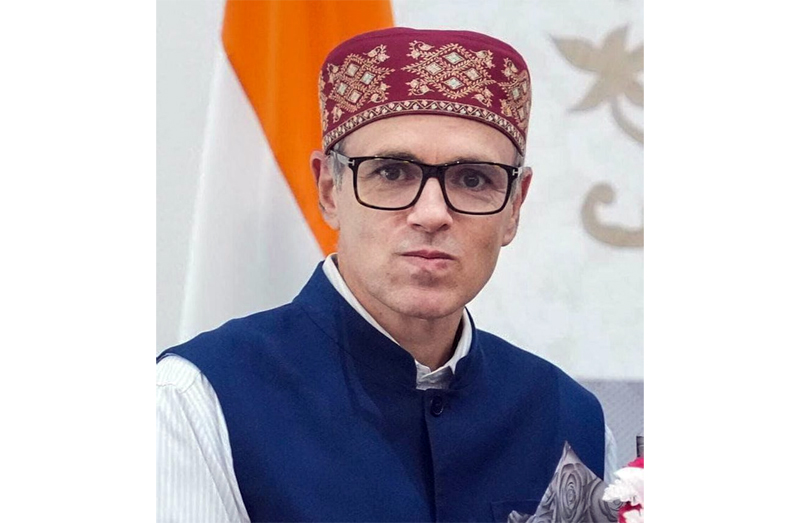
JAMMU, Dec 6: Chief Minister Omar Abdullah today said the homegrown terrorism had never truly disappeared and the changes made to the Constitutional relationship are not going to miraculously result in an end to terror.
Speaking at an event in New Delhi today, Omar argued that the home grown terrorism had never truly disappeared. “When did it ever go away? It was there. Why do you use the word return?” he said.
On the changes made to the Constitutional relationship between Jammu and Kashmir and the rest of India, the Chief Minister said they are not going to miraculously result in an end to terror and warned that those who believed the post-2019 Constitutional changes were a “miraculous cure” for terror were the ones who were surprised by incidents such as the (April 22) attack in Baisaran (Pahalgam) and the (November 10) blast in Delhi.
Asserting that what happened in Baisaran and in Delhi was a sufficient wake-up call, he said “that we will realize the gravity of what we’re dealing with.” He added that the recent terror incidents have effectively led the country to draw a “line in the sand”, declaring that any similar attack in the future “will be considered an act of war”.
Follow the Daily Excelsior channel on WhatsApp
Abdullah suggested that this sharp escalation makes it even more critical to ensure such attacks do not happen again, adding that the Delhi blast’s apparent domestic origin was the only “saving grace”, as it prevented the Government from having to immediately enact what he termed the “Modi doctrine on internal security”, a response that was narrowly avoided due to the lack of a visibly “external hand”.
The Chief Minister also suggested that one “can’t operate Governments in silos” where an elected Government is completely removed from any security-related decisions.
He wondered how do they expect a proper flow of information if the elected representatives “play no part whatsoever in decisions affecting the security”, and compared his present tenure to his first stint as the Chief Minister of the erstwhile State of Jammu and Kashmir.
“I can tell you without the fear of contradiction that the Union Territory model does not work,” he said.
Giving an example of his “limited” authority under the Union Territory model, Abdullah said he has been kept out of crucial security meetings in Jammu and Kashmir which he is governing.
“I read about the Delhi blast in newspaper. I did not know who carried out the attack… (or) how the investigation is proceeding,” he said.
He compared the situation with his first term as the Chief Minister, when the DGP would have instantly informed him about the developments.
Abdullah also cited a striking, unofficial anecdote, heard only through “chatter on the streets”, about how the Delhi plot was uncovered because a jilted young girl complained to the police about her former boyfriend, leading them to a network that culminated in tracking a doctor involved in the conspiracy.
“This is the sort of thing that any other Chief Minister would hear officially. I hear it because there are sort of chatters on the streets. The Union Territory model does not work,” he said.
Abdullah also expressed concern that a unified public stance against violence, which emerged following the Baisaran attack, is being undermined by the discriminatory treatment of people outside Jammu and Kashmir, and cited orders of some State Governments asking “all foreign nationals and Kashmiri Muslims to register in their nearest police station”.
“You are effectively saying that Kashmiri Muslims and foreigners are the same to you,” Abdullah said, warning that this “othering” makes it “very difficult to convince youngsters” to leave Jammu and Kashmir to pursue better educational and economic opportunities across the country, as they find themselves being treated as “untrustworthy”.
If one asks whether all Kashmiris are accepting violence, the answer is “no” because they are as disturbed by what happened in Pahalgam as they are by what happened in Delhi, Abdullah said.
“Do they make that feeling more public? Perhaps not. But that doesn’t mean that it doesn’t continue to disturb us. That doesn’t mean that we don’t find it abhorrent. We continue to. That said, we are also equally concerned when an attempt is made to paint the entire community with one brush,” Abdullah said, reiterating that not all Kashmiri Muslims are terrorists, and not all Kashmiri Muslims support terrorism.
“In fact, it is a minuscule minority that do. The overwhelming majority of people are the ones you saw on the streets after the attack in Baisaran. They are the ones who are in colleges and universities in different parts of the country. They are the ones who are trying to earn an honest day’s living in various parts,” he asserted.
Meanwhile, Omar said the opposition INDIA bloc is currently “on life support” and risks being wheeled into the “ICU” due to infighting and a failure to match the BJP’s round-the-clock election machine.
He detailed the “organizational and strategic failures” of the opposition bloc, contrasting its approach with the BJP’s “unparalleled” work ethic.
Talking about the INDIA bloc’s current health, particularly in the aftermath of the recent Bihar elections, Abdullah said, “We’re sort of on life support, but every once in a while, somebody brings out his paddles and gives us a bit of a shock, and we get up again. But then, unfortunately, results like Bihar happen, and we slump down again, and then somebody has to wheel us into the ICU.”
Abdullah also blamed the INDIA bloc for the return of Nitish Kumar to the BJP-led NDA, saying, “I believe that we pushed Nitish Kumar back into the arms of the NDA.”
He also pointed to the alliance’s failure to take a cohesive view, citing the decision to consciously exclude the Jharkhand Mukti Morcha (JMM) from the Bihar seat-sharing arrangement despite the party’s presence in the state.
Abdullah compared the INDIA bloc’s electioneering to that of the BJP, and said the opposition alliance is structurally unable to compete with the ruling party’s disciplined approach.
“They have an unparalleled election machine,” he said, noting that this strength goes beyond mere organization and funding.
“They also have an incredible work ethic in terms of how they deal with elections… They fight every election as if their lives depend on it. We sometimes fight elections as if we don’t care,” he said.
Abdullah emphasized the 24×7 model of politics pursued by Prime Minister Narendra Modi and his team, and said that “no sooner has one election finished, they’ve already moved into the next territory… We will move into those States two months before the elections. We will be lucky if we sew up our electoral alliances before the last date of filing nominations”.
Looking ahead, Abdullah said the only way for the opposition to mount a serious challenge (to the BJP) is to rally around its largest constituent – the Congress – the only party other than the BJP to have a pan-India presence.
Acknowledging that regional parties are constrained by their limited geographical reach, he said, “The heavy lifting will have to be done by the Congress.”
Regarding the Muslim electorate, Abdullah suggested that the traditional recipients of the Muslim vote have “made a mistake” by taking the community for granted, and only engaging with them just before elections, leading to a churn that benefits parties like AIMIM, which are willing to “espouse our cause for the entire period of five years”.
Asked if it meant that the results of the 2024 general elections were a fluke, Abdullah said, “No, I think the country sent a message to the Central government, to Prime Minister Modi and others in 2024 that things are not as rosy as you made them out to be, and that we are not happy with some of the decisions that have been taken.”
He also said that post the 2024 elections, the Centre changed its approach and showed that it can work in an alliance format as well.
“Hardly any of us remember today that it’s an alliance government. We all felt that the style of functioning of this government did not lend itself to a UPA or NDA-type situation. I for one hardly ever remember that this is a Prime Minister who is actually dependent on two of his allies,” Abdullah said, adding that the Centre reoriented its way of doing things, of carrying people along.
“I mean, from calling it a BJP government, they called themselves an NDA government. These are small changes, but they matter,” he said.
Abdullah, who has always distanced himself from the widespread political charge that the electronic voting machines (EVMs) are rigged, said, “I have never been a supporter of those who say that the machines are rigged.”
However, he drew a distinction between rigging and electoral manipulation, which he believes is a valid concern.
“Elections can be manipulated. And the easiest way to manipulate an election is to do it through the voter list or through the way in which you structure constituencies,” he said.
Abdullah pointed to the recent delimitation exercise in Jammu and Kashmir, calling it “essentially manipulation”, and argued that the exercise, which created new constituencies designed to benefit “one party and its one ally” by rejigging voter lists and excluding specific sections of voters, amounts to manipulating an election.
He concluded by saying that any process that involves altering the voter list, such as the Special Intensive Revision (SIR), must be done “transparently” and “fairly” to prevent questions about bias.
On a lighter note, Abdullah said his personal stance on EVMs puts him at odds with his father, Farooq Abdullah, who is convinced of rigging, saying, “My dad believes everything he gets on WhatsApp.”
 Follow our WhatsApp channel
