

Cabinet nod for expansion of Pune Metro
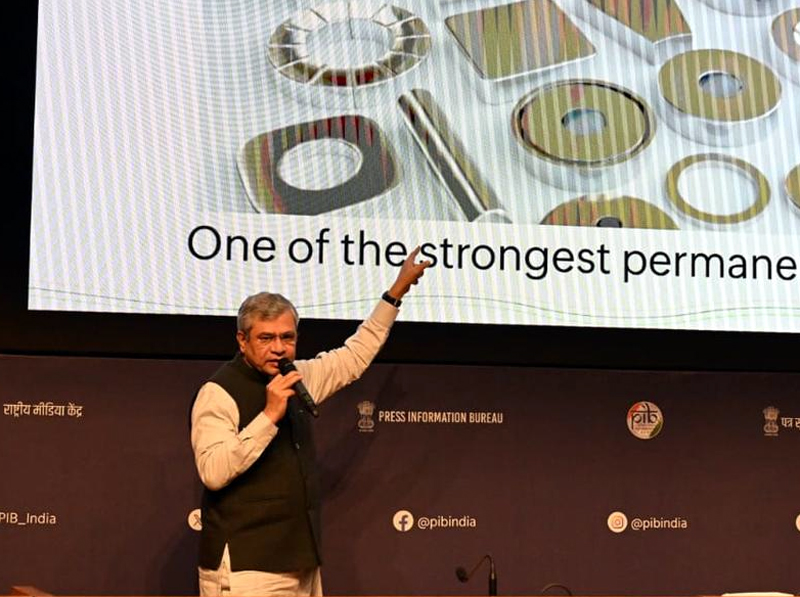
NEW DELHI, Nov 26:The Government on Wednesday approved a Rs 7,280 crore scheme to promote manufacturing of rare earth permanent magnets, a move which would help reduce India’s dependence on China.
Rare earth magnets are vital for a number of sectors like electric vehicles, renewable energy, electronics, aerospace, and defence applications.
The ‘Scheme to Promote Manufacturing of Sintered Rare Earth Permanent Magnets (REPMs)’ was approved at a Cabinet meeting chaired by Prime Minister Narendra Modi.
“The scheme will promote manufacturing of rare earth permanent magnets. The aim is to create capacity of 6,000 MTPA (metric tonne per annum),” Information and Broadcasting Minister Ashwini Vaishnaw told reporters here.
The scheme will support the creation of integrated manufacturing facilities, involving conversion of rare earth oxides to metals, metals to alloys, and alloys to finished magnets.
It envisions allocating the total capacity to five beneficiaries through a global competitive bidding process. Each beneficiary will be allotted up to 1,200 MTPA capacity. The minister said that the detailed guidelines will be released soon.
The total duration of the scheme will be seven years from the date of award, including a 2-year gestation period for setting up an integrated magnets manufacturing facility, and 5 years for incentive disbursement on the sale of the product.
The total financial outlay of the scheme is Rs 7,280 crore, comprising a sales-linked incentives of Rs 6,450 crore on REPM sales for five years and capital subsidy of Rs 750 crore for setting up 6,000 MTPA of REPM manufacturing facilities.
Each beneficiary will be allotted up to 1,200 MTPA of capacity.
Driven by the rapidly growing demand from electric vehicles, renewable energy, industrial applications, and consumer electronics, India’s consumption of REPMs is expected to double by 2030 from 2025.
At present, India’s demand for these goods is met primarily through imports from countries including China.
“With this initiative, India will establish its first ever integrated REPM manufacturing facilities, generating employment, strengthening self-reliance,” an official statement said.
This initiative is a step toward strengthening the domestic REPM manufacturing ecosystem and enhancing competitiveness in the global markets.
Meanwhile, the Government also approved expansion of the Pune Metro rail network at a cost of Rs 9,858 crore, Information and Broadcasting Minister Ashwini Vaishnaw said here.
The Union Cabinet, at a meeting chaired by Prime Minister Narendra Modi, approved the Line 4 (Kharadi-Hadapsar-Swargate-Khadakwasla) and Line 4A (Nal Stop-Warje-Manik Baug) under Phase-2 of the Pune Metro Rail Project.
This is the second major project approved under Phase-2, following the sanction of Line 2A (Vanaz-Chandani Chowk) and Line 2B (Ramwadi-Wagholi/Vitthalwadi).
With this latest approval, Pune Metro’s network will expand beyond the 100-km milestone, a significant step in the city’s journey towards a modern, integrated and sustainable urban transit system, the government said.
Together spanning 31.636 km with 28 elevated stations, Line 4 and 4A will connect IT hubs, commercial zones, educational institutions and residential clusters across East, South and West Pune.
The project will be completed within five years at an estimated cost of Rs 9,857.85 crore, to be jointly funded by the government of India, the government of Maharashtra and external bilateral/multilateral funding agencies.
The Government has also approved doubling of the Dwarka-Kanalus rail line in Gujarat and building third and fourth lines between Badlapur and Karjat in Mumbai metropolitan region.
A meeting of the Cabinet Committee on Economic Affairs, chaired by the Prime Minister, approved the two projects with a total cost of Rs 2,781 crore.
The Devbhumi Dwarka (Okha)-Kanalus rail line will improve connectivity to the Dwarkadhish temple, a key pilgrimage site, and transportation of commodities such as coal, salt, container, and cement.
“The capacity augmentation works will result in additional freight traffic of magnitude 18 MTPA (million tonnes per annum),” Vaishnaw, said.
The Badlapur-Karjat section forms part of Mumbai suburban corridor and the third and fourth line project will improve the connectivity in the region and meet the future demands of passengers, along with providing connectivity to southern India, the minister said.
According to a government statement, the increased line capacity will significantly enhance mobility, resulting in improved operational efficiency and service reliability for Indian Railways.
“These multi-tracking proposals are poised to streamline operations and alleviate congestion,” the statement said.
The projects are in line with the Prime Minister Narendra Modi’s vision of a new India which will make people of the region Atmanirbhar by way of comprehensive development in the area, it said.
“The projects are planned in accordance with PM-Gati Shakti National Master Plan with focus on enhancing multi-modal connectivity and logistic efficiency through integrated planning and stakeholder consultations, it added.
“These projects will provide seamless connectivity for movement of people, goods, and services,” the statement said. (PTI)
 Follow our WhatsApp channel
