

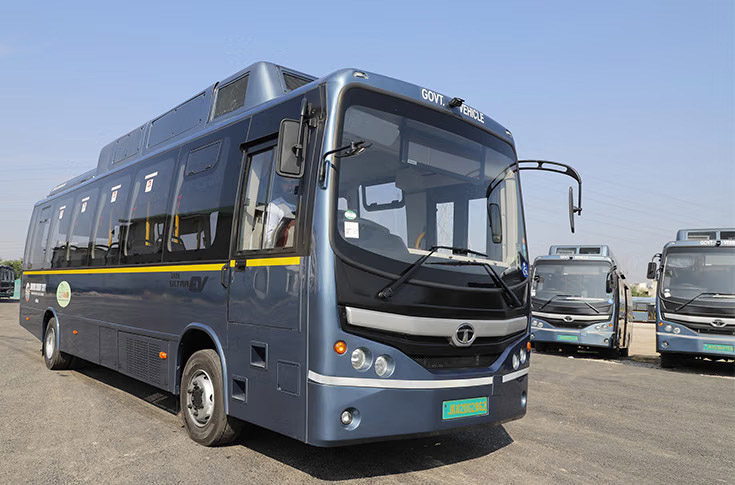
Dedicated bus lanes, smarter passenger facilities also proposed
Bivek Mathur
JAMMU, Nov 21: Jammu and Srinagar are set for a major improvement in the public transport as both the capital cities prepare to add a new fleet of 200 electric buses under the PM eBus Sewa Scheme.
Follow the Daily Excelsior channel on WhatsApp
Supported by the Ministry of Housing and Urban Affairs, the initiative aimed at expanding zero-emission mobility across the two smart cities and provides commuters faster, cleaner and more reliable travel options.
A Jammu Smart City Limited (JSCL) official said that under the scheme, both JSCL and Srinagar Smart City Limited (SSCL) will induct an equal 100 new electric buses into their fleet.
He said the new deployment includes 25 twelve-metre and 75 seven-metre buses for Jammu, and 20 twelve-metre along with 80 nine-metre buses for Srinagar.
“This expansion builds on the FAME-II electric buses already operating in both cities and serving thousands of passengers daily,” said Ashish Anand, Senior General Manager of Jammu Smart City Limited, and the Nodal Officer for the Jammu & Kashmir e-Bus Project.
The Ministry of Heavy Industries’ FAME-II (Faster Adoption and Manufacturing of Electric Vehicles) scheme provides subsidies and incentives to encourage the purchase and deployment of electric buses for intra-city public transport in India.
According to Anand, the larger 12-metre buses in Jammu will be deployed along key corridors such as Samba, RS Pura, Akhnoor, and Sunderbani to meet high passenger demand, while the smaller 7-metre buses will operate in areas of the Old and Heritage City where narrow streets require compact vehicles.
In Srinagar, Anand said, a mix of 12-metre and 9-metre buses will strengthen the busy routes, including Pantha Chowk, Lal Chowk, Hazratbal, and Batamaloo.
“The increased fleet size is expected to reduce overcrowding, improve punctuality, and meet the rising commuter requirements during the peak hours,” he said.
Anand, said that procurement of buses is being carried out through a unified national tender issued by Convergence Energy Services Limited.
“A consortium led by PMI Electro Mobility, supported by Progressive Autoserve Private Limited and Urban Paribahan Services Private Limited has been selected for the supply of 12-metre and nine-metre busses, while the procurement for the 7-metre buses is being handled separately and is in progress,” he said.
Anand further said both cities are also undertaking a series of infrastructure upgrades under the Green Urban Mobility Initiatives. These improvements include dedicated bus lanes, queue jumpers at intersections to reduce delays and better-designed passenger facilities.
Bus queue shelters in Jammu and Srinagar are also being redesigned under the Smart City Mission, and will now come equipped with real-time information displays, route maps, CCTV surveillance, panic buttons, better lighting, seating and accessibility features such as ramps and tactile paving, he said.
Further, to enhance the overall passenger experience, Anand said, the new buses will be fully integrated with the Intelligent Transit Management System (ITMS) and the Automatic Fare Collection System.
“Commuters will be able to use QR-based tickets, NCMC-enabled smart cards and mobile payments. Mobile apps and LED display boards will provide real-time updates on bus locations and expected arrival times,” he said.
The Nodal Officer for the Jammu & Kashmir e-Bus Project, Anand, said these digital systems will help both cities plan routes more effectively, adjust services based on demand patterns and monitor fleet performance more accurately.
He added that the Detailed Project Reports (DPRs) for new depots, opportunity charging stations and administrative facilities have already been cleared by the Central Sanctioning and Screening Committee and the UT-level committee.
Behind-the-meter power infrastructure for both cities has also received approval, with JPDCL and KPDCL entrusted with execution, he said.
Anand said the expansion of electric bus services is expected to bring significant social benefits across Jammu and Kashmir as residents will get safer, more reliable access to schools, hospitals, markets and workplaces.
“Women, senior citizens and low-income commuters are likely to benefit the most due to better frequency and wider route coverage. Electric buses are also expected to reduce pollution levels in the congested parts of the cities, contributing to cleaner air and supporting long-term environmental goals,” he said.
According to him, the project will generate employment opportunities for drivers, conductors, mechanics, depot workers and IT support staff.
In addition, the growth of electric mobility is expected to boost local businesses linked to charging systems, repair services, battery management and component recycling, strengthening the emerging green economy in the region, the JSCL Senior General Manager said.
 Follow our WhatsApp channel
