

Mohammad Hanief
m.hanief@gmail.com
When the warmth of summer begins to fade and the first chill drifts down from the PirPanjal range, Kashmir awakens to its most graceful season – autumn. Locally called Harud, it arrives quietly in late September and lasts until early November, transforming the valley into a golden dream. The land glows beneath a soft sun, the air turns crisp and fragrant, and every leaf seems to carry a message of peace and change.
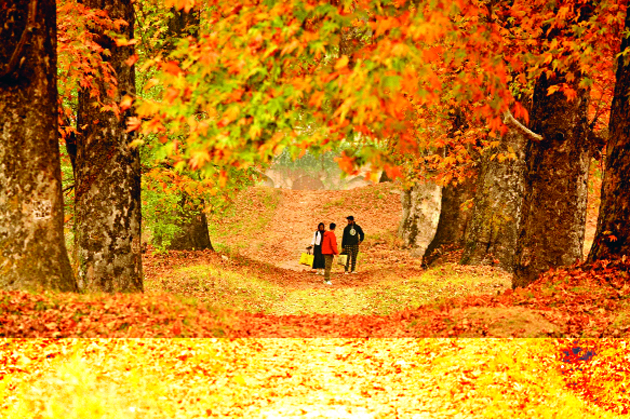
Nowhere is this transformation more striking than beneath the towering Chinar trees, the timeless guardians of Kashmir’s landscape. Their leaves shift from green to gold, then burn into deep red, until entire hillsides appear aflame. Beneath them, paths are carpeted with fallen leaves that rustle softly with each step. In places like Naseem Bagh and the Boulevard Road along Dal Lake, the sight is mesmerizing – as if the valley has wrapped itself in a robe of fire and light.
The season brings a quiet rhythm to life in Srinagar. The crowds of summer fade, and the city slows to a gentler pace. The Dal Lake lies still and reflective, mirroring the fiery Chinars that line its banks. Houseboats float in calm water, their carved walnut balconies touched by golden sunlight. In the evenings, thin trails of smoke rise from chimneys, blending with the soft glow of dusk as the call to prayer echoes over the lake. The scene feels timeless – a moment where nature, faith, and silence meet.
In the Mughal Gardens – Shalimar, Nishat, and ChashmeShahi – autumn performs its most elegant act. The fountains sparkle in the slanting light, petals and leaves drift across the marble pools, and the terraces are washed in shades of bronze. The Botanical Garden, at the foot of the Zabarwan Hills, blooms in warm tones of yellow and orange. Families stroll through the paths, photographers chase reflections, and children play among the drifting leaves. It is a season that turns even ordinary days into poetry.
Beyond the gardens, the countryside carries a different kind of beauty – the purple blush of saffron fields in Pampore. In October, these plains become Kashmir’s pride, covered with countless crocus flowers. Before sunrise, farmers step into the misty fields to pluck the blossoms one by one. Each delicate flower holds three red stigmas – threads that, once dried, become the world’s most precious spice. The air is heavy with the fragrance of saffron, sweet and earthy. Families gather in courtyards to separate the threads from petals, a ritual that connects generations. For centuries, saffron has been the symbol of Kashmir’s wealth and resilience, and in autumn, it blooms as beautifully as the Chinars.
Elsewhere, the orchards of Shopian and Sopore overflow with apples – crisp, red, and shining. Farmers move quickly, gathering fruit before the first frost. Walnuts are cracked open, corn is dried, and smoke curls from piles of burning leaves. The markets fill with apples, almonds, and honey; the samovars brim with steaming Kahwa – green tea infused with saffron and cardamom. Autumn in Kashmir is not only a feast for the eyes but a celebration of abundance, gratitude, and life’s gentle cycle.
In recent years, this season has found a new rhythm through the Kashmir Marathon, now held annually each October. Runners from across India and abroad gather in Srinagar to participate in this festival of endurance. The route winds along the Dal Lake, past the golden Chinars and the majestic Mughal Gardens. The city, often quiet at this time of year, comes alive with cheer and color. Locals line the roads to encourage runners, schoolchildren wave flags, and the air fills with music and laughter. The marathon is more than a sporting event – it is a symbol of peace and renewal, a way for Kashmir to share its spirit with the world.
For those who take part, the experience is unforgettable. To run beneath trees glowing in red and gold, with mist lifting from the lake and the Himalayas rising in the distance, is to feel part of something larger than oneself. Even the rhythm of footsteps on the fallen leaves seems to echo the pulse of the valley – steady, enduring, alive.
As autumn deepens, the days grow shorter and the sunlight softer. The first frost appears on rooftops, and the evenings turn sharply cool. Yet, there is no sadness in this fading. Kashmir wears decline with grace. The golden tones mellow into brown, and the air grows still, carrying the faint scent of saffron and smoke. It is a time for reflection – for gathering what the year has offered and preparing for the long, silent winter ahead.
For the people of Kashmir, Harud is both a season and a state of mind. It invites stillness, introspection, and gratitude. Life slows, conversations lengthen, and evenings are spent by the warmth of the kangri – the earthen firepot that glows beneath the pheran. In homes, walnuts are stored, dried vegetables hung, and saffron packed in small wooden boxes. Outside, the last Chinar leaves drift lazily to the ground, as though reluctant to let go.
Visitors who come to Kashmir during autumn discover a different world from the one they imagine. There are no crowds, no rush – only silence, reflection, and color. The valley seems to whisper its secrets softly: in the hush of the gardens, in the ripple of the Dal, in the violet dawn over Pampore. Artists, writers, and dreamers find their muse here, moved by the quiet majesty that defines this season. Autumn reveals Kashmir’s soul – peaceful, dignified, and unhurried.
By early November, the valley prepares to sleep. The saffron harvest ends, the orchards empty, and the mountains begin to show their first snow. The Chinars, now bare, stand like sentinels against the pale sky. Yet even in this stillness, there is beauty – the promise that spring will come again, that the cycle of life will continue. Autumn’s fading light leaves behind not sadness, but memory: the sight of gold reflected on the water, the sound of distant laughter from the marathon, the fragrance of saffron on the wind.
To witness autumn in Kashmir is to witness life’s quiet truth – that everything beautiful must change, and that in every ending there is a beginning. The valley teaches this lesson gently, through its colors, its calm, and its patience. It reminds us that beauty does not vanish when it fades; it transforms into something deeper – a feeling, a memory, a sense of peace.
As the last rays of the season’s sun touch the waters of Dal Lake, Kashmir glows for a final moment – silent, golden, eternal. Autumn bows out softly, leaving behind a valley steeped in color and calm. And those who see it, even once, carry its memory forever: the golden silence of a land where time itself seems to pause, just long enough to let the heart listen.
(The author is a senior analyst)
 Follow our WhatsApp channel
