

Dr Harmeet Singh
harmeetjnu@gmail.com
India is one of the most ancient and illustrious civilizations of the world, the historical remnants and latest archaeological excavations shows that the Northern most site of Harappan civilization is Manda, Akhnoor in Jammu & Kashmir and the southern most Diamabad in Maharashtra. Thus it can be concluded that the region in which sites of Harappan civilization have been found out is spread from Akhnoor in the north to mouth of river Narmada in the south and Bluchisthan in the west to Alamgirpur, Meerut in the east covering a length of almost 1600 km east-west and 1400 km north-south. The excavations in the Akhnoor area stands as a living testimony to human progress in philosophy, art, science, and spirituality in this area.
The roots of its antiquity run deep and it preserved not only its written texts and mythological lore but also the vast network of archaeological and anthropological remains of this area. The archaeological sites of this area are diverse and scattered across the different corners on the banks of Chenab river of Akhnoor. Numerous excavations and archaeological studies of Akhnoor area have illuminated aspects of India’s early history, a substantial portion of its civilizational treasure still lies buried, waiting to be rediscovered. One such ancient archaeological site is Ambaran situated in the vicinity of Akhnoor and once it was the part of the great “Silk Route” which passes from Akhnoor area and runs from Ambaran to Bamiyan of Afghanistan.
Akhnoor is a town in the Jammu district of Jammu and Kashmir, India, located on the banks of the Chenab River. It is known for its historical and archaeological significance, like the Akhnoor Fort, Pandavas temple and the caves are believed to have been used by the Pandavas and the Parashurama temple all are the rich cultural heritage of this area. This area is recognized for its scenic beauty and the mightiest Chenab river flows in this area which creates an eye soothing view particularly the park alongside the Chenab River is having a unique picturesque. It is exactly near the Chenab River, where at one period of time Maharaja Ranjit Singh crowned Gulab Singh, as the king of Jammu at Jia Potta Ghat on 17 June 1822. One more historical creation in this area is the creation of Gurudwara Sundar Singh Sahib ji, near to Chenab bank in the memory of Sant Sundar Singh ji, it is here the people from Hindu and Sikh religious faiths comes and immerse the mortal remains of bodies of their near ones after the cremation.
Past as Torch for Present
India’s historical richness and diversity is both vast and layered as the people and evolution is in process and the new settlements are coming and remnants of old settlements can be located. Institutions like the Archaeological Survey of India (ASI) have made remarkable progress toward conserving known archaeological sites and monuments, temples, and heritage structures; there remains always a gap in identifying and excavating new sites that could shed light on unrecorded aspects of our ancient past. Much of what is known today and what we are seeing has been derived from the past in the form of classical texts, inscriptions, and travelers’ accounts, yet many such clues remain unexamined on the ground. Historical works such as Rajatarangini by Kalhana, a 12th-century chronicle and artefact on the conducts and works of the kings of Kashmir, is one of the biggest torches of the past, and serves as an invaluable source. In this work Kalhana vividly describes all the temples, shrines, viharas, stupas, and monuments of Jammu and Kashmir, created by rulers, queens, ministers, and generals. This is a detailed account which even provides details about their constructions and the religious orders that managed them.The historical excavations at present are possible because of these historical references, a large number of these sites remain unidentified and unexplored. The religious and cultural history of Northern India is very much vibrant and its the rich historical legacy of past that provides a central attraction to this place.
Spread of Buddhism in Northern India
King Ashoka adopted Buddhism in search of peace that marked a pivotal point in India’s cultural history. His conversion into Buddhist monk and spread of the missionary zeal message of peace transformed Buddhism into a global movement of peace and compassion not only in India even to other areas also. The Monks and scholars, from this land driven by the spirit of spreading the Buddha’s message, traversed vast regions – from Inner Asia, Afghanistan to South Asia to Tibet to Southeast Asia and even Mongolia. Buddhism travelled in all these areas as the message of peace through the Silk Route, King Ashoka spread and established monasteries, stupas, and learning centers that became the nuclei of Buddhist thought. In northern India especially in Jammu and Kashmir the Spread of Buddhism was in full swing and even the second Buddhist Council was held in Kashmir.
Kashmir, historically known as Kashmira Mandala, played a crucial role in this spiritual enlightenment journey of Buddhism. Ancient historical records suggest that Buddhist teachings and monasteries received royal patronage in this region. One such greatest scholar from Kashmiri monks was Kamalashree, who contributed to the spread of Buddhist philosophy in China, Tibet and beyond.
The Discovery of Ambaran at Akhnoor
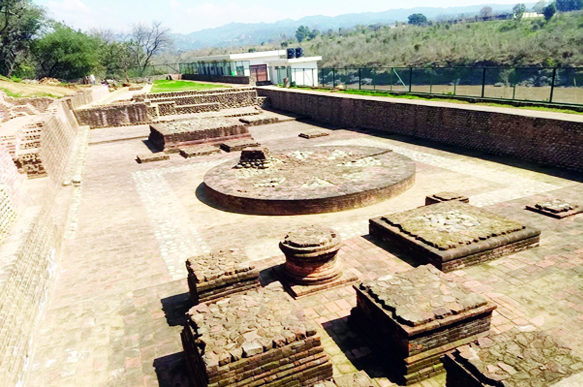
A turning point came in the 1990s when the Srinagar Circle of the Archaeological Survey of India, under the supervision of Dr. B. R. Mani excavated a site at Ambaran, located on the right bank of the Chenab River near Akhnoor 28 Kms in towards the North-West of Jammu city. The excavations, carried out between 1990 and 2001, revealed the remains of a Buddhist monastic complex dating back over two millennia – making it the earliest known Buddhist monastery in Jammu and Kashmir. The visit of His Holiness the Dalai Lama to this ancient Buddhist site on November 16, 2011 has reaffirmed and recreated the Ambaran’s rich historical and cultural importance. The site of Ambaran had come into prominence in the third decade of the twentieth century when Charles Fabri, the English art historian and then curator of Lahore Museum (now in Pakistan) found a basket lying in a corner of the museum with no clue to its origin. In it were lying terracotta figurines, Buddha’s head, female torsos, draperies of lifesize terracotta Buddha figures or monks. He then decided to locate the origin of these terracotta objects. After painstaking investigations, including trips to various places like Baramulla, Srinagar, Harawan, in Kashmir and Akhnur, in Jammu, Fabri finally traced the place from where these finds originated. This place was Pambarwan hamlet under the village of Ambaran. He named these relics the Akhnur terracotta and explored the area and found fragments and parts of statues of Lord Buddha and female figures, draperies, jewellery, one beautiful and a nearcomplete head of a woman, and similar in style to heads found in the Lahore museum.
The site’s discovery marked a significant milestone and uncovered the rich past heritage in the Akhnoor region as understanding the spread of Buddhism in northern India. Archaeologists under the supervision of B.R Wani found a well-planned monastic structure, relic caskets, Terracotta figurines, micro beads of pearl harbour, pottery, coins, and other artefacts that belonged primarily to the Kushan period (1st-3rd century CE). All the collected evidence from this Ambaran site suggests that the monastery was abandoned around the 7th century CE, possibly due to devastating intensity of floods in the Chenab and due to this the concurrent decline of Buddhism in the region.
Silk Route and Early Buddhist Connections with Ambaran
The Ambaran site holds particular importance because it offers a tangible link to the region known in ancient texts as Madradesh i.e the part of the land which lies between the Chenab and Ravi rivers. The old Buddhist texts and the literature mentions several of the Buddha’s close disciples, including Mahakappina, Khema, and Bhadda Kapilani, as hailing from Madradesh. The capital of this rich literary region was Sialkot, which is in Pakistan now and lies in the Southern part of present-day Jammu city. It can be decoded from this fact and historical excavations that the people from this region adopted Buddhism and were the active followers of Buddhist religion and the magnitude and spread of Buddhism in this region and beyond it towards Bamiyan of present day Afghanistan.
The archaeological findings at Ambaran site thus confirms that this part of Jammu was a significant center of Buddhist learning and practice and Buddhist monks travelled via Silk route to all parts of the region and halted and stayed here and Ambaran site exists long before Buddhism spread to the Kashmir Valley. The site provides evidence that this region has a tremendous historical significance and Ambaran acts as a close linking bridge with other parts of the world. Despite its profound historical and spiritual value, the Ambaran site has not received the attention it deserves. No major excavations, research projects, or conservation initiatives have been undertaken in order to make this region as a centre of attraction for Buddhism.
This neglect represents a missed opportunity for both scholars and heritage custodians. The Ambaran complex could serve as a starting point for tracing the ancient routes of Buddhist missionaries across the plains of North India, mapping connections between sites along the Ravi and Chenab rivers, and uncovering the larger story of Buddhism’s northward journey.
To Sum Up
To sum up we can say that the need of the hour is that we have to preserve this archaeological city and special centre of Buddhist learning should be established in the nearby degree college i.e Govt Degree College (GDC) Akhnoor and under New Education Policy (NEP) research projects should be promoted for ancient India and well established department of History and Geology with post graduation courses should be established inside it, these departments will take care of all these research projects and conservation initiatives should be taken. The Archaeological Survey of India (ASI), in collaboration with universities, local colleges, historians, and Buddhist scholars, should undertake a comprehensive exploration of this region. Multidisciplinary studies involving archaeology, history, geology, and cultural anthropology should be encouraged. The Ambaran Buddhist site deserves greater government attention for full development and preservation, and promotion as a center of learning and cultural tourism. There is great need of the time to develop Akhnoor as a tourist attraction site with introduction of water sports and promote it for pilgrimage tourism.
(The author is HoD Political Science, GDC Kakryal Reasi)
 Follow our WhatsApp channel
