

Dr Vikas Padha
drvikaspadha@yahoo.com
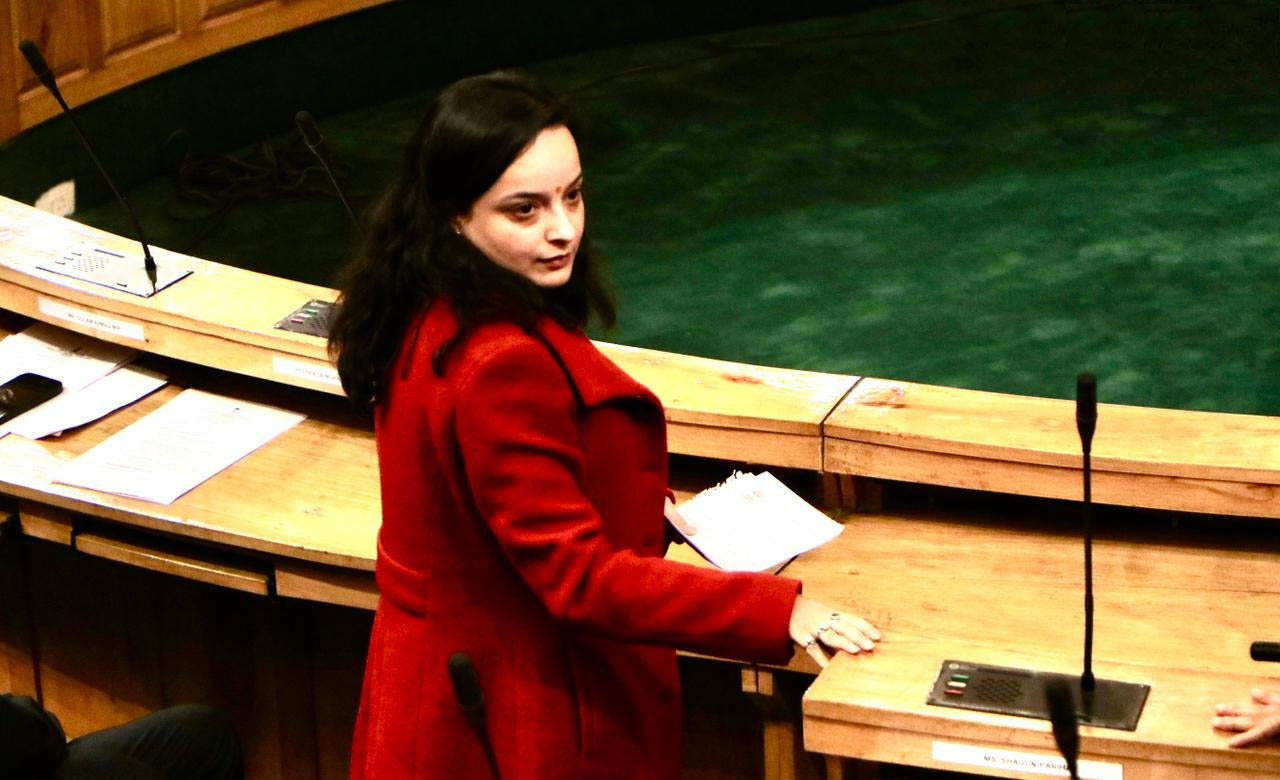
Ms Shagun Parihar MLA Kishtwar while speaking in Jammu and Kashmir Assembly raised the issue of lack of road connectivity to a particular area in her Kishtwar Assembly Constituency during which she alleged that this area was deliberately neglected by the Omar Abdullah Government while implementing Pradhanmantri Gram Sadak Yojna because this area had majority of “Hindu Nationalists” which caused uproar in J&K Assembly mostly by the sitting Ministers and MLAs of ruling National Conference.
This issue triggered a debate about the neglect of “Nationalists” in Jammu and Kashmir .
Jammu and Kashmir , one of the largest princely states was founded by Dogras in 1846 who ruled over J&K till August 25 , 1947 after which it acceded to Union of India to become an integral part of India. Despite the full and final Accession of J&K with Union of India , an ambiguity was deliberately created by the vested interests regarding this accession by adding the clause of “will of people” to this document that was totally unnecessary as the entire Authority to sign Instrument of Accession was with the corresponding Prince of the Princely states and once instrument of Accession was signed , the Accession with Union of India was final and irreversible. So was the case with J&K too . But this unnecessary confusion lead to creation of two types of ideologies in J&K. One was the “Nationalists” who wanted full and final integration of J&K with India and this was the overwhelming sentiment of Jammu region and Ladakh region . Second one was of “Secessionists” who wanted conditional Accession of J&K with India subject to Plebiscite, a sentiment prevailing in Kashmir Valley . But there was no option for this “conditional” Accession or the option of remaining independent for any of the princely states that got acceded to either India or Pakistan. From where this idea of “conditional accession subject to plebiscite” was entertained is beyond the logic when Instrument of Accession had to be signed by the Prince of Princely state who had the full authority to make decision about the choice of country . Let’s track the treatment the “Nationalists” got in J&K since 1947 .
Maharaja Hari Singh , the last Dogra Maharaja went to attend Round Table Conference in London in 1931 as the representative of the Princely States during which he told Britishers that he was an “Indian” first and then the representative of the Princely states that irked the Britishers very much . So , even before the birth of Union of India in 1947 , Maharaja Hari Singh was technically the First “Nationlist” of J&K because he had labeled himself as an “Indian” in 1931 itself. And how Maharaja Hari Singh paid the heavy the price of being Indian “Nationalist ” is known to all of us . First Prime Minister of India Mr Nehru didn’t agree to sign Instrument of Accession with Maharaja Hari Singh until his friend Sheikh Abdullah was handed over power by the Maharaja . So , “nationlist” Maharaja Hari Singh had to sacrifice his power to make Accession of J&K with Union of India possible. But Maharaja Hari Singh’s woes didn’t end with his giving up the power . Sheikh Abdullah ensured that Maharaja Hari Singh was exiled from J&K and thanks to Mr Nehru , Maharaja Hari Singh breathed his last in Mumbai( Bombay ) as only his ashes came back to be immersed in River Tawi as per Maharaja’s wish. This was how shabbily the first “nationlist” of J&K Maharaja Hari Singh was treated in his own state founded by his forefathers .
Jammu Province, the epicentre of “Nationalists” opposed the separate flag , separate constitution and separate Prime Minister for J&K for which a regional party called Praja Parishad Party that was founded in 1947 launched an Agitation called Praja Parishad Agitation that aimed at full and final integration of J&K with India. As first fallout , the nomination of candidates of Praja Parishad Party were fraudulently rejected during election for the members of constituent assembly and consequently Sheikh Abdullah’s National Conference won all 75 seats of Constituent Assembly unopposed.
Praja Parishad Agitation was badly crushed with force by Sheikh Abdullah Government that resulted in death of 15 “Nationalists” who made Supreme Sacrifices across Jammu Province for the full and final integration of J&K with India in addition to thousands getting injured during course of this Agitation. This Agitation ended after the sacrifice of Dr Syama Prasad Mookerjee that lead to arrest of then Prime Minister of J&K Mr Sheikh Abdullah following his dismissal . But before getting jailed , Sheikh Abdullah had succeeded in getting special status for J&K in the form of Article 370 as special provision of Indian constitution through which Article 35A was introduced in 1954 from back door with retrospective effect from 1944 so as to save the demography of J&K . Thereafter the rulers of J&K misused these provisions of Indian Constitution to target the “nationlists” since decades. A glaring example of misuse of “special status” was denial of citizenship rights of J&K to the Refugees who had migrated from West Pakistan into J&K because they were Hindus and Sikhs where as J&K Assembly passed a Bill in 1982 known as Resettlement Bill that allowed persons from J&K who had migrated to Pakistan after Pakistan to come back and claim their land and properties because they were Muslims. Another glaring example of discrimination was denial of Citizenship to Dalit community called Valmikis who were settled in J&K from Punjab for working as “Safai Karamcharis” and because of that denial, their kids could do job of “Safai Karmacharis” only even if they had got education till PhD. Such was the level of discrimination with “nationlists”.
Kashmiri Hindu Pandits were another community of “nationlists” living in Kashmir and they were made to flee from their homeland in 1990 because of hostile conditions created by those in power because of Article 370 and 35A .
The “nationlist” Jammu region and Ladakh region were given very less number of seats in J&K Assembly that resulted in their political disempowerment . Due to prevailing ecosystem supported by Article 35A and 370 , “nationlists” were subjected to massive discrimination when it comes to employment opportunities ( percentage of Employees from Kashmir & Jammu region working in J&K Secretariat / Administration ) , selections in professional colleges of J&K and developmental activities .
Looking at the underdevelopment in Jammu region and Ladakh region especially in the Tourism sector and road connectivity , one can easily imagine the degree of discrimination faced by “Nationalists” in J&K .
When MLA Kishtwar Ms Shagun Parihar has spoken about this issue in J&K Assembly, she has spoken the stark reality that has prevailed in J&K since 1947 itself. Its high time to do away with this discrimination by adopting measures to strengthen “nationlists” in J&K . Hope those sitting in North Block in New Delhi read this and act accordingly .
(The author is Senior Joint Replacement Surgeon & Political Analyst)
 Follow our WhatsApp channel
