

Dr Parveen Singh, Karman Singh
imparveen@yahoo.com
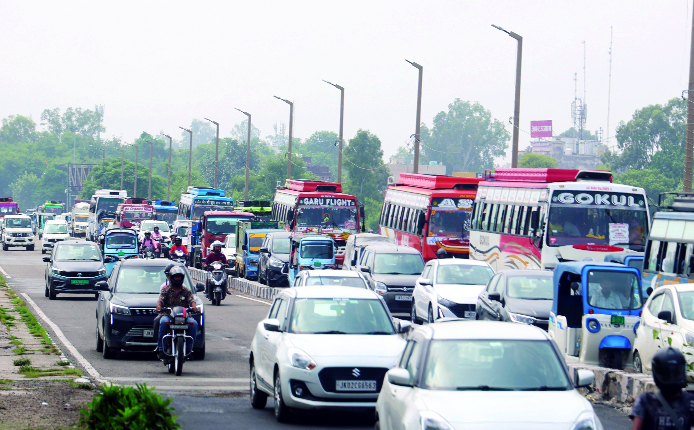
As Jammu braces for the annual Secretariat Darbar move next month, the city’s traffic chaos threatens to reach its breaking point. Congestion already clogs every major route-from the City Chowk to Kunjwani to Jewel Chowk to Janipur , Bikram Chowk to Gandhi nagar to Nanak nagar, jamming has become a daily ordeal.
With administrative offices shifting back and thousands of government vehicles adding to already jammed roads, the situation is set to worsen. What makes it even more alarming is the severe shortage of traffic police personnel. With few Traffic officers on the streets, enforcement is weak, and there is no fear of accountability among drivers and vehicle owners. Signals malfunction, rules are routinely ignored, and a sense of lawlessness defines the city’s roads. At the same time, Jammu’s unemployment has touched unprecedented levels-educated youth remain idle, their talents untapped, and their frustration rising. The twin challenges of urban disorder and record joblessness demand urgent, imaginative solutions.
Amid this mounting chaos and civic frustration emerges a transformative vision-a Public-Private Partnership (PPP) model to modernize Jammu’s traffic system and generate meaningful employment for its youth. Drawing on over two decades of experience as an IT professor and innovator with several patented solutions, I have developed a practical, technology-driven framework built on transparency, accountability, and efficiency.
This model doesn’t just seek to manage traffic-it seeks to redefine how cities function by merging technology with civic responsibility. It transforms enforcement into opportunity, bringing order to the roads while empowering young citizens to become active participants and job creators in Jammu’s journey toward a smarter, more disciplined urban future.
A Two-Tier System for Traffic
The proposed PPP model rests on two integrated pillars-automated traffic management using fixed cameras at intersections and mobile enforcement through GPS-enabled camera vehicles.
The first component places private firms in charge of maintaining and monitoring key intersections across the Jammu Division, which has roughly 300 traffic junctions that could be brought under this system. These companies will repair broken signals, install intelligent cameras, and track real-time violations such as red-light running or dangerous turns. Each offense will be documented with clear video and photo evidence, followed by automatic fines issued through a streamlined digital system.
Managing such a large network could directly create over 1,000 new jobs-including technicians for installation and maintenance, monitoring and analytics staff, software operators, data managers, patrol vehicle crews, and administrative personnel. Indirect employment in hardware supply, data services, and system maintenance could add another 500-700 jobs, making this initiative one of the most significant employment generators in Jammu’s urban governance history.
The second component equips GPS-activated private hired patrol vehicles with high-resolution cameras. These mobile units will patrol streets continuously, capturing violations like illegal parking, footpath encroachments, and over speeding. Each infraction will be recorded with geotagged proof, and fines will be issued electronically. In a city like Jammu-where narrow roads, unplanned parking, and encroachments are daily hurdles-these patrols could transform traffic discipline.
Youth Entrepreneurship and Startups in Traffic Management
One of the most promising aspects of this proposed PPP model lies in the potential for youth-led startups. Local entrepreneurs can form companies specializing in traffic technology-camera installation, data analytics, GPS vehicle operations, and monitoring systems. These ventures can partner with municipal authorities under transparent contracts, generating hundreds of jobs for technicians, drivers, software operators, and analysts.
This approach does more than provide employment-it builds capacity. Jammu’s youth can become pioneers in smart city traffic management, adopting modern tools like AI-based violation detection and IoT-enabled monitoring, while ensuring transparency and legal compliance. In this way, the unemployed are not just beneficiaries but active creators of solutions that make their city safer and smarter.
Ensuring Transparency and Legal Accountability
A legitimate concern in introducing private players into enforcement is the fear of misuse or opaque systems. The model addresses this upfront with strict transparency safeguards.
” Every fine or challan issued by private operators must be supported by verifiable evidence-timestamped videos, photographs, and GPS location data.
* All data will be uploaded to a secure city portal accessible to both authorities and citizens.
* Courts will accept only those challans accompanied by clear digital proof, ensuring fairness in every penalty.
* The onus of accuracy lies entirely on the private company. It must prove that each recorded violation is genuine, documented, and meets evidentiary standards.
* Regular audits, encryption of recordings, and third-party verifications will keep the system tamper-free and legitimate.
These measures guarantee that while enforcement is outsourced, governance remains transparent and firmly within the framework of the law.
Sustainable and Self-Financing Model
Initially, private operators will retain the fine revenue to recover investment costs-hardware installation, patrol vehicle procurement, and software development. Once costs are recovered, revenues will be shared between the private operator and the traffic department. This ensures sustainability without straining public finances, while motivating all stakeholders to maintain operational excellence.
Transformative Impact on Jammu’s Roads and Economy
The benefits of this proposed PPP model radiate across multiple fronts:
Employment Generation: Thousands of direct and indirect jobs emerge-from camera maintenance to data interpretation.
Entrepreneurial Growth: Youth-led tech startups gain a platform in civic management.
Traffic Discipline: Automated monitoring and mobile patrols cultivate respect for rules and safety.
Reduced Congestion: Efficient signal management and prompt enforcement prevent chokepoints.
Safer Roads and Footpaths: Encroachments and illegal parking decline sharply.
Public Revenue: Fines finance further improvements, including smart signals and pedestrian paths.
Environmental Benefits: Decreased idling time means less fuel waste and pollution.
Greater Police Efficiency: Automated systems free officers to tackle major offenses instead of routine violations.
A Glimpse into a Smarter Jammu and Kashmir
Imagine an intersection near Bikram Chowk during peak hours-currently a bottleneck where signals falter and drivers rush through red lights. Under the PPP model, a private team ensures the lights work flawlessly, monitors cameras in real time, and issues evidence-backed fines to violators. Simultaneously, a camera-fitted patrol vehicle roams the Parade-Bus Stand-Janipur stretch, flagging illegal parkers and shopkeepers encroaching on walkways.
Each fine is digitally recorded, geotagged, and shared with authorities and violators alike. Citizens are aware, rules are followed, and previously idle youth are now operating technology that keeps the system fair and functional.
For Jammu, this initiative could mark the beginning of an urban renaissance. Cities can no longer rely solely on manual enforcement-the complexity and scale of urban life demand technology-driven governance. A PPP-based, transparent traffic system addresses unemployment, disorder, and inefficiency all at once.
Critics may voice concerns about private intervention in public systems, but accountability mechanisms-the legal obligation for proof, data transparency, and regular audits-keep every player answerable. The government’s role remains supervisory and regulatory, ensuring that private efficiency serves public interest.
As the Secretariat Darbar returns to Jammu this month, and traffic pressure spikes once again, this model offers a timely, realistic solution. It promises jobs for the unemployed, order in chaos, and trust through transparency. In essence, it transforms Jammu’s biggest urban headaches into opportunities-for innovation, employment, and civic pride.
 Follow our WhatsApp channel
