

Excelsior Correspondent
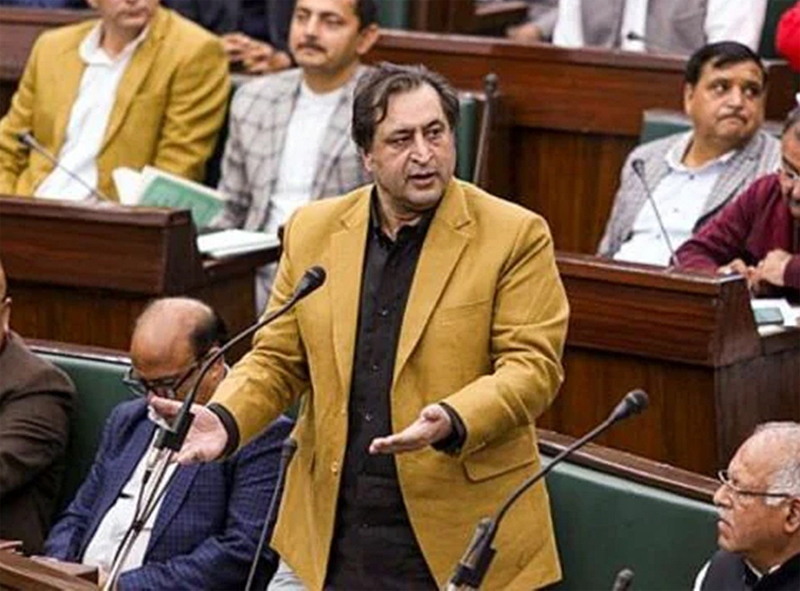
SRINAGAR, Oct 30: The Legislative Assembly today witnessed a spar between legislators Sajad Lone and Nazir Ahmad Khan Gurezi after the former questioned the Government’s reservation policy and warned it could undermine merit-based progress, while the latter strongly defended it as a Constitutional safeguard for marginalised communities.
Follow the Daily Excelsior channel on WhatsApp
Lone, during the Zero Hour, demanded that the Government disclose the data and Cabinet Sub-Committee report that justify reservations in employment and education. “I consider reservation a serious matter. When I asked for the subcommittee report and the supporting data, there was no clear response,” he said, accusing the Government of evading his questions.
The PC Chief argued that increasing reservations without a comprehensive assessment could limit opportunities for meritorious candidates. “If reservation had been applied earlier, would we have the top doctors, engineers, and lawyers we see today? They reached those positions through open competition. Increasing reservation now will restrict the talent that could represent Jammu and Kashmir globally,” Lone remarked.
Urging transparency, Lone said the Government must make all information public instead of “stonewalling” queries. “Someone wants to research and analyse this issue. The Government should provide data rather than block questions,” he said.
His comments drew an immediate and impassioned response from Gurezi, who said Lone’s argument overlooked the realities of backward regions like Gurez. “You studied in London, while my son studies in Dawar where there are no teachers,” Gurezi shot back.
“There is no science stream in many schools in Gurez, yet our students sit for the same exams. When a boy from Gurez gets selected, you say he cannot compete. He can, and he is as capable as anyone.”
Gurezi defended reservation as a Constitutional right, saying students from marginalised areas had achieved success despite inadequate facilities. “Even with minimal resources, our students have excelled. Reservation only levels the playing field,” he said.
The spar triggered protests from lawmakers representing reserved constituencies, who stood up to oppose Lone’s remarks, forcing the Speaker to intervene and restore order.
Lone said the Government had deliberately avoided his questions by clubbing them with unrelated ones. “I had submitted two questions about reservations. Both, or at least one, were clubbed with another member’s question. There is no overlap in content,” he said.
The PC chief added that even seeking factual information had become “a luxury” under the current administration. “Why is the Government not willing to share basic information on recruitments? Seeking simple answers has become a luxury in the present regime,” he said.
The Government in a written answer, said the CSC constituted to rationalize reservation quotas has submitted its report to the Council of Ministers and it will be finalized and notified in due course of time.
Responding to an unstarred question by MLA Showkat Hussain Ganie in the Legislative Assembly, the Minister In-Charge of the Social Welfare Department said the committee was constituted to address grievances raised by various stakeholders regarding the existing reservation policy.
“The report has been presented to the Council of Ministers through circulation and will be officially notified in due course of time,” the Minister said.
However, the Government did not commit to making the report public or specify any timeline for implementing the proposed amendments to address concerns raised by general category candidates.
Earlier, replying to a similar question by MLA Handwara Sajad Lone and MLA Shabir Kulley, the Minister In-Charge of the General Administration Department said the CSC on reservation had completed its deliberations and consultations before submitting its report to the Council of Ministers.
“The report shall be finalized after obtaining requisite approval from the competent authority,” the Minister said, adding that the existing reservation policy broadly aligns with Constitutional provisions and judicial principles, including those laid down in the Indira Sawhney vs Union of India (1992) judgment.
He further noted that while the Supreme Court held that reservations should ordinarily not exceed 50 percent of available vacancies, the ceiling “is not an absolute rule” and may be relaxed in extraordinary circumstances where peculiar regional factors justify such deviation.
The Government also informed that it does not maintain region-wise or district-wise data on selections for junior scale posts in the Jammu and Kashmir Administrative Service, Police (Gazetted) Service, and Accounts Service.
 Follow our WhatsApp channel
