

A Call for Action
R K Handa
ravindersaroj@gmail.com
A city is not just bricks and mortar. It is a
living organism. It breathes through its roads, drinks through its pipes, and speaks through the harmony-or the discord-of its planning.
The Jammu Master Plan 2032 was supposed to be our compass. But I ask you-what good is a compass if the traveller refuses to look at it? With only eight years left, how much has been achieved? Very little. And unless we act, this plan will go down as another forgotten manuscript. The draft master plan has still to get nod from the UT Govt but the Development Authority and Municipal Corporation have since started implementing the undesirable parts of the plan (mixed land use, composite land use, ground plus three storeys) but no one in the Govt questions.
Let me focus on five critical issues: Mixed Land Use, Composite Land Use, the push for Ground Plus Three storeys and Decongestion plan. And above all, the missing conductor-coordination.
Point One: Mixed Land Use
Do we want our homes to remain sanctuaries-or become bazaars?
Mixed land use is being sold as modernization. But in reality, it is like planting weeds in a garden. At first, they look harmless. Soon, they spread and choke everything.
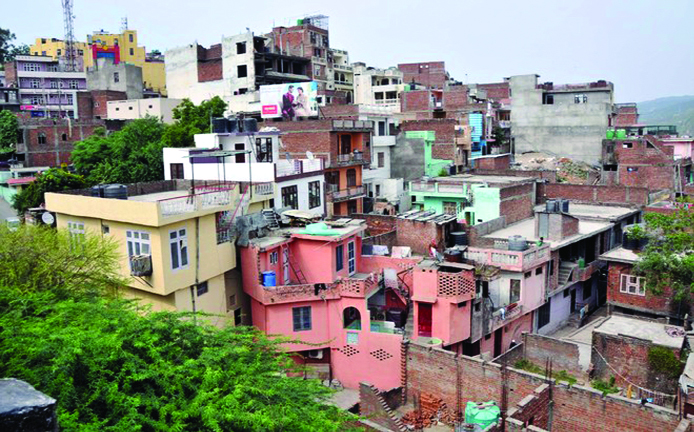
Look at Gandhinagar or Trikutanagar. A doctor’s chamber here, a lawyer’s office there-that was the intent. But what happened? Rows of eateries, shops, and showrooms. Families now live beside garbage heaps, honking traffic, and the endless hum of generators.
Now consider this: the Jammu Local Planning Area already houses 1.28 million people including floating population. And more than 70% of households are already urbanized. Can these fragile colonies take more commercial load-or are we setting ourselves up for collapse?
Contrast this with Chandigarh, where zoning laws preserve peace in neighbourhoods. Compare it with Delhi’s Defence Colony, once serene, now drowned in commercial chaos. Which model do we want for Jammu-Chandigarh’s order or Delhi’s disorder?
Mixed land use is not modernization-it is urban decay in disguise.
Point Two: Composite Land Use
Composite land use-residential as well as commercial use laterally i.e. on the same floor-is advertised as flexibility which is going to create chaos. In disguise of this, most of the residential buildings have turned 100% commercial.
BOCA, the body meant to regulate, has in 95% of cases allowed misuse. Streets in Shastrinagar and Trikutanagar are permanently jammed. Behind the shopfronts, families live with noise, overflowing drains, and sunlight stolen by high walls.
Ask yourself-can a family truly call a house “home” if their neighbour is a 24-hour eatery?
Composite land use is not the answer. It is not a solution-it is an invitation to chaos.
Point Three: Ground Plus Three
Efficiency without capacity is collapse. The push for Ground Plus Three is reckless.
Gandhinagar was planned in 1950s for one or two storeys. The pipes, roads, and drains were built for that load. Today, ground-floor homes already lack water pressure. Residents are forced to pump water to rooftop tanks. Electricity wasted, money drained. Now imagine four-storey buildings stacked onto this fragile system.
And what of traffic? The government quarters in Gandhinagar have been proposed for multi-storeyed flats. These quarters are surrounded by hospitals, schools, and a gurdwara. Do we want patients, children, and worshippers trapped in permanent gridlock?
Consider this: in August 2025, Jammu recorded 190.4 mm of rainfall in just 24 hours-its second-highest single-day August rainfall in nearly a century. When extreme weather collides with overstressed drains and multi-storey colonies, disaster is inevitable. All the storm water drains (nallas) are encroached and people have constructed houses on the retaining walls of these nallas, thanks to Municipal corporation and Development authorities who are just silent on this issue.
Do we want taller buildings-or do we want sustainable living?
POINT FOUR: DECONGESTION PLAN: Plan to decongest city has been drafted very casually. For example the planners are proposing shifting ware house and Nehru market outside the city (site not identified till now although only eight years have left for 2032 to come).They have proposed shifting the office of Deputy Commissioner and other Govt offices to this site without thinking of how to approach this site when road from hotel Asia to fourth bridge is generally choked and this site is already in the heart of the city. Similarly other proposals of decongesting old city need rethinking. Why cannot this site of ware house and Nehru market be merged with river front and yoga center, walking trails, botanical garden and open air library be thought of? Why cannot the Govt offices be shifted to Sidhra, Majeen and Rangoora where JDA has large chunks of land which are prone to encroachment?
Point Five: The Missing Conductor
A city is like an orchestra. Every section-water, sewage, housing, power, roads-must play in harmony. But in Jammu, each department plays its own tune. The result? Discord.
Sewage plants are non-functional. Solid waste is dumped in rivers. Old pipes leak and water distribution network is like branches of a tree; leaving tail-end households dry. Yet, the Master Plan dreams of higher density through ground plus three floors.
And here lies the contradiction: The J&K economy is projected to grow at 7.06% this year. Tourism touched 2.3 crore arrivals. But what use is economic growth if the city cannot handle water, traffic, or waste?
Without coordination, even the best master plan becomes a paper tiger.
Closing Call
Mixed Land Use turns homes into markets.
Composite Land Use blurs order into chaos.
Ground plus Three overloads fragile systems.
Casual approach towards decongesting old city is not going to solve the problem of congestion.
And without coordination, no plan can succeed.
So I ask again: will Jammu choose the path of Chandigarh-or the path of Delhi? Will we nurture a garden-or let weeds choke it?
The Jammu Master Plan must not be a forgotten manuscript. It must become the score sheet from which every department plays, creating a symphony of sustainable growth.
The choice is ours. The time is now.
 Follow our WhatsApp channel
