

Let’s embrace home grown tech apps
Vishal Sharma
xxxxxxx
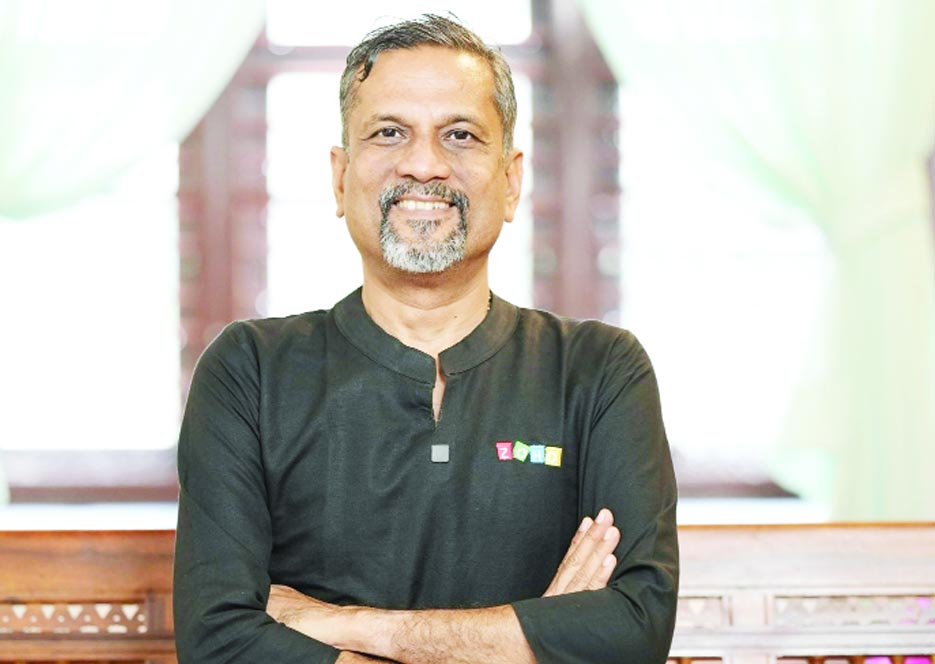
If by chance you happen to either walk alongside or walk past Sridhar Vembu, founder of Zoho Corporation, in a market, nine out of ten times you will likely take him for a person other than Sridhar Vembu.
He carries himself in such an unassuming manner that for some one who is helming a billion dollar company and is a phd from Princeton university, it verges on incredulity that someone with such great accoplishments can be like the way he is. It is not peoples’ fault if they fail to recognise him. It is Vembu’s simplicity that makes him unrecognisable in a world in which everyone is forever seeking attention.
No one knew Vembu before he began giving interviews in media after union minister, Ashwani Vaishnaw announced that he had begun using Zoho applications in lieu of Microsoft apps and found the experience wonderful. The minister’s message was one of going swadeshi in tech usage in line with PM, Modi’s recent push for buying swadeshi goods.
It took Vaishnaw’s pitch for Zoho applications for everyone to ask the familiar questions and look for what Zoho is?, how big or small company it is?, who has set it up ? and where it is headquartered?. As is often the case in India, an influencer has to so much as only trigger something, then that thing takes momentum of its own. Unsurprisingly, there was massive downloading of the Zoho applications across the country. And Zoho soon became the next big thing in the country. Every media channel was talking about Zoho and its founder, Sridhar Vembu.
Sridhar Vembu’s interview on Republic channel recently revealed the various facets of his character. His commitment to an austere life has an ideological, civilizational underpinning. For him Indian civilisation is best typified by two values- simplicity and high thinking. In that sense, he comes across as the proud flag bearer of the ancient civilizational legacy of this country when he is seen in traditional Tamil attire, holding his cycle on an unpaved or a dirt path with the large expanse of farmland in the background in a far off place like Tenkasi district in TN.
His connect with his roots though has not come not at the expense of tech excellence that he has achieved and hopes to achieve in future too. Even today, Vembu said, his company Zoho functions from Tenkasi and a large number of engineers and technicians, who run this company, are drawn from the rural districts in and around Tenkasi. In an answer to a question why he had not set up offices in Bangaluru, Chennai or Silicon Valley, Vembu said that he was happy being closer to the place where he grew- amongst the plants, trees, animals and the whole ethereal ambience of his village.
Vembu thinks that India’s moment has arrived with a large talent pool that exists in this country especially in the rural areas. Talking up demographic dividend that everyone in this country hails as the India’s unique advantage, he said, threats to this country were internal and not external. The danger to India was from within and not without is what Vembu would have us believe. And there aren’t many who will quibble with him over that.
The man’s clarity on all things tech is baffling and he is not overawed by the competition that his company is faced with. For a bootstrapped company like Zoho valued at around 12.5 billion USD to even think that it can compete with Microsoft valued at 3.85 trillion USD ( Oct 2025) is something of a stretch. But Vembu sees it differently and believes that Zoho will find a way to grow and stay in the space as a dependable player.
Vembu informed that Arratai, a messenger app, equivalent of whats app has seen massive downloading from the internet recently like other Zoho tools. He said he had not expected massive downloads of this app so early and that he in fact had planned the launch of the whole thing for October- November this year. However, his back end tech guys were working overtime to deal with the massive net traffic that had suddenly hit them. He jocularly informed that while some people had no problem with the products launched by a foreign company by the name- Xiaomi, they seemingly had issues with the Tamilian name of this app.
A country like India which has around 1.4 billion population is a host to a lot of global tech giants like google, Microsoft, whats app, X etc. But all these companies are tech behemoths, and are usually not willing to abide by the rules of the country in which they operate. Indian government in the past has faced resistance when some restrictions have been sought to be imposed on these companies in the interest of law and order. Sometimes, the matter has been resolved quietly behind the scenes. At other times, the falling out has taken place in full glare, creating problem for the government.
In Nepal, the genesis of the Gen Z unrest was the push by the Nepalese government to tax these tech companies and refusal of the latter to submit to local taxation. When the Nepalese government stopped the services of these companies in the country, the entire world saw what ensued. There are all kinds of conspiracy theories on what happened. Truth will never come out though. But one thing is certain that these companies wield too much of power and work like the deep state.
All these companies are known to work in a cloak and dagger manner and it is not known where they keep the data of the people they collect and what do they do with it? Data is an asset in this day and age. It is a tool that enables companies to understand the market behaviour of the people and help them craft their business policies accordingly. This can, as a consequence, vastly expand their mercantilist gains. Data can be manipulated too in times of war and elections to gain edge over the adversary. US has alleged on many occasions that Russians have tried to influence their elections. So has Canada with regard to the Chinese. The questions of data privacy and data sovereignty are, therefore, too important to be put off any longer, especially in the case of India, whose vulnerabilities in this regard are greater than most of the countries.
This is where Vembu’s company, Zoho can be an important player. Zoho is a through and through Indian company, which is headquartered in India. It reportedly keeps Indian data in India only. This is presently a small company, but it will not stay small forever. Indian Ministers have reportedly started switching to Zoho tools. The wider Indian public will have to similarly start using Zoho products. Trumps actions on H1 B visa, Chahbahar port, penal tariff, remittance tax etc are a grim reminder that India could soon be submitted to tech giants’ tyranny. We are so much dependent upon these companies that a sudden disruption will bring this country to a grinding halt in the absence of alternative home grown tech solutions.
Indians, therefore, need to swiftly move to indigenous tech solutions without waiting for a nudge from the government. Vembu must also ramp up the infrastructure/bandwidth of the tools he offers to cope with any possible rush towards his tech tools, which may crash the systems far too frequently raising issues of its reliability. And Indian government for its part should start finding ways to underwrite the growing Indian tech companies so that in this David vs Goliath battle in the global coliseum, they don’t lose before it has even begun.
 Follow our WhatsApp channel
